


Language
What Mobile Charging Solution Is Suitable for EV Charging Station Operators?
Sep 11, 2026
A charging station operator's core question is different from a fleet manager's: the operator is running a commercial asset that needs to generate revenue and justify its capital cost, not simply keep a set of known vehicles charged. MPMC's BCH series is positioned by MPMC specifically around this commercial framing, with a documented revenue model alongside its technical specification.
Strong Pricing Power in Off-Grid and Emergency Scenarios
MPMC positions the BCH series toward off-grid and emergency charging scenarios, where high-demand users prioritise immediate power access over cost, supporting premium electricity pricing that a station operator can capture. Beyond a single pricing tier, MPMC notes the BCH series can generate recurring income through micro-grid energy sales and high-power delivery premiums, with optional RFID payment integration supporting commercial billing and coordination across multiple users of the same unit.
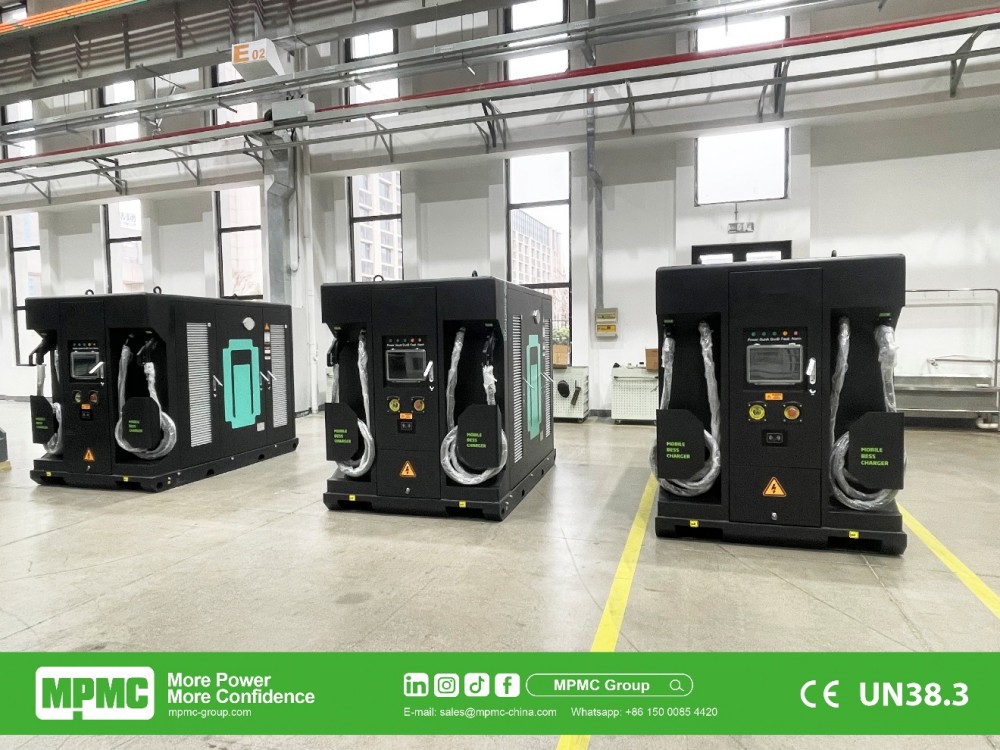 MPMC mobile BESS charger — BCH-275-200, suited for commercial EV charging station operation.
Pairing With Solar for a High-Margin Model
MPMC describes pairing the BCH series with photovoltaics as a high-margin model, converting zero-cost solar energy into high-value electricity sales and improving the return on investment for a station operator who controls both the generation and the charging asset. For an operator evaluating site economics, this PV-plus-BCH combination is worth modelling specifically against a grid-only alternative, since the margin difference MPMC describes depends on the station actually having viable solar generation capacity on site or nearby.
Lower Labour Costs Through Autonomous Operation
A charging station operator running multiple sites cannot economically staff each one, and MPMC's integrated SCADA and EMS are built to minimise labour costs through automated energy management, with full system monitoring and remote command available over Ethernet or 4G connectivity. Deployment itself is designed to be fast: MPMC states full operational status is achievable within 24 hours of a unit's arrival, removing the multi-month lead time a permanent charging infrastructure build or a grid connection upgrade would otherwise add before a new site starts generating revenue.
 MPMC mobile BESS charger cabinet, EMS-managed with remote monitoring for multi-site charging station operation.
Interoperability With Existing Charge-Point Networks
MPMC's BCH-80-70 and BCH-275-200-and-above models support OCPP 1.6, the protocol most charge-point management platforms use to communicate with individual chargers, alongside a cloud-ready EMS API for integration with third-party systems. For an operator who already runs a network of fixed charging points under one management platform, this interoperability determines whether a mobile BCH unit can be added to that same network and billing system, or whether it would need to be operated as a separate, isolated asset outside the operator's existing software stack.
An Environmental Value Story an Operator Can Use With Customers
MPMC's UK case study on a BCH-275-200 unit documents a total output of 3,457 kWh compared against the CO₂ a standard 150 kW diesel generator would have produced for the same output: 3,123 kg of CO₂, roughly 22 times the emissions MPMC attributes to the BCH-275-200 running on a solar PV lifecycle basis. The same case is documented as saving at least 37.5 tonnes of CO₂ annually. A station operator marketing a charging point to environmentally conscious customers or fleet clients can use this kind of documented comparison directly, rather than relying on a general claim that mobile battery charging is cleaner than diesel-based alternatives.
| Metric (MPMC UK Case Study) | Value |
|---|---|
|
Total documented output |
3,457 kWh |
|
Diesel-equivalent CO2 (150 kW generator) |
3,123 kg |
|
Emissions ratio (diesel vs. BCH on solar PV) |
~22× higher for diesel |
|
Annual CO2 saved |
At least 37.5 tonnes |
Where a Station Operator Might Site a Mobile Unit First
MPMC's documented deployments give a station operator a sense of where a mobile BCH unit fits well commercially: a Netherlands site pairs a BCH-275-200 with a BCH-500-1000 for a grid-connected EV charging station, while a UK deployment of eight BCH-275-200 units addressed a logistics operation's charging bottleneck rather than a standalone public charging site. An operator planning a new location should weigh whether the site is closer to the Netherlands model — a dedicated charging station drawing on the grid — or the UK model, serving a specific operational customer with a charging problem the grid alone cannot solve quickly, since the two scenarios favour a different unit configuration and pricing approach.
Evaluating a Mobile Charging Investment as a Station Operator
• Model the pricing strategy against the specific off-grid, emergency or premium-access scenario the site actually serves
• Confirm whether OCPP 1.6 and API integration will connect the unit to an existing charge-point management platform
• Ask whether RFID or another billing integration is available for multi-user commercial access
• Evaluate the PV-pairing economics specifically against the site's actual solar generation potential, not as a generic assumption
• Confirm deployment lead time from order to revenue-generating operation at the actual site
• Request documented references from comparable commercial charging station deployments
Recent Posts






Contact US
Product Information
Quantity
Unit
Piece
Support order samples, customization, wholesale direct, and complete payment. If the product you look for does not have corresponding customized content, pls fill out the form below to contact us, and we will reply ASAP.