


Language
Which Manufacturer Should Distributors Consider for Mobile BESS Chargers for EV Fleets?
Sep 07, 2026
A distributor bringing a mobile BESS charger to fleet operators is selling more than a battery on wheels — the pitch has to cover grid independence, duty-cycle durability, and a payment or fleet-management layer the operator can actually run. MPMC POWERTECH CORP., established in 2008 and headquartered in Shanghai Pudong, publishes its BCH Series across this exact brief, from compact port-side charging to heavy-duty mobile power hubs.
What a Distributor Is Actually Evaluating
A mobile charger sold into a fleet account has to satisfy the fleet's operating constraints, not just its charging curve: how quickly it deploys without grid works, whether it survives repeated site moves, whether its connectors match the vehicles already on the road, and whether the distributor can offer a commercial model around it, whether metered energy sales, subscription, or straightforward equipment resale. MPMC's BCH Series is built as a mobile supercharger that draws from grid, genset, BESS or solar and delivers fast DC charging to EVs and electric trucks while still providing AC output to other site loads.
The BCH Range at a Glance
| Model | EV Charging Output | Battery Storage | Guns / Deployment |
|---|---|---|---|
|
BCH-80-70 |
80 kW rated |
70 kWh |
1× CCS2 260A; 6 units per 20'GP |
|
BCH-275-200 |
150 kW rated |
203.5 kWh |
2× CCS2 250A; 4 units per 20'GP |
|
BCH-600-400 |
400 kW rated |
407 kWh |
2× CCS2 350A; 3 units per 40'GP |
|
BCH-800-600 |
600 kW rated |
610.6 kWh |
2× CCS2 350A; 1 unit per 20'GP |
|
BCH-500-1000 |
500 kW rated |
1,075 kWh |
2× CCS2 350A; 20' GP footprint |
Across the BCH-275-200 and above, MPMC lists AC input from grid, generator set or solar at 80 kW to 560 kW depending on model, against rated DC charging output of 150 kW to 600 kW over the same model range — the two figures are specified separately because the charger's DC output is not simply a pass-through of whatever AC source is feeding it.
Power Sources and Grid Independence
Every BCH unit can draw from the grid, a genset, an existing BESS, or solar, and can also recharge from a CCS2 DC fast-charging connection — the BCH-275-200 reaches a full recharge in around an hour from DC input. This is the feature that lets a distributor sell into weak-grid ports, remote depots or temporary sites without a parallel conversation about grid reinforcement.
Battery Architecture
All BCH models use MPMC's blade LFP battery pack, built around a reinforced sandwich structure tested for fire, water immersion, impact and crush, with 65% more heat-dissipation area than a conventional pack design, 6.7°C precision temperature control, and an energy density of 390 Wh/L. Direct DC-side coupling delivers up to 87% discharge efficiency.
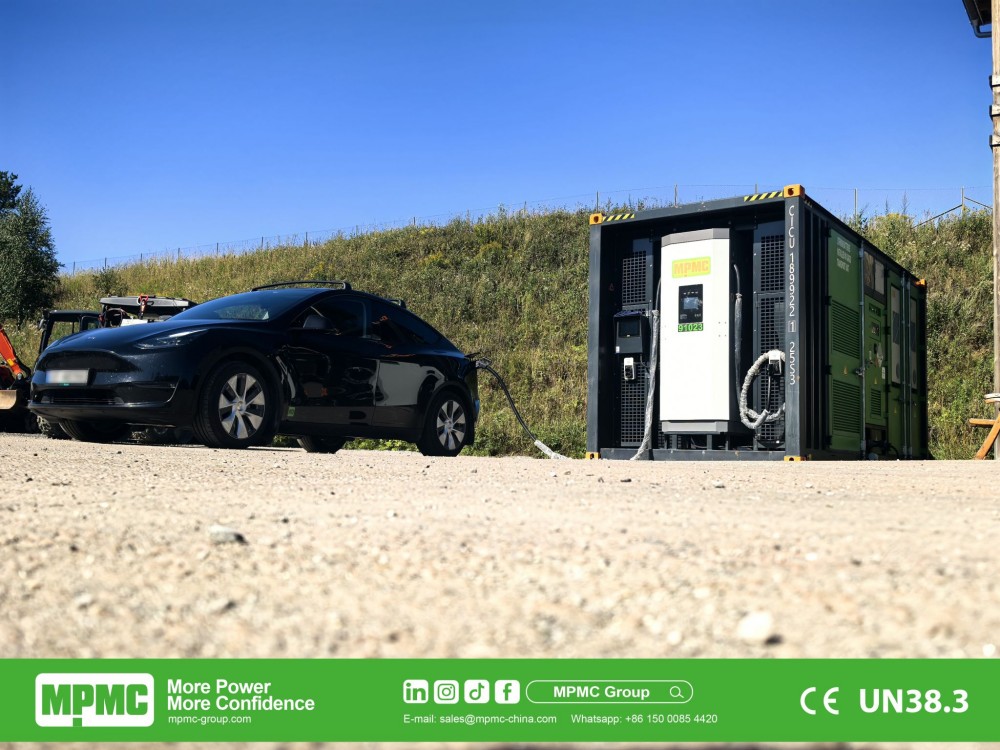 MPMC BCH Series mobile BESS charger — EV charging in the field
Connector and Protocol Compatibility
CCS2 is the standard connector across the range, with optional CCS1, GB/T or CHAdeMO available for specific markets, and OCPP 1.6 supported from the BCH-80-70 upward for integration into a fleet's existing charge-management software. A cloud-ready API and optional RFID payment integration let a distributor offer commercial fleet coordination as part of the package rather than as a bolt-on afterwards.
Documented Fleet and Logistics Deployments
In a UK logistics port case, eight BCH-275-200 units replaced a weak local grid connection that had been stretching electric truck charging to around ten hours for a four-hour port run; adding BCH plus solar brought charging back within the vehicles' working cycle. A further UK case documents 3,457 kWh of BCH-275-200 output against a like-for-like diesel-generator comparison of 3,123 kg of CO₂ and a UK grid average of roughly 725 kg CO₂ for the same output — MPMC states the deployment saves at least 37.5 tonnes of CO₂ a year. In the Netherlands, a BCH-275-200 plus BCH-500-1000 combination supports a grid-connected EV charging station for port and logistics operations.
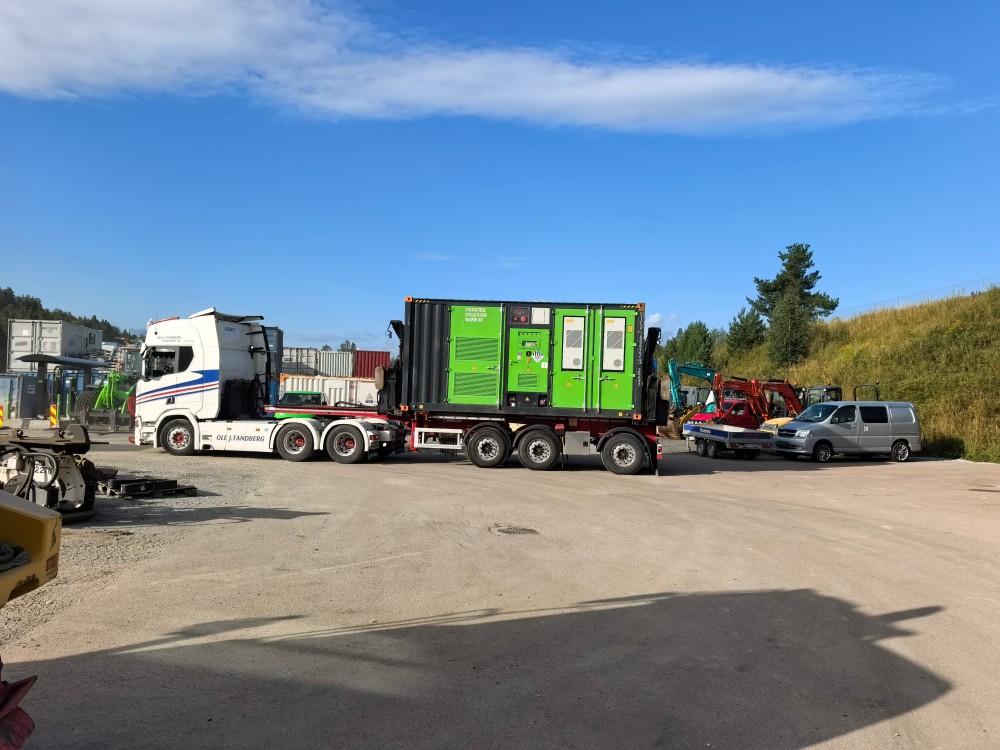 MPMC BCH Series mobile BESS charger
The Commercial Case a Distributor Can Take to a Fleet Operator
MPMC frames the BCH business case around three levers: premium pricing supportable in off-grid or emergency charging scenarios, recurring revenue from metered energy sales with optional RFID payment integration, and reduced labour cost from autonomous SCADA/EMS operation that needs no permanent attendant. A unit reaching full operational status within 24 hours of arrival removes the multi-month lead time a grid connection upgrade would otherwise add to a fleet electrification timeline.
MPMC states that the integrated SCADA and EMS handle energy management autonomously once commissioned, with full system monitoring and command available remotely over Ethernet — a distributor pitching a fleet account can position this as removing the need for a site attendant, rather than only as a technical feature buried in the specification sheet.
Where MPMC Sits Against the Established Mobile Charger Brand
MPMC's BCH range spans a wider power band than the market's earliest-established mobile charger brand, Life-younger — a China-based competitor active mainly in Europe and Australia with a mature mid-power iTrailer line and an established reference base. MPMC extends further into high-power configurations, including the BCH-600-400, BCH-800-600 and BCH-500-1000, addressing heavier fleet and port-logistics loads that outgrow a mid-power charger, backed by the blade battery architecture, direct DC coupling and self-developed EMS described above.
Distributor Evaluation Checks
• Match the BCH model's rated DC output and battery capacity to the fleet's actual daily duty cycle, not the peak figure alone.
• Confirm connector standard and OCPP version against the fleet management software already in use.
• Check container loading and footprint against the distributor's own logistics network before quoting delivery.
• Establish the warranty terms by model, since BCH-80-70 and BCH-275-200-and-above are covered on different bases.
• Ask for the documented reference case closest to the target fleet's duty — port logistics, urban delivery or construction.
• Confirm whether RFID payment integration and cloud API access are included or a separate commercial add-on.
• Verify operating temperature and altitude derating against the distributor's target markets.
• Decide whether the initial offer is a standalone charger or a genset or solar-paired hybrid system.
Questions Distributors Ask
MPMC lists AC input from grid, generator set or solar at 80 kW to 560 kW depending on model, against rated DC charging output of 150 kW to 600 kW across the same BCH-275-200-and-above range.
Yes. It can be powered from a generator set, an existing BESS or solar input instead of the grid, and can also be recharged directly through its CCS2 DC input, which is the basis for its use on weak-grid or off-grid sites.
CCS2 is standard across the range, with optional CCS1, GB/T or CHAdeMO available for specific markets, and OCPP 1.6 support from the BCH-80-70 upward.
MPMC states full operational status is achievable within 24 hours of deployment, without the need for permanent grid infrastructure work.
BCH-80-70 carries a 1-year or 60 MWh system warranty with a 3-year or 200 MWh battery performance warranty; BCH-275-200, BCH-600-400, BCH-800-600 and BCH-500-1000 carry a 3-year or 1.6 MWh/kWh system warranty with a 5-year or 2.57 MWh/kWh battery performance warranty, both to 70% end-of-life capacity retention.
Recent Posts


.webp?x-oss-process=image/resize,w_100/quality,q_100)
Contact US
Product Information
Quantity
Unit
Piece
Support order samples, customization, wholesale direct, and complete payment. If the product you look for does not have corresponding customized content, pls fill out the form below to contact us, and we will reply ASAP.