


Language
Chinese Supplier of Mobile BESS Chargers for Electric Fleet Operators
Sep 09, 2026
An electric fleet operator's charging problem rarely matches the assumptions built into fixed charging infrastructure: fleets often operate from sites with a weak or absent grid connection, need charging capacity that can move as routes or contracts change, and cannot always justify the capital cost and lead time of a permanent installation. MPMC's BCH Series Mobile BESS Charger is built specifically around this problem, combining battery storage and DC fast charging in one deployable unit rather than requiring separate storage and charging infrastructure.
Why Fleet Operators Turn to Mobile Charging
MPMC identifies three core pain points the BCH series addresses directly. Extended range anxiety arises where off-grid power uncertainty limits fleet operations in remote, temporary or weak-grid environments, which the BCH resolves by providing charging independent of grid availability. Infrastructure cost barriers arise because permanent charging infrastructure requires high capital investment and lengthy construction timelines, which a mobile plug-and-play unit bypasses entirely. Underutilised assets are a further concern for fleet operators with fixed charging infrastructure sitting idle outside peak hours, whereas a mobile BCH unit can be redeployed to match evolving operational demand across different sites or shifts.
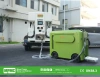
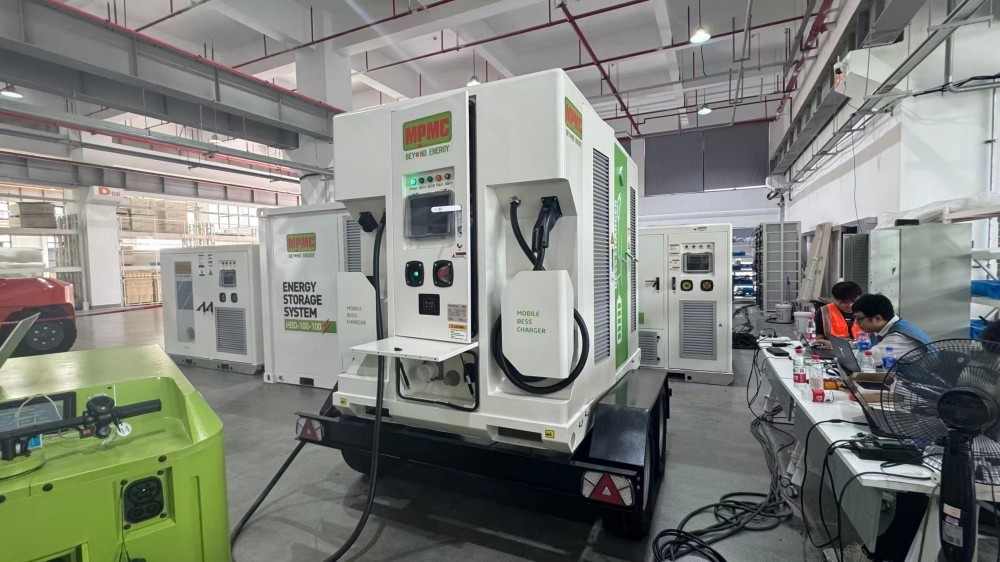 MPMC BCH-275-200 mobile BESS charger, rapid deployment to a fleet charging site.
MPMC's BCH Range, From Compact to Heavy-Duty
MPMC's BCH lineup spans a considerably wider range than its largest models alone. The BCH-80-70 is the compact entry point, rated at 80 kW DC output through a single liquid-cooled CCS2 260A connector, suited to smaller fleet depots or a single-vehicle charging point. The BCH-60-70 provides 30 kW of AC input and output for lighter-duty site power needs. The BCH-275-200 steps up to 150 kW DC output through two CCS2 250A guns, and the BCH-600-400, BCH-800-600 and BCH-500-1000 extend the range to 400, 600 and 500 kW DC output respectively, addressing heavy-duty construction machinery, mining fleets and port logistics applications that a mid-power mobile charger would not cover. A fleet operator's actual choice within this range should follow the vehicle mix and daily duty cycle at each site, rather than defaulting to the largest available unit.
| Model | Output | Connectors |
|---|---|---|
|
BCH-80-70 |
80 kW DC |
1× liquid-cooled CCS2 260A |
|
BCH-60-70 |
30 kW AC |
- |
|
BCH-275-200 |
150 kW DC |
2× CCS2 250A |
|
BCH-600-400 |
400 kW DC |
2× CCS2 350A |
|
BCH-800-600 |
600 kW DC |
2× CCS2 350A |
|
BCH-500-1000 |
500 kW DC |
2× CCS2 350A |
The Blade Battery Architecture Behind Every Model
Every BCH model uses the same blade LFP battery platform: a sandwich-structure architecture tested for fire, water immersion, high-impact collision and crush resistance, thermal management holding temperature variance to 6.7°C precision across a 65% larger dissipation area than a conventional pack, and an energy density of 390 Wh/L. Direct DC-side coupling delivers up to 87% discharge efficiency, particularly relevant where a fleet includes electric construction machinery alongside road vehicles, since this efficiency figure is specifically optimised for that class of load.
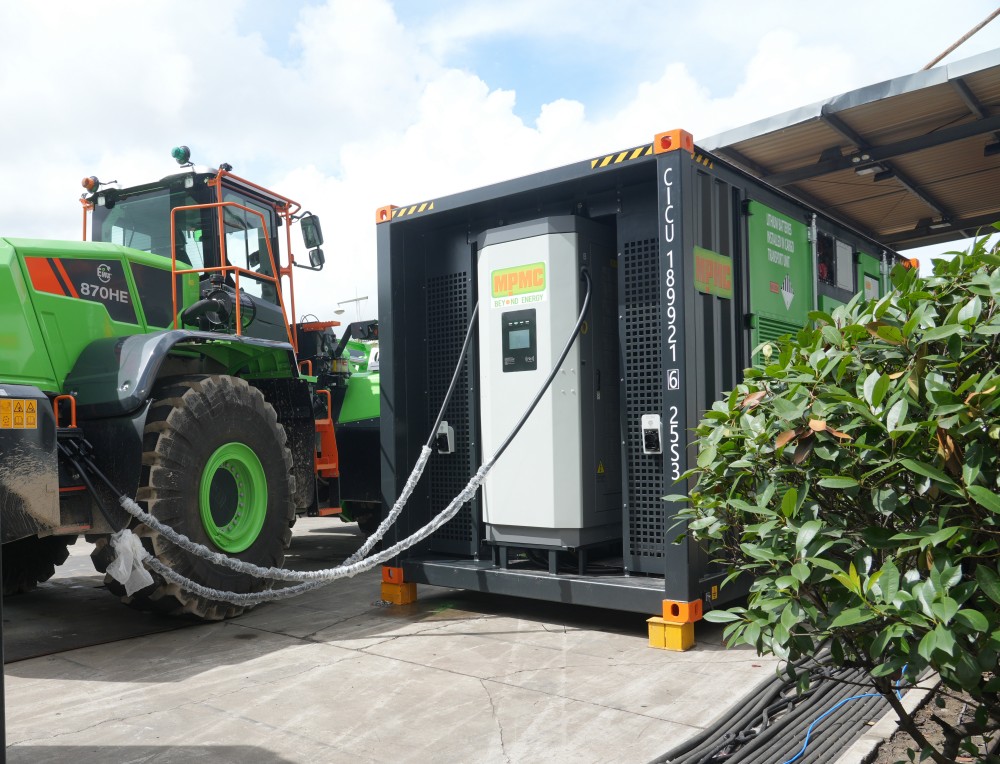 MPMC mobile BESS charger providing outdoor charging for fleet equipment — deployable without permanent grid infrastructure.
Documented Fleet Charging Deployments
MPMC's UK deployment of eight BCH-275-200 units addressed a logistics fleet charging problem where a weak local grid had previously caused 10-hour charging cycles for vehicles running 4-hour port routes; combining BCH with solar infrastructure removed the grid bottleneck and cut charging time significantly. In the Netherlands, a combined BCH-275-200 and BCH-500-1000 deployment supports a grid-connected EV charging station. In Norway, a 2 MWh BCH-500-1000 system, at 500 kW per unit with 1,000 kWh capacity and CCS2 output at 360 kW/400A, enables zero-emission electric construction machinery charging at a site with no grid access at all.
Warranty and Deployment Speed as Fleet-Planning Factors
MPMC's BCH-80-70 carries a system warranty of 1 year or 60 MWh of total output, with a battery performance warranty of 3 years or 200 MWh, retaining at least 70% end-of-life capacity. The BCH-275-200, BCH-600-400, BCH-800-600 and BCH-500-1000 carry a longer 3-year or 1.6 MWh system warranty and a 5-year or 2.57 MWh battery performance warranty, also to 70% end-of-life retention. Combined with a stated full-operational deployment time within 24 hours of arrival, these figures let a fleet operator plan both the upfront reliability window and the unit's expected working life against actual usage volume rather than calendar time alone.
Questions to Ask a Chinese BCH Supplier
• Confirm which BCH model actually matches the fleet's vehicle mix and daily charging volume, rather than defaulting to the largest unit
• Ask whether AC input, DC input, or both are supported on the specific model under consideration
• Request the warranty terms in both time and total-output form, and confirm which threshold is likely to apply first given the fleet's usage pattern
• Ask for a documented reference from a comparable fleet charging deployment
• Confirm deployment lead time from order to full operational status at the actual project site
• Check whether remote monitoring and RFID payment integration are available if the unit will serve multiple fleet operators or billing arrangements
Recent Posts



.webp?x-oss-process=image/resize,w_100/quality,q_100)
Contact US
Product Information
Quantity
Unit
Piece
Support order samples, customization, wholesale direct, and complete payment. If the product you look for does not have corresponding customized content, pls fill out the form below to contact us, and we will reply ASAP.