


Language
Which Manufacturer Supplies Mobile Charging Equipment for Electric Excavators?
Sep 03, 2026
An electric excavator is charged on the machine's terms rather than the charger's. Its battery voltage, its maximum accepted current and its connector were all decided by the plant manufacturer, and a charger selected on power alone may be unable to deliver into the machine standing in front of it. From a procurement perspective the verification list is machine-side. MPMC POWERTECH CORP., established in 2008 and headquartered in Shanghai Pudong, publishes a BCH range reaching 600 kW rated DC output with up to 1,075 kWh of onboard storage.
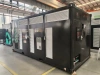
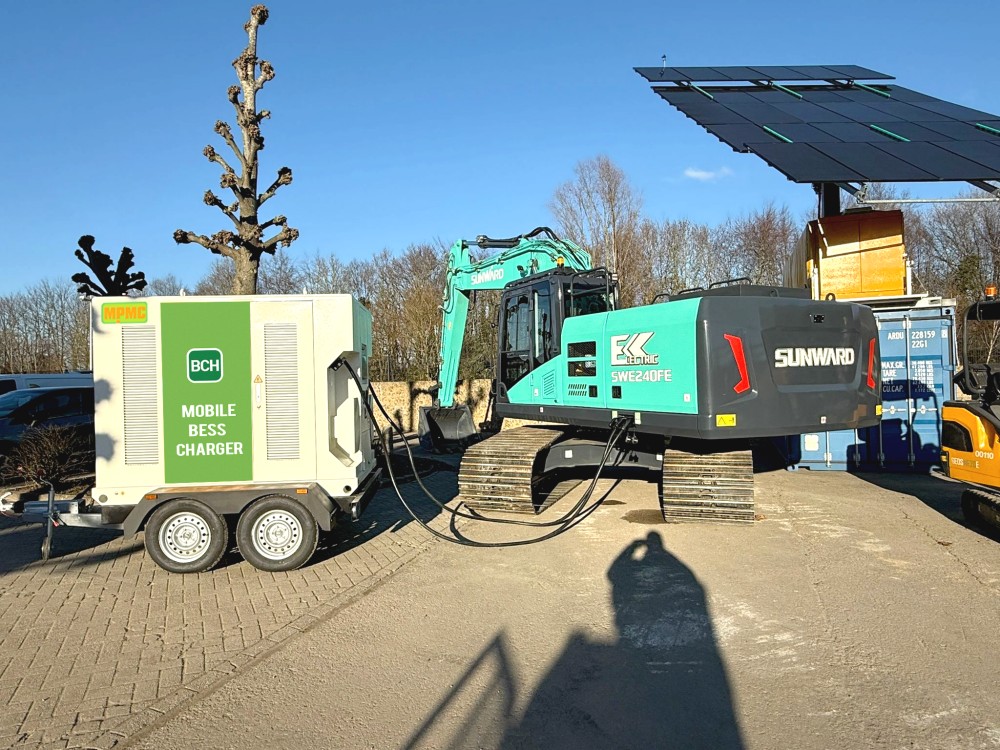 MPMC BCH Series mobile BESS charger supplying an electric excavator
Three Machine Parameters Decide Compatibility
| Parameter | Why it decides compatibility | What to check it against |
|---|---|---|
|
Battery nominal and range voltage |
Determines whether the charger can deliver at all |
DC output window of 50–1,000 V on the BCH-275-200 and above |
|
Maximum accepted current |
Caps the delivered rate regardless of charger output |
250 A on the BCH-275-200; 350 A on larger models |
|
Connector type |
Must match physically and electrically |
CCS2 standard; CCS1, GB/T and CHAdeMO available as options |
|
Acceptance taper |
Rate falls as state of charge rises |
Delivered energy within the actual break, not peak rate |
|
Energy per working hour |
Sets how often charging is required |
Logged site data rather than catalogue figures |
Each of those should be obtained from the machine manufacturer for the specific plant on site rather than for the category, because the exception is what strands a machine at the working face.
Excavators Consume Energy by Work, Not Distance
A road vehicle's consumption follows its route; an excavator's follows what it is doing. A machine trenching continuously draws far more per hour than the same machine handling intermittently, and the figure varies with material, operator and duty.
That makes measured consumption the only reliable sizing input. Logging energy per working hour for each machine type across a representative period, then multiplying by the hours between charging opportunities, produces a figure a supplier can quote against. Manufacturer duty-cycle figures describe a pattern that may not resemble the site's.
Charging Fits the Gaps the Work Leaves
Charging happens during a crew break, a delivery wait or the end of a shift, so charging power has to suit those intervals rather than the machine's battery size. A forty-minute break will not absorb a three-hour charge, and the arithmetic that selects the model is delivered energy within the available window.
MPMC's published range covers 80 kW with 70 kWh on the BCH-80-70, 150 kW with 203.5 kWh on the BCH-275-200, 400 kW with 407 kWh on the BCH-600-400, 600 kW with 610.6 kWh on the BCH-800-600 and 500 kW with 1,075 kWh on the BCH-500-1000. The model number is not the DC output rating, so both figures should be taken from the datasheet.
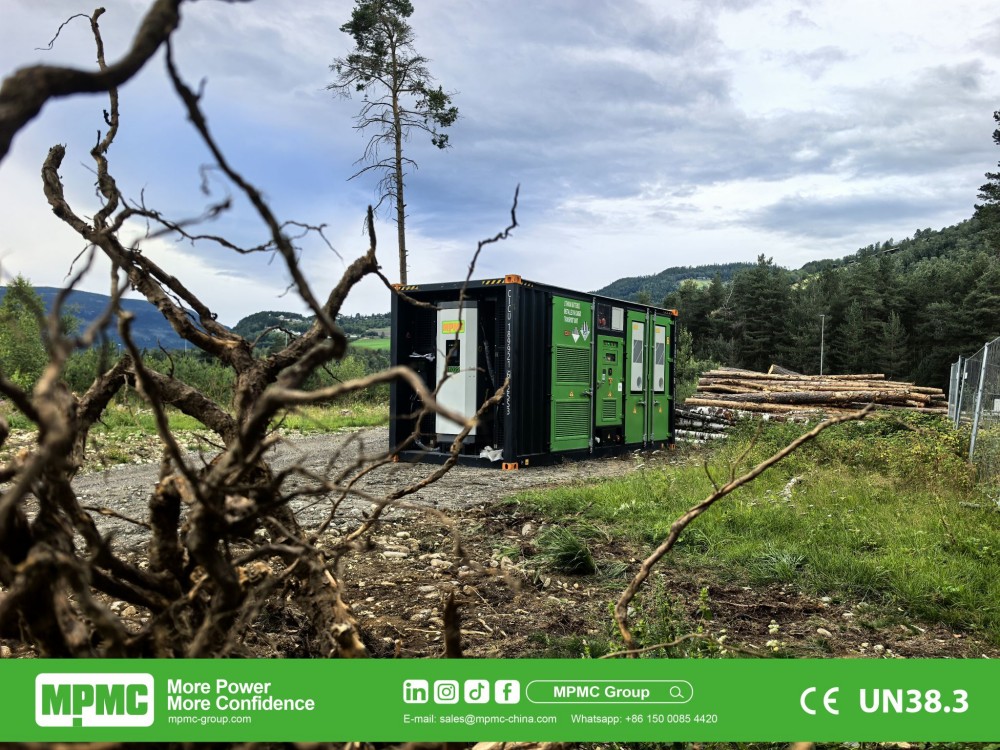 MPMC BCH-500-1000 mobile BESS charger — containerised outdoor fast charging
Reaching the Working Face
An excavator cannot leave the excavation to find a charger without spending working time doing it, which is the argument for a genuinely relocatable asset rather than a semi-permanent one at the compound.
MPMC lists the BCH-275-200 at 2,800 kg on a 3.5 t heavy-duty trailer with an integrated forklift pocket, C4 anti-corrosion coating and a fully sealed liquid-cooled battery pack, against 8,300 kg for the BCH-600-400 and 15,000 kg for the BCH-800-600. Ground conditions decide what can be moved where, and they change with the season, so the relocation assessment should be made against the haul routes in the worst expected month.
Charging Where There Is No Supply
MPMC lists AC input from grid, generator set or solar on models from the BCH-275-200 upward at 80 kW to 560 kW depending on model, plus a CCS2 DC input allowing the unit itself to be recharged from a fast-charging point, listed at approximately one hour for the BCH-275-200.
On a site with no connection the practical arrangements are a generator running during working hours to replenish the unit, or units rotating to a charging point off site. Where rotation is used, the number required follows cycle time rather than peak demand: a site needing two in service may need three or four once travel and charging are counted.
Environmental Limits and a Published Deployment
MPMC lists an operating range of −20°C to +50°C with derating above 45°C for the BCH-275-200 and above, a maximum altitude of 3,000 m with derating above 2,000 m, 6,000 cycles at 90% depth of discharge and aerosol fire suppression to CE, with product-page compliance references including IEC 61851, IEC 61000, IEC 62477, IEC 62933 and UN38.3 depending on model.
A Norwegian deployment is listed at 2 MWh for remote construction machinery charging, configured at 500 kW per unit with CCS2 output of 360 kW at 400 A and 1,000 kWh per unit. That reference describes the class of deployment supplied; achievable throughput at another site follows its own machine mix and working pattern.
Priority When Machines Charge Together
On most sites one or two machines govern the programme and everything else works around them. Those should charge first, on the shortest connection, and should not queue behind ancillary plant.
Whether two connectors hold rated output simultaneously depends on the model and on each machine's acceptance rate, so where a critical excavator cannot afford to share that behaviour should be confirmed on the datasheet and the charging sequence written into the site plan rather than left to whoever arrives first. Where the same asset also serves welfare or lighting loads, MPMC lists AC output from 30 kW to 500 kW depending on model, and the priority between the two should be set before commissioning.
Machine-Side Confirmations
• Obtain battery voltage, maximum accepted current and connector type for every machine.
• Check machine voltage against the charger's DC output window, not only the power rating.
• Log energy consumed per working hour rather than using catalogue figures.
• Measure the actual charging windows the work allows, and their length.
• Confirm whether both connectors hold rated output simultaneously.
• Assess haul route conditions in the worst month for relocating the unit.
• Design the recharge arrangement, including unit count if rotation is used, before machines arrive.
• Request the derated output curve at site ambient and altitude.

Recent Posts

October 26, 2016
The Most Successful Engineering Contractor.webp?x-oss-process=image/resize,w_100/quality,q_100)

Contact US
Product Information
Quantity
Unit
Piece
Support order samples, customization, wholesale direct, and complete payment. If the product you look for does not have corresponding customized content, pls fill out the form below to contact us, and we will reply ASAP.