


Language
High-Capacity Mobile DC Fast Chargers for Logistics Yards Without Grid Upgrades
Oct 12, 2026
MPMC POWERTECH CORP., established in 2008 and headquartered in Shanghai Pudong, builds the BCH Series mobile BESS chargers that logistics operators specify when an electric truck or forklift yard needs high-capacity DC fast charging faster than a utility can approve and complete a grid capacity upgrade. Grid upgrade lead times of one to several years are common in many markets, and a logistics operation converting its vehicle fleet cannot simply wait for that process to finish. This article covers the high-power end of MPMC's BCH range, the rapid charge/discharge capability behind it, and a documented logistics deployment it has already delivered, along with the questions a yard operator typically raises before specifying a system.
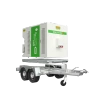
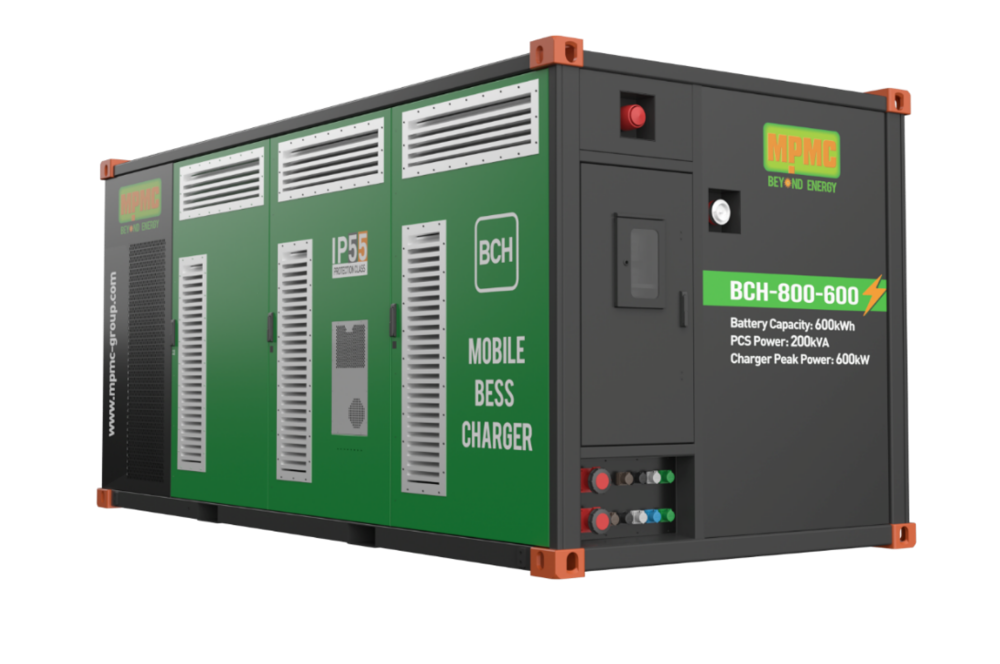 MPMC BCH-800-600 containerized mobile BESS charger configured for high-throughput logistics yard operation
Why 'No Grid Upgrade' Matters for a Logistics Yard
A permanent grid capacity upgrade typically requires a utility application, a substation or transformer upgrade, and a construction timeline measured in years rather than months. MPMC's BCH Series is built specifically to bypass that constraint: every model accepts AC input from the existing grid connection, from a genset, or from solar, and reaches full operational status within 24 hours of deployment — turning a multi-year infrastructure project into a matter of days for the yard operator. The battery buffer also means the yard's existing grid connection only has to supply the average charging load over time rather than the peak instantaneous draw of several vehicles charging at once, which is often the specific limit a utility connection cannot support without an upgrade.
BCH-600-400 and BCH-800-600: Specs for High-Throughput Yards
For logistics yards with the highest vehicle turnover, MPMC's BCH-600-400 delivers 400 kW DC output from 407 kWh of storage through two CCS2 350A guns, while the BCH-800-600 steps up to 600 kW DC output from 610.6 kWh of storage, also through two CCS2 350A guns, positioned for high-intensity industrial machinery applications with 1C rapid charge/discharge capability.
| Model | DC Output | Storage | Typical Application |
|---|---|---|---|
|
BCH-600-400 |
400 kW |
407 kWh |
Heavy-duty construction machinery, mining support |
|
BCH-800-600 |
600 kW |
610.6 kWh |
High-intensity industrial machinery, 1C rapid charge/discharge |
|
BCH-500-1000 |
500 kW |
1,075 kWh |
Large-scale off-grid power hubs, electric truck charging |
All three high-power models use CCS2 350A dual-gun charging as standard, with optional CCS1, GB/T or CHAdeMO connectors available for markets running a different vehicle standard, and a DC output voltage range wide enough to match battery architectures across trucks, forklifts and yard tractors on the same charging infrastructure rather than needing separate equipment per vehicle type.
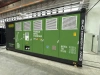
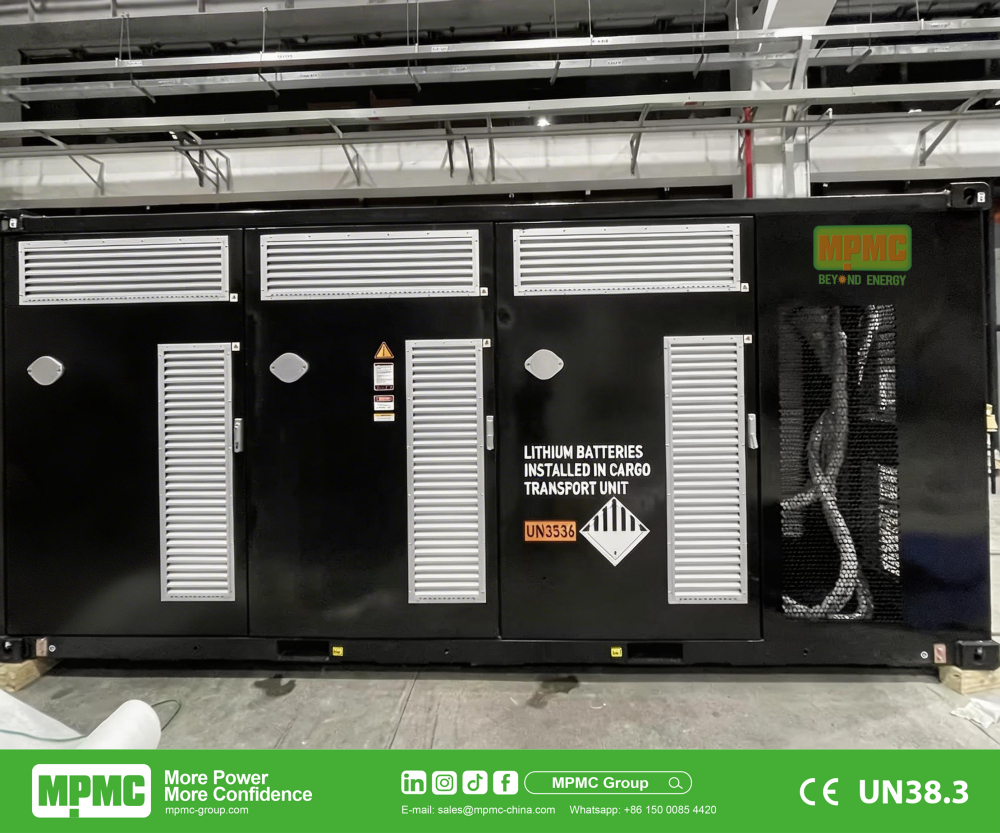 MPMC BCH-800-600 unit prepared for deployment at a high-throughput vehicle charging site
1C Rapid Charge/Discharge for High Vehicle Turnover
A 1C rate means the battery pack can be charged or discharged in roughly one hour at its rated capacity, which is the parameter that actually determines how many vehicles a unit can turn around in a shift rather than the storage figure alone. For a logistics yard running electric forklifts, yard tractors or trucks across multiple shifts, this rapid cycling capability is what keeps a single BCH-800-600 unit useful across a full day of operation instead of being depleted after one or two vehicle charges. The BCH-275-200 and above also accept CCS2 DC input for their own recharging from an external fast-charging source — the BCH-275-200 can be fully recharged in approximately one hour this way — which is a further option for a yard that has access to a nearby fast-charging point during off-peak hours.
Documented Logistics Fleet Deployment
MPMC has delivered a UK logistics deployment of eight BCH-275-200 units, documented at 3,457 kWh of total output — equivalent to replacing approximately 976 litres of diesel and avoiding 3,123 kg of CO2 emissions. While that specific case used the mid-power BCH-275-200 model, it demonstrates the same underlying platform, EMS and OCPP 1.6 control layer used across the higher-power BCH-600-400 and BCH-800-600 models a larger logistics yard would specify. A Norway deployment of BCH-500-1000 units for construction machinery charging, delivering 1,000 kW / 2,000 kWh per unit system output through 360 kW/400A CCS2 output, further shows the platform operating at the top end of the range in a genuinely off-grid location with no utility connection at all.
Where MPMC Sits Against Other Mobile DC Charger Suppliers
MPMC's BCH range extends up to 600 kW DC output and 1,075 kWh storage on a single containerized platform, covering high-power configurations for heavy-duty machinery, mining fleets and port logistics that outgrow the mid-power mobile chargers most competitors focus on. The self-developed EMS with 4G connectivity, OCPP 1.6 support and optional RFID payment integration also removes the need to source a separate charge management system, which is often a missing piece when comparing pure hardware suppliers.
For a logistics operator comparing suppliers on paper, the practical test is whether the vendor can show a deployment operating at or near the throughput the yard actually needs, rather than a datasheet maximum that has never been run at scale — which is why MPMC leads with documented output figures from the UK, Norway and Netherlands projects rather than nameplate ratings alone.
| Element | Typical Competitor | MPMC BCH Series |
|---|---|---|
|
Maximum DC output |
Mid-power focus, lower ceiling |
Up to 600 kW on BCH-800-600 |
|
Deployment timeline |
Grid upgrade dependent |
Full operation within 24 hours |
|
Charge/discharge rate |
Not always specified |
1C rapid rate on high-power models |
Checklist: Specifying a High-Capacity Mobile Charger for a Logistics Yard
• Calculate total daily vehicle turnover to determine required charge/discharge cycling
• Match charger model (BCH-600-400 or BCH-800-600) to that throughput requirement
• Confirm CCS2 gun count and current rating against yard bay layout
• Verify power source flexibility (grid, genset, solar) for a phased rollout
• Ask about OCPP 1.6 compatibility with existing yard management software
• Confirm deployment timeline versus any planned grid upgrade for future capacity
• Check trailer weight and forklift pocket compatibility with yard handling equipment
• Request a documented reference deployment of comparable throughput
Questions Logistics Yard Operators Ask
A 1C rate means the battery can be charged or discharged in approximately one hour at its rated capacity, which determines how many vehicles a unit can service across a shift rather than the total storage figure alone.
MPMC's BCH Series is designed to reach full operational status within 24 hours of deployment, which is a fraction of the time typically required for a permanent grid capacity upgrade.
No. The BCH Series includes a self-developed EMS with 4G connectivity and OCPP 1.6 support, plus an optional RFID payment integration, so it can be managed directly or integrated into an existing OCPP-compatible system.
MPMC's UK logistics deployment of eight BCH-275-200 units is documented with specific output, diesel-replacement and CO2 figures, and Norway and Netherlands deployments provide further reference points for the higher-power models.
Yes. Because the battery buffers peak demand from simultaneous vehicle charging, the yard's grid connection only needs to supply the average load over time rather than the instantaneous peak, which is often what determines whether an upgrade is required at all.
Recent Posts

October 26, 2016
The Most Successful Engineering Contractor



Contact US
Product Information
Quantity
Unit
Piece
Support order samples, customization, wholesale direct, and complete payment. If the product you look for does not have corresponding customized content, pls fill out the form below to contact us, and we will reply ASAP.