


Language
Battery Energy Storage Systems With 2 MWh or More Capacity for Photovoltaic Power Plants
Sep 15, 2026
Sizing storage for a photovoltaic power plant is a different exercise from sizing backup power for a facility: the reference point is the plant's own generation curve and export limit, not a building's load list, and at 2 MWh and above the coupling method — not just the headline capacity — decides how efficiently that curve gets captured. MPMC POWERTECH CORP., established in 2008 and headquartered in Shanghai Pudong, lists both AC-coupled and DC-coupled configurations on its HBD-A platform for exactly this scale of solar-paired storage.
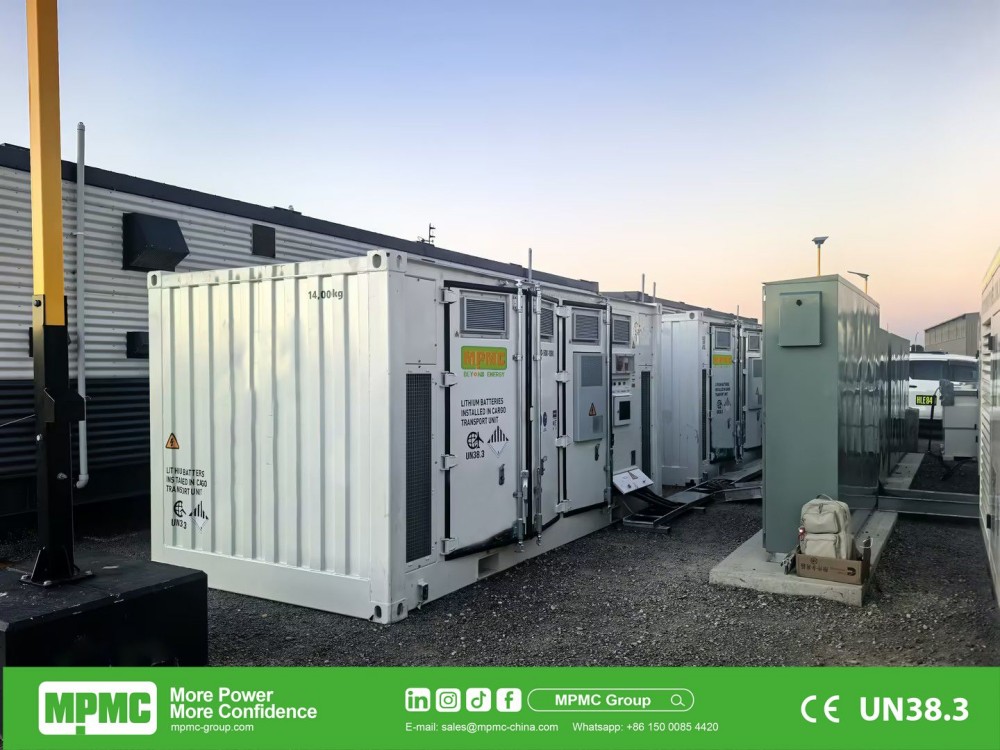 Two MPMC HBD-500-1000 battery energy storage units
Sizing Storage Against a Solar Plant's Output
A facility backup system is sized against a load list; a solar plant's storage is sized against a generation curve, an export limit, and how much midday output would otherwise be curtailed or sold at a low feed-in rate. The 2 MWh threshold typically marks the point where a project has moved from a small commercial rooftop array into a utility-scale or larger C&I solar plant, where MPMC's HBD-A Series is positioned as the primary product line.
DC-Coupled or AC-Coupled: The Choice That Matters for a Solar Plant
MPMC's standard HBD-A models are AC-coupled, accepting an external PV inverter and ATS integration alongside grid and generator inputs — a configuration suited to a plant retrofitting storage onto an existing installed inverter base. For a new-build solar-storage project, MPMC also lists DC-coupled options: the HBD-DC 410 (0.5P, 418 kWh) and the HBD-DC 5000 (0.5P, 5,015 kWh), which couple directly to PV strings ahead of the inverter stage. Coupling storage on the DC side avoids one extra AC-DC-AC conversion step for solar energy that is being stored rather than exported immediately, which is the reason a new-build plant is more likely to specify it than a retrofit.
Reaching 2 MWh and Beyond From the HBD-A Platform
| Model | Rated AC Power | Capacity | Coupling |
|---|---|---|---|
|
HBD-500-1000 |
500 kW |
1,045 kWh |
AC — two units reach approximately 2.09 MWh |
|
HBD-1000-2000 |
1,125 kW |
2,170 kWh |
AC — a single unit already exceeds 2 MWh |
|
HBD-DC 410 |
0.5P DC-coupled |
418 kWh |
DC — multiple units scale into the MWh range |
|
HBD-DC 5000 |
0.5P DC-coupled |
5,015 kWh |
DC — a single unit exceeds 2 MWh |
Manufacturing and Cell Technology Behind the Rating
Every HBD-A model uses 314 Ah LiFePO₄ cells rated to 8,000 cycles at 90% depth of discharge, with liquid cooling as standard and protection to IP54 at the system level and IP67 at the battery pack. Battery pack assembly runs through MPMC Energy Tech Corporation in Yangzhong, Jiangsu — a USD 27 million facility housing semi-automatic and fully automatic battery pack assembly lines — with unit-level testing carried out at the CNAS-accredited facility in Haimen, Jiangsu.
All HBD-A models are rated for operation from −20°C to 55°C, with derating above 45°C and above 2,000 m altitude, and a maximum altitude limit of 3,000 m — a specification range wide enough to cover most solar plant locations without a bespoke climate variant of the standard product.
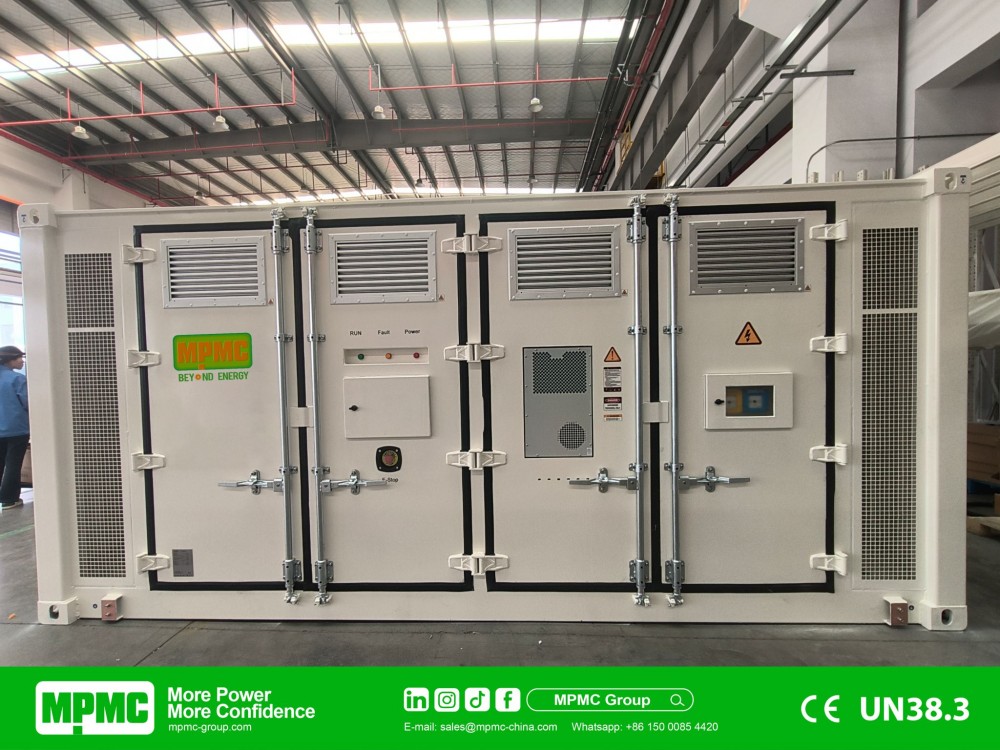 MPMC HBD-500-1000 battery energy storage units in factory production, ahead of shipment to a large-scale project
Maximising Self-Consumption From Midday Generation
MPMC's EMS charges the battery from excess midday solar output and discharges it during the evening demand peak, a pattern documented as raising self-consumption rates above 90% in MPMC's zero-carbon industrial park deployments. For a plant facing curtailment risk or a low midday feed-in tariff, that same dispatch logic converts otherwise-discounted generation into full-value output shifted to a later, higher-value hour.
Documented Multi-Megawatt-Hour Deployments
| Project | Scale | Configuration |
|---|---|---|
|
Grid-Connected FM Energy Storage Plant, Netherlands |
8 MWh |
4× 2 MWh HBD-A Series units |
|
Green Power Plant, Hungary |
8 MWh |
2× HBD-500-1000 + 3× HBD-1000-2000 |
|
8 MWh BESS System, Europe |
8 MWh |
HBD-1000-2000A dual-PCS, 5 units × 2,097 kWh, CATL 1P52S packs |
|
Oil & Gas Wellhead Peak Shaving, China |
3 MW |
6× 250 kWh, 2C units, HBD-A Series |
Grid Services Beyond Solar Smoothing
The same HBD-A platform supports PQ, VF and VSG operating modes, black start, and grid-forming capability, alongside its core frequency regulation and peak-shaving functions. Where a solar-storage plant also intends to participate in grid services markets, these modes turn the same hardware that smooths solar output into a second, independent revenue stream during hours when solar generation is not the constraint.
MPMC's own reference point for this dual role is its Dubai off-grid hybrid deployment, where a battery-genset pairing delivered a documented 20% operating expenditure reduction — a different application to solar pairing, but evidence of the same EMS logic being asked to optimise more than one objective at once rather than running a single fixed charge-discharge routine.
Safety Engineering for a Multi-Container Solar-Storage Site
MPMC's documented 8 MWh European BESS deployment specifies a full-weld container frame with reinforced lifting points, C4 anti-corrosion coating, ceramic-based aerogel insulation and IP55 protection, with aerosol fire suppression fitted per battery pack and smoke, temperature and humidity alarms linked through the BMS and EMS to automatic power cut-off and remote alarm notification. At a multi-container scale, that per-pack fire suppression and alarm linkage is what keeps a fault in one unit from becoming a site-wide event.
How MPMC Compares Among Chinese Storage Suppliers for Solar-Paired Projects
Singularity Energy (Shaanxi) brings grid-scale engineering credibility from its founder's TBEA background, and Alpha-ESS (Jiangsu) has built meaningful distribution in Australia and Europe, particularly in the residential and small C&I segment. Neither is documented offering a DC-coupled option for direct PV-string pairing at MPMC's scale. MPMC's differentiation for a solar-paired project is the combination of a DC-coupled product line reaching 5,015 kWh in a single unit, a documented export record spanning the Netherlands, Hungary and wider Europe, and native integration with MPMC's own gensets and SCADA where a hybrid solar-storage-generator architecture is the eventual target.
PV-Storage Sizing Checks Before Ordering
• Decide DC-coupled or AC-coupled configuration based on whether storage sits alongside new PV strings or an existing installed inverter base.
• Confirm the plant's daily generation curve and export limit before selecting total capacity.
• Ask for the cycle life rating at the depth of discharge the operational plan actually uses, not only the headline figure.
• Confirm liquid cooling and IP54/IP67 ratings are specified for the site's climate.
• Establish whether grid services revenue (frequency regulation, peak shaving) is a secondary use case requiring VSG or black-start support.
• Request the fire suppression and alarm specification for the container count being ordered.
• Confirm remote monitoring and data retention meet the plant operator's O&M reporting requirements.
• Ask for a documented reference project at a comparable capacity, not only the component datasheet.
Questions Solar Plant Operators Ask
A new-build plant pairing storage with new PV strings generally benefits from a DC-coupled option such as MPMC's HBD-DC 410 or HBD-DC 5000, which avoids an extra conversion step; a plant retrofitting storage onto an existing installed inverter base is better served by MPMC's standard AC-coupled HBD-A models.
The HBD-DC 5000 reaches 5,015 kWh in a single DC-coupled unit; among AC-coupled models, the HBD-1000-2000 reaches 2,170 kWh in a single unit, already above the 2 MWh threshold on its own.
Yes. The HBD-A platform supports PQ, VF and VSG modes, black start and grid-forming capability alongside its core frequency regulation and peak-shaving functions, so the same hardware can participate in grid services during hours when solar smoothing is not the priority.
MPMC's documented multi-container deployments specify aerosol fire suppression fitted per battery pack, with smoke, temperature and humidity alarms linked through the BMS and EMS to automatic power cut-off and remote alarm notification.
Yes, including an 8 MWh grid-connected plant in the Netherlands built from four 2 MWh HBD-A units, an 8 MWh green power plant in Hungary, and a separate 8 MWh European deployment using dual-PCS 2,097 kWh units.
Recent Posts


Contact US
Product Information
Quantity
Unit
Piece
Support order samples, customization, wholesale direct, and complete payment. If the product you look for does not have corresponding customized content, pls fill out the form below to contact us, and we will reply ASAP.