



Language
Roadside Emergency EV Charging: Choosing a Mobile Charging Solution for Every Call-Out
Nov 09, 2026
Electric cars, vans, buses and trucks are now a familiar sight on Europe's roads, and roadside assistance providers, recovery companies and motorway operators are adding emergency charging to their services. When an electric vehicle needs energy at the roadside, the response has to be fast, safe and sized to the vehicle in front of it. MPMC POWERTECH CORP. (MPMC), established in 2008 in Shanghai and supplying more than 120 countries, builds its BCH Series mobile BESS chargers for exactly this kind of work: each unit carries its own blade LFP battery and delivers DC fast charging wherever it is parked, with references in the UK, Norway and the Netherlands.
What Roadside Emergency Charging Requires
Fast DC Energy Wherever the Vehicle Stops
A stranded vehicle needs enough energy to reach the next charging hub, so DC fast charging is the core capability. BCH units charge through standard CCS2 connectors with DC output up to 1,000 V (50 to 1,000 V on the BCH-275-200 and larger models), covering cars, vans and heavy vehicles, with CCS1, GB/T and CHAdeMO available as options.
Ready Again Between Call-Outs
An emergency service is measured by how quickly its next unit is ready. The BCH-275-200 and larger models recharge from the grid, a generator set or solar through their AC and solar inputs, and every model accepts CCS2 DC input; the BCH-275-200 reaches full charge in about one hour from a fast-charging station. A depot can keep a recharged unit on standby while another is out, and the EMS reports each unit's state of charge remotely, so dispatchers always know which unit is ready to go.
Simple, Safe Operation at the Scene
Roadside crews work quickly and often in poor weather, so the equipment needs to be straightforward. The BCH-275-200 uses a plug-and-play fast output box that eliminates on-site wiring, the BCH-80-70 reaches the vehicle with a 7 m cable, and charging guns on the larger models support simultaneous charge and discharge. Every unit is monitored by its own EMS, which manages the battery automatically while the crew focuses on the vehicle and the scene.
Three Response Tiers, Three BCH Formats
Tier 1: Light-Vehicle Call-Outs With the BCH-80-70
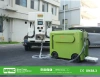
The BCH-80-70 is the compact first responder. It delivers 80 kW through a liquid-cooled CCS2 260 A gun on a 7 m cable, stores 70 kWh, weighs 880 kg and measures 1,460 × 780 × 1,200 mm, so service teams can transport and position it easily beside a stranded car or light van. A 70 kW CCS2 DC input recharges it, and it operates from -20°C to +55°C and at altitudes up to 4,000 m.
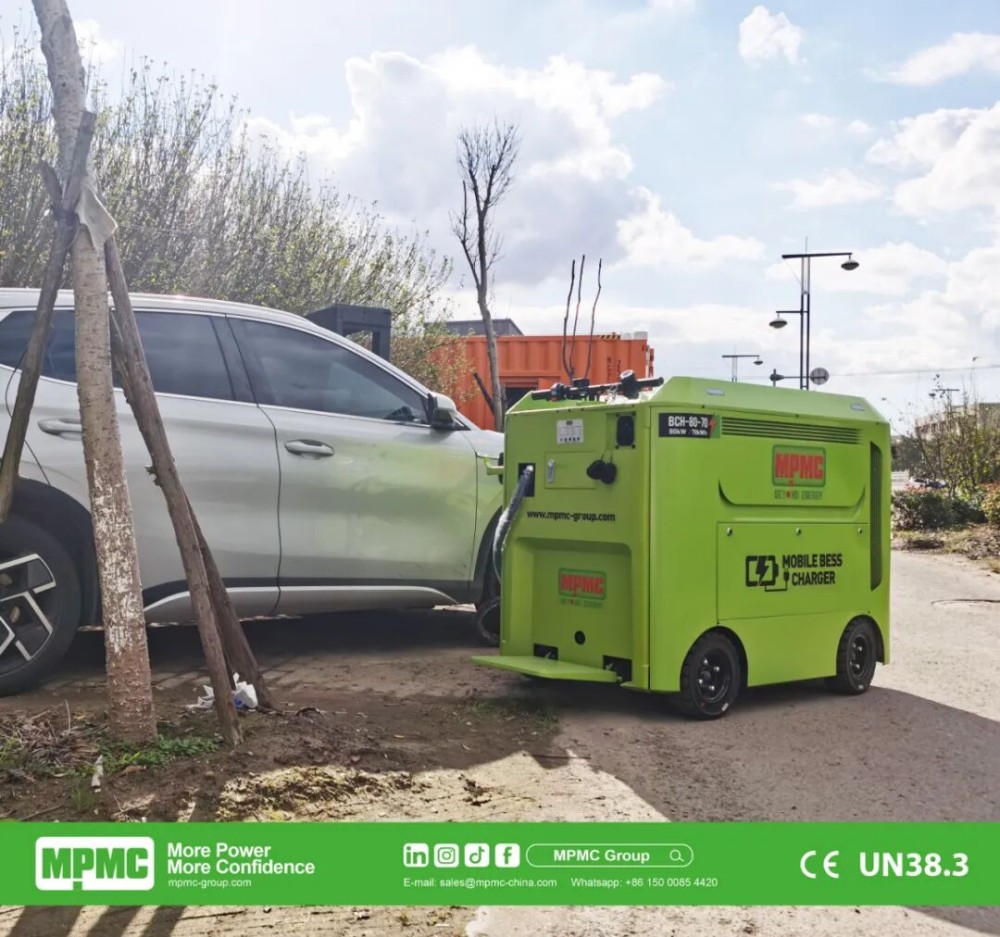 MPMC BCH-80-70 mobile BESS charger delivering DC fast charging to an electric car outdoors.
Tier 2: Vans, Buses and Trucks With the BCH-275-200
For commercial vehicles and multi-vehicle incidents, the BCH-275-200 delivers 150 kW through two CCS2 guns from 203.5 kWh of storage. It travels on a 3.5 t heavy-duty trailer, has integrated forklift pockets and C4 anti-corrosion coating, and its 125 kW AC output can also power scene lighting, tools and traffic equipment. Two guns mean two vehicles can be charged at the same time.
Tier 3: Major Incidents and Motorway Closures With the BCH-500-1000
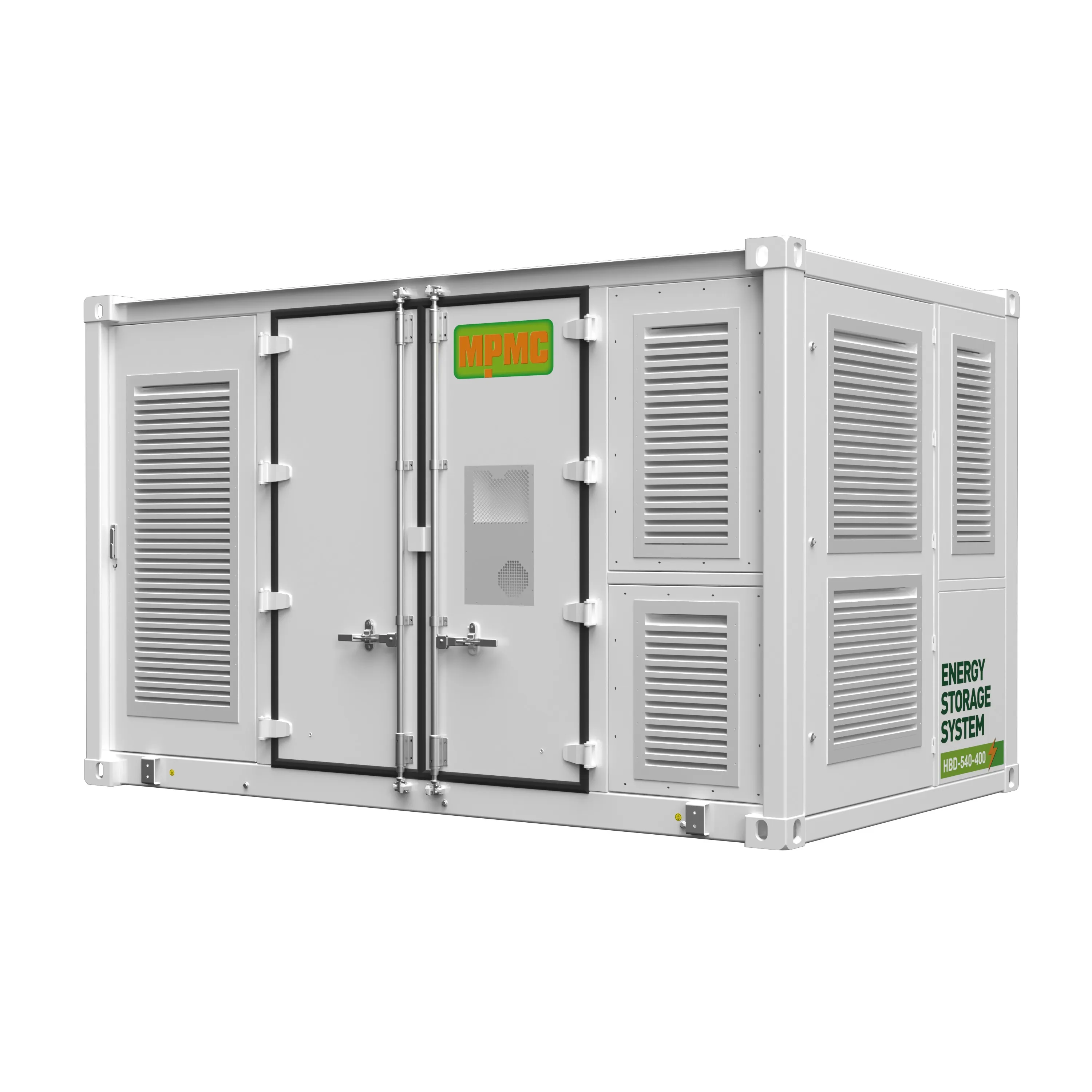
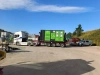
When a closure, severe weather or a large incident leaves many vehicles waiting, the BCH-500-1000 sets up a temporary charging hub. Housed in a 20-foot container, it stores 1,075 kWh and delivers 500 kW of DC charging through dual 350 A CCS2 guns, with 560 kW peak, plus UPS-grade AC output of 500 kW for welfare, lighting and traffic management. The BCH-800-600, with 600 kW output and 1C performance, suits high-intensity duty where rapid energy transfer matters.
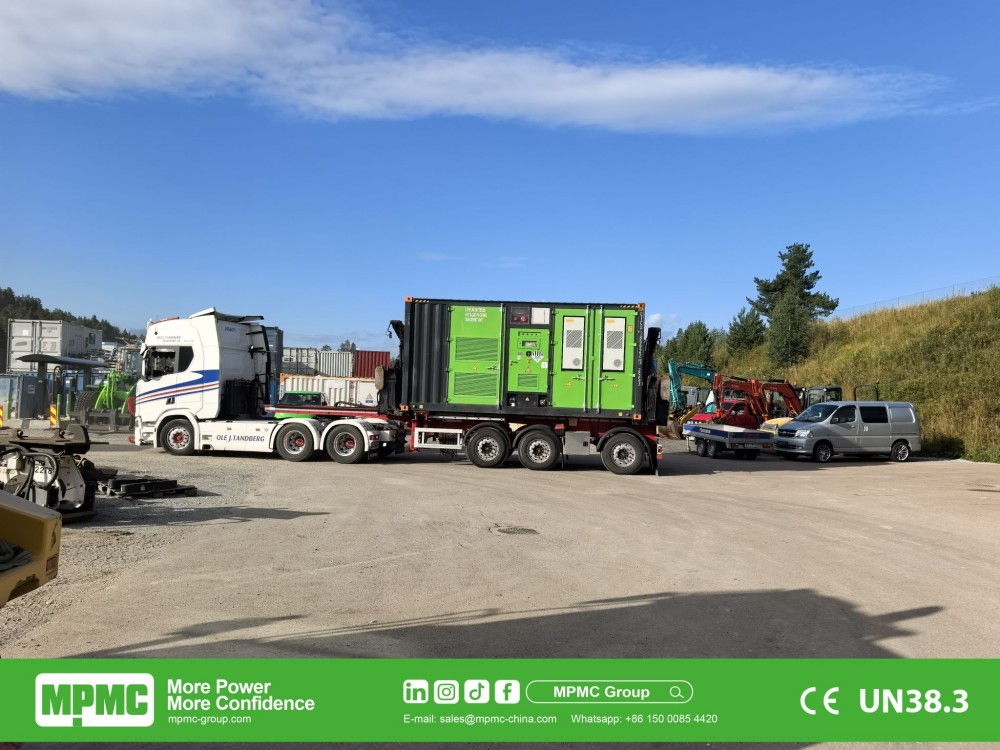 MPMC BCH-500-1000 containerised mobile BESS charger providing outdoor fast charging for electric trucks and cars.
Table 1. Matching BCH models to roadside response tiers
| Tier | Typical call-out | BCH model | DC charging output | Storage | Format |
|---|---|---|---|---|---|
|
1 |
Stranded cars and light vans |
BCH-80-70 |
80 kW, 1 × CCS2 260 A |
70 kWh |
Compact 880 kg unit |
|
2 |
Vans, buses, trucks; two vehicles at once |
BCH-275-200 |
150 kW, 2 × CCS2 250 A |
203.5 kWh |
3.5 t trailer |
|
3 |
Motorway closures, major incidents |
BCH-500-1000 |
500 kW, 2 × CCS2 350 A |
1,075 kWh |
20-foot container |
|
3 |
High-intensity, rapid energy transfer |
BCH-800-600 |
600 kW, 2 × CCS2 350 A |
610.6 kWh |
4,800 × 2,250 × 2,250 mm |
Note: The table shows selected models; the BCH Series also includes the BCH-60-70 and BCH-600-400.
Running the Service Day to Day
Remote Visibility and Dispatch
Every BCH unit carries an EMS with 4G connectivity, and the BCH-80-70, BCH-275-200 and larger models support OCPP 1.6. A cloud-ready API connects units to dispatch and back-office systems, so controllers see each unit's state of charge before assigning a job, and optional RFID payment supports billing for commercial customers.
Recharging at the Depot or on the Road
Units return to full charge from a 125 A CEE grid connection on the BCH-275-200, an 800 A PowerLock connection on the BCH-500-1000, a solar input, or the CCS2 DC input. Depots with solar can turn daytime generation into energy for evening call-outs.
Built for Roadside Conditions
The blade battery's sandwich structure is tested for fire, water immersion, high-impact collision and crushing, a 65% larger heat dissipation area holds temperature variance to 6.7°C, and the BCH-275-200 and larger models carry CE-certified aerosol fire protection. Units operate from -20°C, so winter call-outs are covered.
A Service Model That Pays Its Way
Emergency charging is a premium service: customers at the roadside value immediate access to energy, which supports strong pricing for each session. Between emergencies, the same units can earn revenue at events, depot peaks and construction sites, which keeps utilisation high across the year, and all units are fully operational within 24 hours of arrival at a new base. Logistics companies running electric vans and trucks can also contract dedicated emergency cover for their fleets, adding a recurring service line alongside individual call-outs.
European references show the platform at work. At a UK logistics port, eight BCH-275-200 units bypassed a constrained local grid and reduced electric truck charging time from 10 hours to near-continuous operation; in Norway, a 2 MWh BCH system charges construction machinery off-grid; and in the Netherlands, BCH-275-200 and BCH-500-1000 units supply renewable-powered charging for port and logistics operations. The BCH-275-200 and larger models carry a 3-year system warranty and a 5-year battery performance warranty.
Table 2. BCH features that support a roadside emergency service
| BCH feature | Benefit for the service |
|---|---|
|
Full operation within 24 hours |
New service bases go live quickly |
|
EMS with 4G, OCPP 1.6 and cloud API |
Dispatch, monitoring and billing integration |
|
Dual CCS2 guns (BCH-275-200 and above) |
Two vehicles charged at the same time |
|
CCS2 DC input |
Fast turnaround between call-outs |
|
AC output |
Power for lights, tools and traffic equipment at the scene |
|
Blade LFP battery, 6,000 cycles at 90% DOD |
Long service life with daily use |
Launching a Roadside Charging Service With MPMC
• Map the road network and the call-out types you expect
• Estimate the energy needed per call-out and per shift
• Assign BCH models to each response tier
• Plan depot recharging by AC, DC or solar input
• Connect units to dispatch and billing through OCPP 1.6
• Set pricing for emergency charging sessions
• Plan second roles for units between emergencies
• Contact MPMC at sales@mpmc-china.com or WhatsApp +86 150 0085 4420 for a roadside charging proposal
Frequently Asked Questions
BCH models deliver 80 kW to 600 kW of DC charging, and the vehicle's own charging capability sets the actual rate, so most cars gain useful range within a short stop.
Yes. The BCH-275-200 and larger models have two CCS2 guns, so two vehicles can charge at the same time.
Through its AC input from the grid or a generator set, a solar input, or CCS2 DC input; the BCH-275-200 reaches full charge in about one hour via DC.
CCS2 is standard across the range, with CCS1, GB/T and CHAdeMO available as options for specific markets.
MPMC manufactures and supplies the BCH equipment, and roadside assistance companies, charging service providers and rental operators run their services with it, supported by MPMC's remote technical support and on-site commissioning.
Recent Posts




Contact US
Product Information
Quantity
Unit
Piece
Support order samples, customization, wholesale direct, and complete payment. If the product you look for does not have corresponding customized content, pls fill out the form below to contact us, and we will reply ASAP.