


Language
What Hybrid Power Solution Suits Rural Electrification Projects in Africa?
Aug 21, 2026
Rural electrification projects rarely fail on the electrical engineering. They fail because a part could not be obtained, because nobody local could diagnose a fault, because the tariff did not cover the fuel, or because the equipment was specified for a load that grew faster than anyone expected. A hybrid solution suits these projects well, provided it is chosen against those risks rather than against a technical specification alone. MPMC POWERTECH CORP., established in 2008 and headquartered in Shanghai Pudong, publishes a documented multi-site microgrid programme in the region.
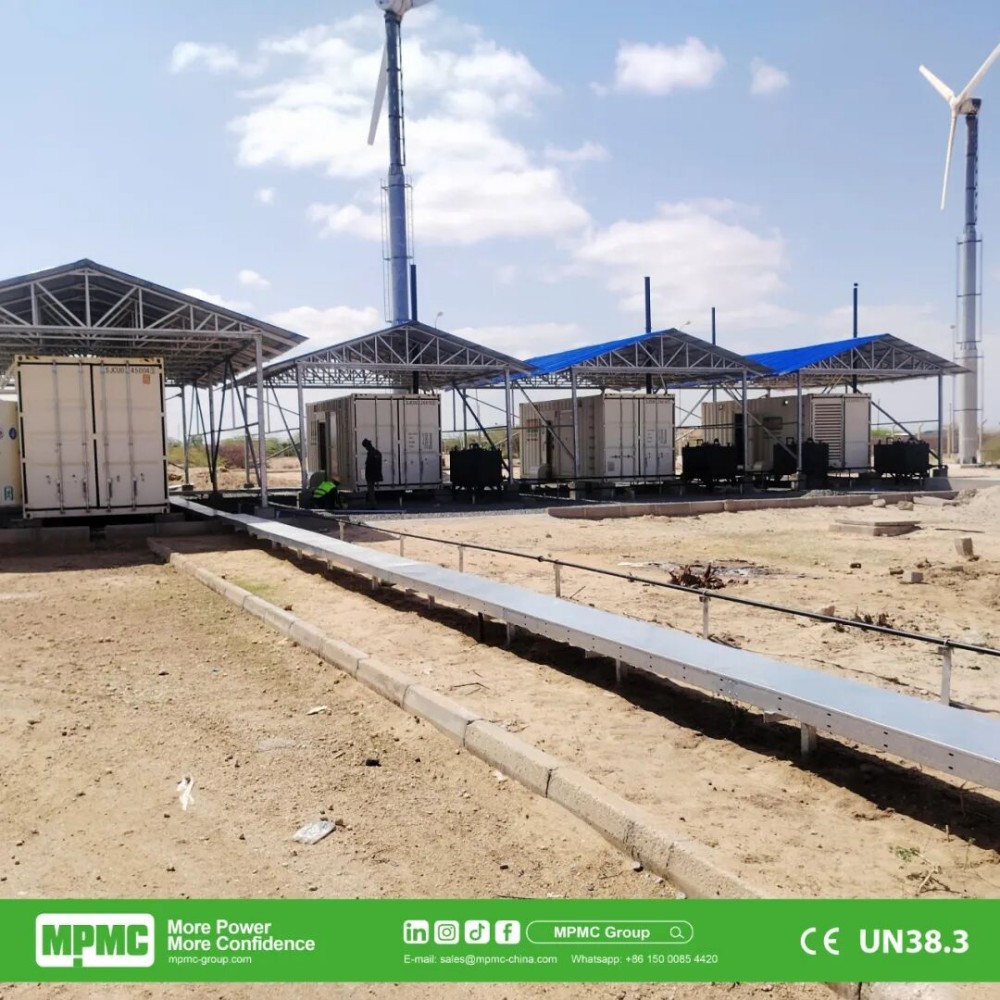 MPMC microgrid project — 6 MW across four sites combining solar, storage and generator sets
What a Documented Regional Programme Looks Like
MPMC lists a Kenyan microgrid programme of 6 MW across four sites. Each site is described with more than 1 MW of solar generation, at least 1 MWh of DC-coupled battery storage rated at 80% depth of discharge and 6,000 cycles with dual-unit redundancy, and diesel backup of two 500 kW plus two 250 kW units.
Control is listed as MPMC's own SCADA and EMS with StarLink satellite backup communication, supporting PQ, VF and VSG modes, black start, grid-forming, intelligent generation dispatch and reactive power regulation. The published outcome describes stable round-the-clock operation in a high-ultraviolet, sandy environment with seamless solar-to-diesel switching and minimal on-site staffing. That result belongs to that resource and demand profile rather than transferring to another location.
Designing for the Constraints That Actually Bite
| Constraint | Why it decides success | What to build into the design |
|---|---|---|
|
Spare parts availability |
A failed component can idle a site for months |
Consumables held locally; standardised across sites |
|
Local maintenance skill |
Specialist visits are slow and costly |
Equipment a trained local technician can service |
|
Demand growth |
Connections rise faster than forecast |
Parallel expansion capability designed in from the start |
|
Revenue and affordability |
Tariffs must cover fuel and replacement |
Configuration that minimises engine hours |
|
Environmental exposure |
High ultraviolet, dust and heat shorten component life |
Coating class, ingress protection and derating at site conditions |
|
Security |
Equipment is remote and unattended |
Siting, enclosure and monitoring provisions |
Standardising across sites addresses several of these at once. A programme built from one configuration keeps the spares list short, lets one training course cover every location, and turns commissioning into a repeated procedure rather than a series of separate designs.
Minimising Engine Hours Is the Affordability Lever
Where fuel must be transported to the site and paid for from local tariff revenue, every engine hour removed improves the project's viability more directly than any equipment discount. That is the strongest argument for solar and storage in this setting, and it is a cash-flow argument rather than an environmental one.
MPMC lists an SPK series of mobile solar plants from 7.65 kWp to 231.84 kWp, storage from 125 kW and 261 kWh upward on the stationary series, and containerised generation from 800 to 3,750 kVA. The design target is to keep engines stopped for as much of the day as the resource allows, and to run them near their efficient load point when they do run.
Building for Demand That Will Grow
Rural sites almost always exceed their forecast, because connection changes what people do. A design that cannot expand strands the project at exactly the moment it succeeds, and retrofitting capacity is far more expensive than reserving for it.
The practical measures are modest at design stage: reserve switchgear capacity, size the control system for more units than the first phase requires, and confirm what parallel expansion needs of the electrical arrangement. MPMC lists multi-unit parallel operation with load sharing through DSE or DEIF controllers and motorised circuit breakers across its generation range, and parallel operation on its storage platform.
Monitoring and the Response Chain Behind It
MPMC lists a self-developed SCADA supporting real-time monitoring, alarm and fault management, maintenance management with early warnings and spare parts tracking, automated reporting and up to ten years of data retention, with StarLink satellite communication as a backup link.
Monitoring is only as useful as the response behind it. The questions that determine availability are who receives an alarm, what they are trained and authorised to do, and how long a part takes to arrive. Those answers belong in the project design rather than in an operations manual written afterwards.
Phasing Against Available Funding
Rural programmes are frequently funded in tranches, which makes the ability to build in stages a financial requirement as much as a technical one. A first phase that establishes generation, storage and control, with solar or additional capacity added later, spreads capital while delivering supply early.
What makes that work is reserving for it at the outset. MPMC lists a GB series covering the same output and battery range as its GSB hybrid stations but without the integrated array, which suits a site intending to add generation later, and parallel operation across both its generation and storage platforms. Confirming the switchgear and control headroom in phase one is what keeps phase two straightforward.
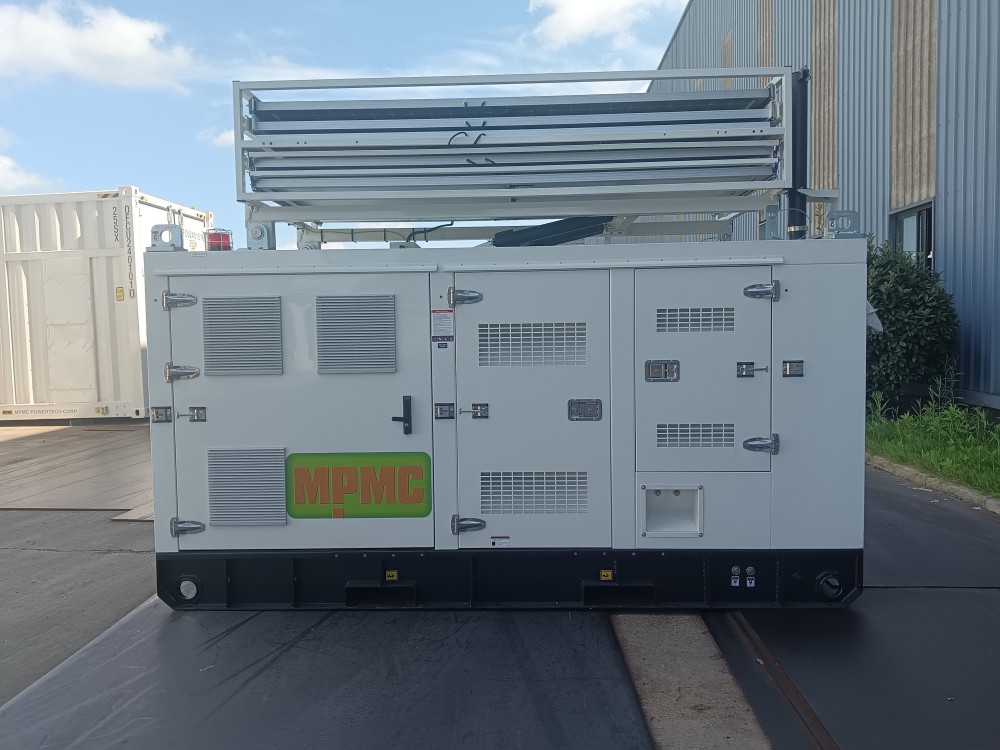 MPMC GSB Series hybrid power station — GSB-20-40
Smaller Sites and Distributed Loads
Not every rural application is a village-scale station. For clinics, pumping stations, telecommunications sites and workshops, MPMC lists a GSB series from 10 to 120 kVA combining solar, generator set and battery on one mobile chassis, with a GB series covering the same output and battery range without the integrated array.
For dispersed small loads these integrated units frequently outperform a central station with long distribution, because cable cost and losses over distance can exceed the saving from consolidating generation. Which approach suits a programme is a distribution study rather than a product preference.
Rural Programme Design Checks
• Standardise on as few configurations as the load range allows across all sites.
• Hold consumable spares locally and confirm the lead time for major components.
• Specify equipment a trained local technician can maintain without a manufacturer visit.
• Design parallel expansion capability into the first phase, including switchgear headroom.
• Target minimum engine hours, since fuel is the recurring affordability constraint.
• Define the alarm response chain, including who acts and how parts arrive.
Recent Posts


Contact US
Product Information
Quantity
Unit
Piece
Support order samples, customization, wholesale direct, and complete payment. If the product you look for does not have corresponding customized content, pls fill out the form below to contact us, and we will reply ASAP.