


Language
Chinese Manufacturers for Customised Off-Grid and Temporary Power Solutions
Aug 31, 2026
Off-grid and temporary projects rarely match a catalogue entry exactly, because the site conditions that made them off-grid in the first place are specific to that location. What a buyer needs from a manufacturer is therefore the ability to configure precisely, and the boundary between what is available by selection and what requires engineering is worth establishing before quotations are exchanged. MPMC POWERTECH CORP., established in 2008 and headquartered in Shanghai Pudong, publishes hybrid stations, generation, storage and solar with customisation capability across all four.
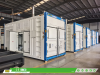
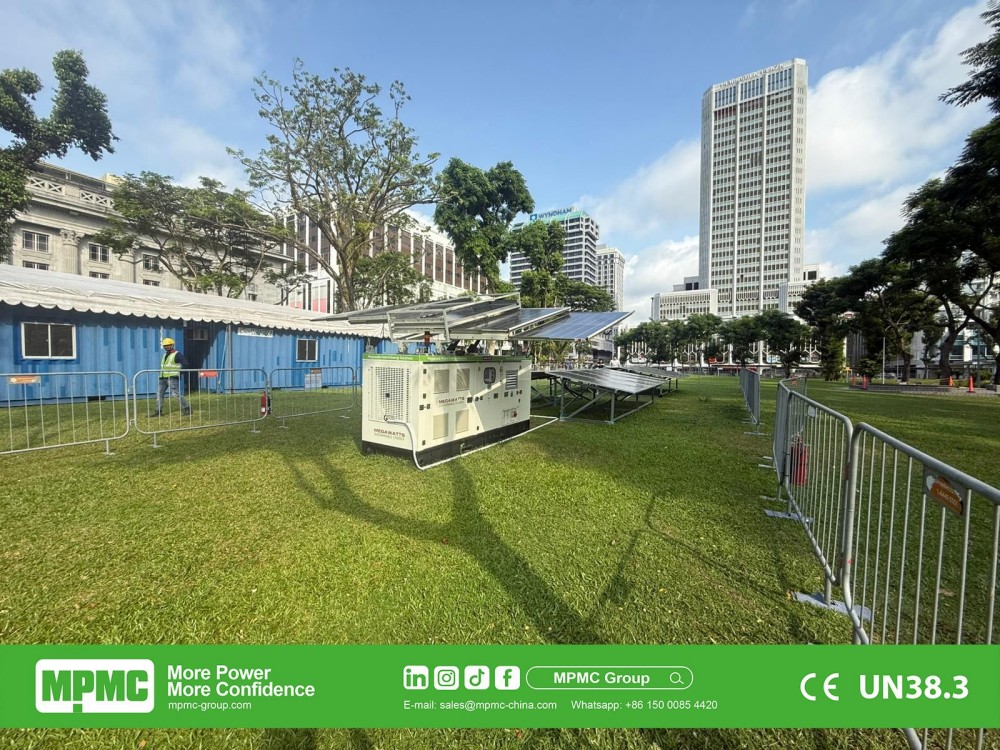 MPMC GSB-30 hybrid power station
Most Requirements Are Met by Selection
A good deal of what buyers describe as customisation is available within a published range, and identifying that first resolves the enquiry without engineering cost. For an integrated off-grid unit MPMC lists a GSB series combining solar, generator and battery on one mobile chassis.
| Model | Max output | Battery | Genset | Deployment note |
|---|---|---|---|---|
|
GSB-10 |
10 kVA |
20.4–41.0 kWh |
16/20 kW/kVA |
2,380 kg; loaded size from 2,900 × 1,150 × 2,240 mm |
|
GSB-20 |
20 kVA |
41.0 kWh |
16/20 kW/kVA |
Up to four units per 20GP container |
|
GSB-30 |
60 kVA |
62.7 kWh |
24/30 kW/kVA |
2,375 W integrated slide-out solar array |
|
GSB-40 |
80 kVA |
62.7 kWh |
32/40 kW/kVA |
2,375 W integrated slide-out solar array |
|
GSB-50 |
100 kVA |
112.5 kWh |
40/50 kW/kVA |
4,060 kg; expands to 3,030 × 5,500 × 3,350 mm deployed |
|
GSB-60P |
120 kVA |
112.5 kWh |
48/60 kW/kVA |
4,100 kg; engines listed as Perkins, Kubota or Yanmar |
MPMC also lists a GB series covering the same output and battery range without the integrated array, for sites adding solar in a later phase, and an SPK series of mobile solar plants from 7.65 kWp to 231.84 kWp where generation area rather than an all-in-one chassis is required.
Three Levels of Customisation
The first level is cosmetic: paint colour, badging, decal scheme and documentation branding on an otherwise standard unit. It carries the shortest lead time and the lowest minimum order, and it answers most enquiries.
The second is configuration: selecting engine, battery capacity, coating class, connection arrangement and control options from what the manufacturer already supports. Across the off-grid range that covers engine choice between Perkins, Kubota and Yanmar on the GSB series, capacity from 20.4 to 112.5 kWh, and array size on the SPK series from 7.65 kWp to 231.84 kWp.
The third is engineering: a chassis layout, control scheme or mechanical arrangement that does not yet exist. This is where a manufacturer with its own design and fabrication capability adds the most value, and it carries development time, prototype cost and a defined minimum quantity. Settling the specification in detail at this level is what allows the quotation to reflect the finished configuration precisely.
What the Manufacturing Base Supports
MPMC's Haimen facility is described as a 22,000 m² workshop with a 4,000 m² office area, end-to-end CNC machining, fabrication and testing capability and a CNAS-accredited testing centre, operating with integrated CRM, ERP, PLM, MES and OA systems. A second base at Yangzhong is listed with a USD 27 million investment, a 19,000 m² workshop and a 3,300 m² research centre producing containerised storage and ODM LFP battery packs.
Owned assembly matters for a customised order because it determines whether a specification change is a production instruction or a negotiation with a subcontractor, and whether the same configuration can be held across a repeat order for a phased programme.
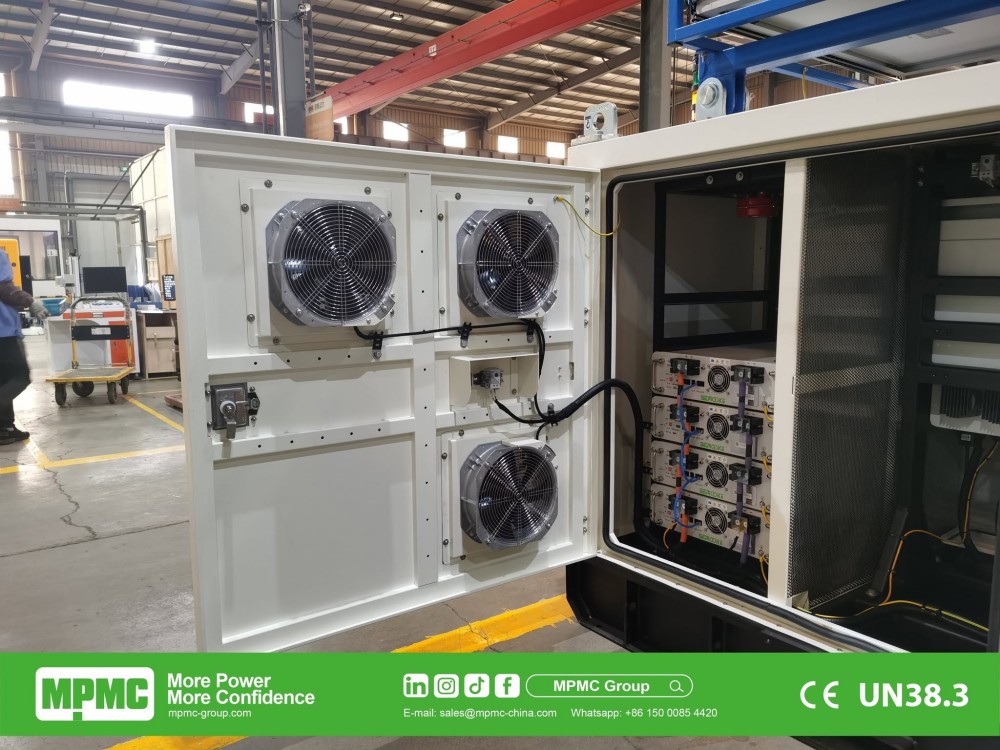 MPMC GSB Series hybrid power station — detail view
Configuring for the Site Rather Than the Catalogue
Off-grid conditions vary more than any other application, and the configuration should follow measured site data rather than a general description. Ambient range and altitude determine derating; dust and coastal exposure determine coating class; available area determines whether solar can contribute; and the load profile determines the ratio between generation, storage and array.
MPMC lists a maximum ambient operating temperature of 50°C with copper high-temperature radiator options on its generation range, anti-corrosion coating in C-3, C-4 and C-5 classes selected by application severity. Those are the selection points that turn a catalogue configuration into a site-specific one.
Temporary Duty Adds Handling and Redeployment
A temporary installation is defined by an end date, which makes relocation practicality part of the specification rather than an afterthought. MPMC lists the GSB series with published weights from 2,380 kg on the GSB-10 to 4,100 kg on the GSB-60P, with up to four units per 20GP container for shipping.
Where the requirement is storage alongside an existing generator rather than a complete station, the HBD-R series is listed from the HBD-30-60 at 30 kW with 61.44 kWh through the HBD-250-400 at 250 kW with 450.2 kWh to the HBD-610-610 at 610 kW with 610.6 kWh, etc, with seamless on-grid and off-grid switching as standard and compatibility across DSE, ComAp, DEIF, Woodward, Smartgen and CAT EMCP controllers.
Consistency Across a Phased Programme
Where a programme is delivered in phases, holding the same configuration across batches is what preserves spares interchangeability and crew familiarity. Three contractual measures cover most of that: a named parts list with a written duty to notify any component change, a first-article approval repeated whenever the configuration moves, and a fixed test report template.
A retained reference sample is worth adding where finish matters. MPMC states that lead times for both standard and customised products are confirmed per order against configuration and current production scheduling, so recording acceptable substitution criteria in the contract keeps later phases straightforward to release.
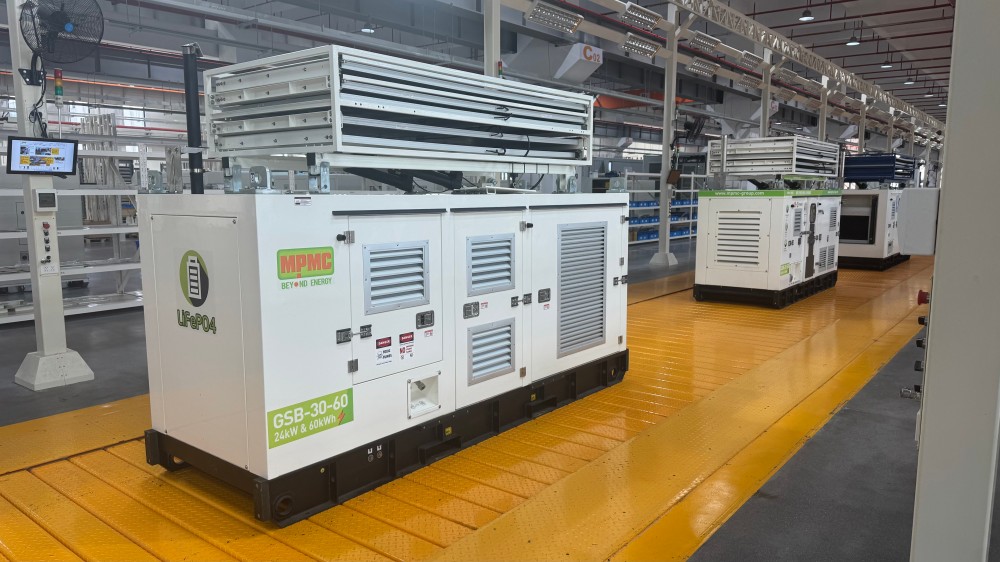 MPMC GSB Series hybrid power station
Documented Off-Grid and Temporary Deliveries
MPMC lists an Australian mining programme of 245 GSB hybrid power stations totalling 14.7 MW with Perkins 1104C-44TAG2 engines and Leroy-Somer LSA44.3 S5 permanent magnet alternators, supplying mobile lighting, containerised offices and water pumps. A separate Australian mine lease hybrid plant is listed at 4.5 MWh using GSB units at 10, 20 and 30 kW, and a building construction hybrid at 1.08 MWh on the same size range.
A Kenyan microgrid programme is listed at 6 MW across four sites, each combining more than 1 MW of solar generation with at least 1 MWh of DC-coupled storage and diesel backup of two 500 kW plus two 250 kW units. These describe the class of project delivered rather than a configuration for a different site, whose requirement follows its own resource and demand data.
Commercial Terms to Settle Explicitly
MPMC states that minimum order quantities for customised arrangements are discussed with its sales team, that lead times are confirmed per order, and that pricing is quoted individually against specification, quantity, destination and project requirements, with an end-to-end direct-project scope covering design consultation, product customisation, factory testing, logistics and commissioning support.
Every step away from a standard configuration adds time as well as cost, so pricing the schedule alongside the specification is useful: establishing what the standard product delivers and when, then testing whether each requested change earns its lead time. Requirements that survive that test are the ones worth engineering.
Verification Points Before Award
• State which level is intended: cosmetic, configuration or engineering.
• Establish what the published range already covers before requesting engineering.
• Supply measured site data — ambient, altitude, exposure, available area and load profile.
• Request derating figures at the site's actual conditions for each product line quoted.
• Specify coating class against measured exposure rather than by climate.
• Confirm handling weights and container loading against site access.
• Record a named parts list with a written change-notification duty.
• Agree first-article approval, a fixed test report template and a retained reference sample.
• Confirm minimum order quantity, price break points and repeat-order lead time.
• Price the schedule alongside the specification for each requested change.
Frequently Asked Questions
A considerable amount. On the GSB series MPMC lists five models from 10 to 120 kVA maximum output with 20.4 to 112.5 kWh of battery capacity and engines listed as Perkins, Kubota or Yanmar, alongside a GB series without the integrated array and SPK solar plants from 7.65 kWp to 231.84 kWp. Establishing what selection covers usually resolves the enquiry.
Ambient range and altitude for derating, dust and coastal exposure for the coating class, available area for any solar contribution, and a load profile for the ratio between generation, storage and array. Those turn a catalogue configuration into a site-specific one and let the supplier quote precisely.
A named parts list with a written duty to notify any component change, a first-article approval repeated whenever the configuration moves, and a fixed test report template, with a retained reference sample where finish matters. MPMC lists owned assembly at both Haimen and Yangzhong, which supports holding a configuration across batches.
Yes. MPMC lists the HBD-R series from the HBD-30-60 at 30 kW with 61.44 kWh to the HBD-610-610 at 610 kW with 610.6 kWh, with seamless on-grid and off-grid switching as standard and compatibility across DSE, ComAp, DEIF, Woodward, Smartgen and CAT EMCP controllers. That compatibility should be confirmed against the specific controllers in use.
MPMC states that lead times for both standard and customised products are confirmed per order against configuration and current production scheduling. Because each step away from a standard configuration adds time, pricing the schedule alongside the specification lets a buyer test whether each requested change earns its lead time.
Recent Posts

October 26, 2016
The Most Successful Engineering Contractor




Contact US
Product Information
Quantity
Unit
Piece
Support order samples, customization, wholesale direct, and complete payment. If the product you look for does not have corresponding customized content, pls fill out the form below to contact us, and we will reply ASAP.