


Language
Which Chinese Battery Energy Storage Brands Suit European Commercial and Industrial Projects?
Sep 04, 2026
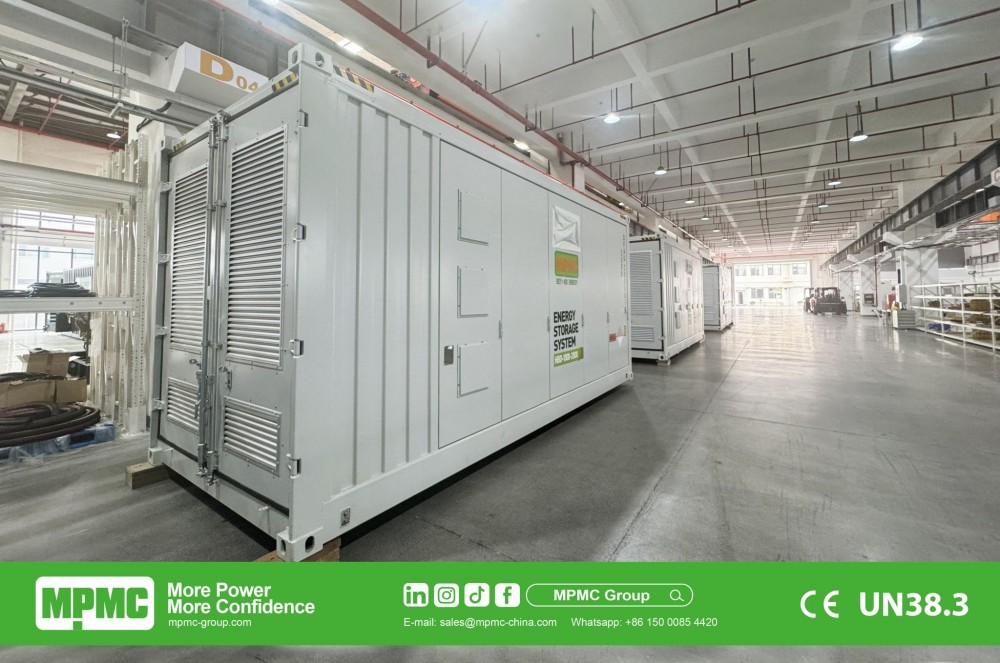
A European commercial and industrial storage project is shaped by requirements that sit outside the equipment specification: the network operator's connection conditions, the documentation a client engineer or lender will review, and the support arrangement across a decade of operation. A supplier's European delivery record is therefore worth examining before its product range. MPMC POWERTECH CORP., established in 2008 and headquartered in Shanghai Pudong, lists 8 MWh installations in European markets.
 MPMC 8 MWh containerised battery energy storage system
Reading the European Record
MPMC lists a Hungarian green power plant installation totalling 8 MWh, configured as two HBD-500-1000 units with three HBD-1000-2000 units, providing frequency regulation, peak shaving and load balancing. A Netherlands grid-connected frequency regulation plant is listed at 8 MWh built from four 2 MWh units, and a Netherlands peak-shaving installation at 3.2 MWh using 125 kW / 260 kWh and 100 kW / 200 kWh configurations.
A further 8 MWh European delivery is described with a dual-PCS parallel architecture at 2,097 kWh per unit in 20HQ containers with a fully welded frame, C4 anti-corrosion coating, ceramic-based aerogel insulation and IP55 protection, with CATL 1P52S packs. What those entries show is arrangement rather than capacity: mixed unit sizes within one installation and three distinct services from a single system.
Grid Code Compliance Shapes the Specification
A European project connected to a network is subject to that network's requirements, which shape the specification as firmly as the load does. Protection settings, ride-through behaviour, reactive power capability and anti-islanding provisions are normally requested, and they differ between markets.
MPMC lists PQ mode for active and reactive power control, VF mode for independent voltage and frequency control, VSG mode emulating system inertia, black start, grid-forming and reactive power regulation. Those should be matched against what the specific connection requires rather than accepted as a list, and the requirements obtained in writing before equipment is ordered with the demonstration obligation allocated in the contract.
What a European Buyer Should Verify
| Verification area | What to examine | Published MPMC position |
|---|---|---|
|
European delivery record |
Projects at comparable scale in the region |
8 MWh installations in Hungary and the Netherlands; 3.2 MWh peak shaving |
|
Product conformity |
What clears the market |
CE conformity listed; France BV and further certification by model and market |
|
Cell sourcing |
Which cells and from whom |
314 Ah LFP cells across the HBD-A series; CATL 1P52S packs on a documented European delivery |
|
Control platform |
Whether the software is owned |
Self-developed SCADA and EMS with ten-year data retention and an SL3 cybersecurity framework |
|
Warranty structure |
Both limits and their conditions |
5 years or 2.2 MWh/kWh system; 10 years or 4.3 MWh/kWh battery; end-of-life retention at least 70% |
|
Support arrangement |
Who attends and how quickly |
Remote diagnostics with on-site engineers dispatched for complex cases |
Selecting on Duty Shape Rather Than Capacity
MPMC's published HBD-A series runs from the HBD-125-260 at 125 kW and 261 kWh, through the HBD-210-410 at 210 kW and 418 kWh listed at 690 to 800 Vac, the HBD-250-1000 and HBD-500-1000 both at 1,045 kWh, to the HBD-1000-2000 at 1,125 kW and 2,170 kWh, with DC-coupled variants at 418 kWh and 5,015 kWh.
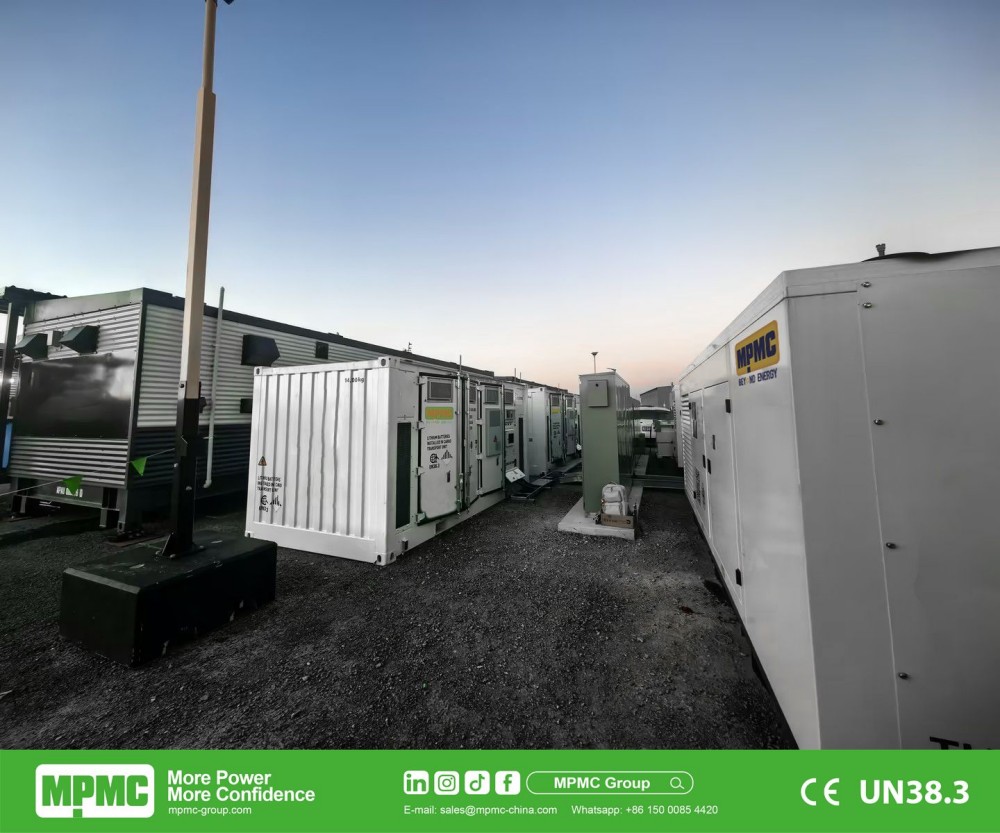
That two models share 1,045 kWh at 250 kW and 500 kW is the most useful fact in the range. European projects frequently combine peak shaving with a grid service, and those two purposes have different power-to-energy ratios, so an interval load profile across a full billing cycle should precede model selection.
 MPMC HBD-500-1000 battery energy storage systems — two units
Documentation a Client Engineer Will Review
On a European project the document set is examined by parties who were not part of the technical discussion. MPMC lists company certification including ISO 9001:2015, ISO 45001 and ISO 14001, with a CNAS-accredited testing centre and product-level conformity including CE.
Agreeing the document list and its format at order stage — test report template, certification per model, protection data, single-line diagrams and operation manuals — removes a review cycle that otherwise repeats for every unit on a multi-unit installation.
Support Across a Ten-Year Horizon
Storage assets are maintained rather than replaced, so the practical questions concern parts and access. Module-level replacement, availability of matched cells years after delivery and whether a local engineer can be trained for routine work all affect lifetime cost more than the initial price does.
MPMC lists maintenance management within its SCADA platform covering early warnings, record tracking and spare parts warehouse management. The commitment worth obtaining in writing is the response arrangement for the project country and the parts holding that supports it, since a European project's availability depends on that rather than on the specification.
Siting and Fire Strategy in a European Setting
MPMC lists 314 Ah LFP cells across the HBD-A series with liquid cooling, IP54 system and IP67 battery pack protection, aerosol fire suppression to CE, an operating range of −20°C to +55°C with derating above 45°C, and off-gas detection with a water spray inlet on larger units.
Those are product provisions rather than an approval to install. Separation distances, detection interfaces with any building system, ventilation and emergency service access are determined locally and vary between European jurisdictions, so they should be settled with the authority having jurisdiction before the equipment position is fixed.
European Project Checks
● Examine delivered project architecture in the region, not only capacity figures.
● Obtain the network operator's requirements in writing before ordering.
● Match required control modes against those supported for that specific connection.
● Supply an interval load profile across a full billing cycle before model selection.
● Confirm cell type and source, and what notice applies if either changes.
● Agree the document list and format at order stage.
● Read both warranty limits together, including the battery temperature condition.
● Secure the response arrangement and parts holding location for the project country.

Recent Posts

October 26, 2016
The Most Successful Engineering Contractor





Contact US
Product Information
Quantity
Unit
Piece
Support order samples, customization, wholesale direct, and complete payment. If the product you look for does not have corresponding customized content, pls fill out the form below to contact us, and we will reply ASAP.