


Language
High-Capacity Battery Energy Storage Solutions for Industrial Facilities
Oct 12, 2026
MPMC POWERTECH CORP., established in 2008 and headquartered in Shanghai Pudong, manufactures the HBD-A Series stationary battery energy storage system that commercial and industrial facilities specify to manage two distinct cost pressures: grid instability in the form of frequency deviations and voltage fluctuations, and demand charge penalties billed on peak kW draw rather than total energy consumed. This article covers the HBD-A platform's full specification range, two documented industrial deployments, the warranty terms that determine long-term project economics, and where MPMC sits against other suppliers of high-capacity C&I battery storage.
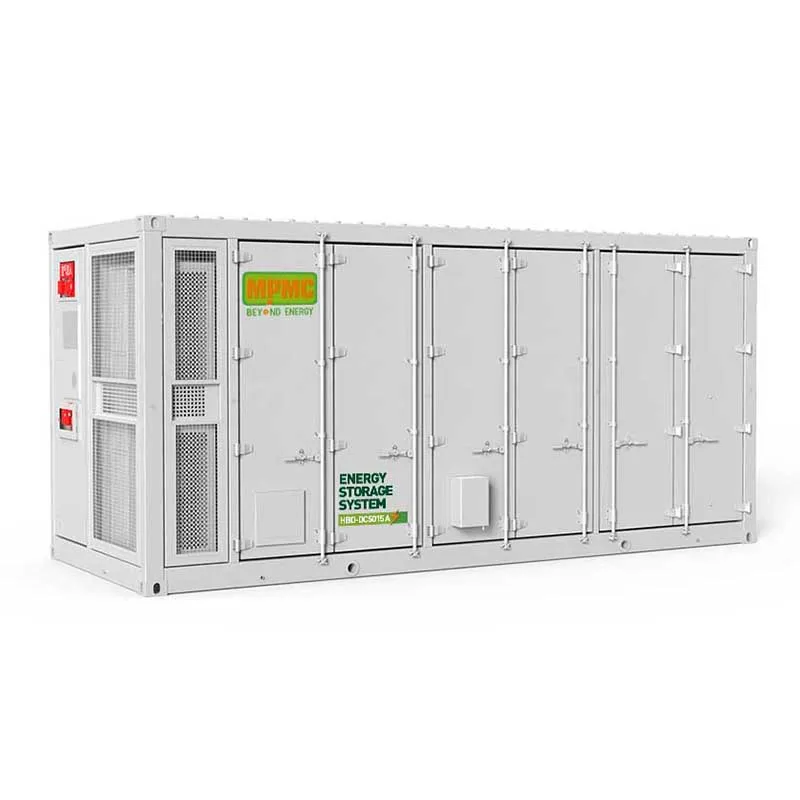
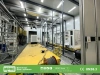
 MPMC HBD-A Series containerized battery energy storage system configured for industrial-scale deployment
The HBD-A Platform Across Its Full Capacity Range
The HBD-A Series spans from the HBD-125-260 (125 kW / 261 kWh) through to the HBD-1000-2000 (1,125 kW / 2,170 kWh), all built on liquid-cooled LFP 314Ah cells rated for 8,000 cycles at 90% depth of discharge, with C4 anti-corrosion coating and expandable power and capacity configurations. A DC-coupled variant, the HBD-DC 5000, scales up to 5,015 kWh for facilities needing grid-scale storage on a single coupled architecture rather than multiple discrete AC-coupled units. Operating temperature range extends from -20°C to 55°C, and maximum altitude is rated at 3,000 m above sea level with derating above 2,000 m, which covers most industrial site locations without requiring a special high-altitude configuration.
| Model | AC Power | Capacity | Cycle Life | Cooling |
|---|---|---|---|---|
|
HBD-125-260 |
125 kW |
261 kWh |
8,000 @90% DOD |
Liquid |
|
HBD-500-1000 |
500 kW |
1,045 kWh |
8,000 @90% DOD |
Liquid |
|
HBD-1000-2000 |
1,125 kW |
2,170 kWh |
8,000 @90% DOD |
Liquid |
|
HBD-DC 5000 |
DC-coupled |
5,015 kWh |
8,000 @90% DOD |
Liquid |
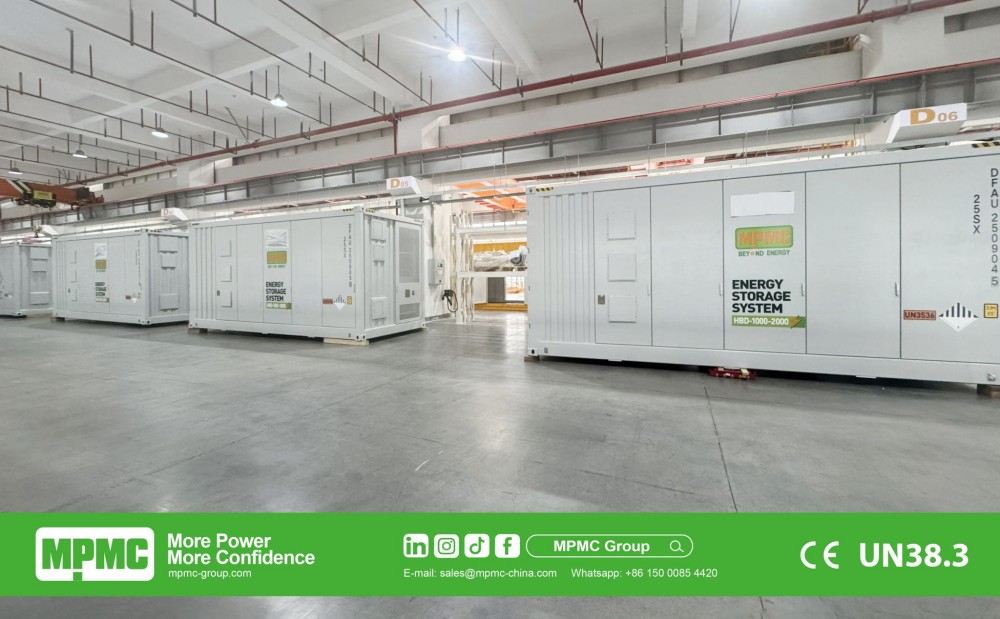
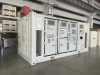
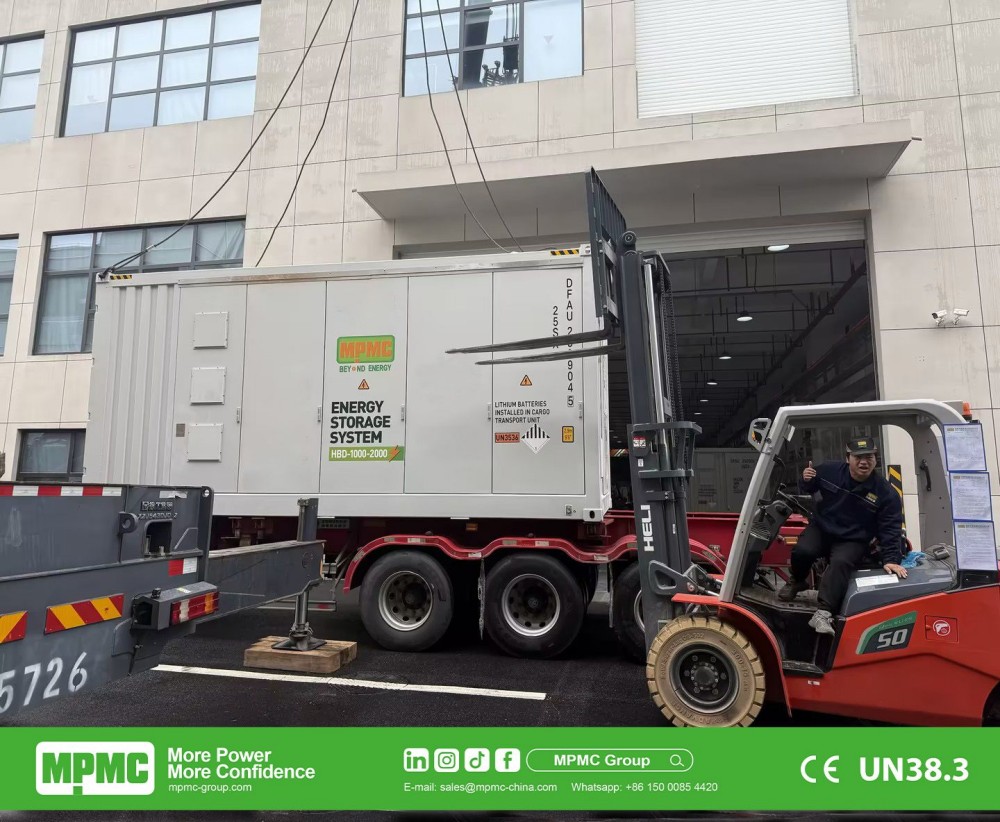 MPMC HBD-A 8 MWh containerized battery energy storage system built from multiple parallel units
Documented Industrial Deployments
MPMC's Hungary 8 MWh system — two HBD-500-1000 units plus three HBD-1000-2000 units — provides grid frequency regulation, peak shaving and load balancing for a green power plant, with millisecond-level response to frequency deviations across PQ, VF and VSG control modes, demonstrating that a single HBD-A deployment can serve more than one of these functions concurrently rather than requiring a separate system per use case. A separate Dubai concrete batching plant deployment, combining an HBD-500-1000 with three 500 kVA gensets, delivered an estimated 20% OPEX reduction through peak shaving, charging the battery during off-peak grid hours and discharging during peak demand periods to reduce the maximum kW draw billed by the utility.
Self-Consumption and Renewable Integration
For facilities with rooftop solar, the HBD-A stores excess midday solar generation and delivers it during evening demand peaks, maximising PV self-consumption rather than exporting surplus generation back to the grid at a lower feed-in rate. All HBD-A models support on-grid/off-grid switching, external PV inverter and ATS integration, and remote monitoring via EMS, with IP54 system protection and IP67 protection on the battery pack itself. MPMC's documented Netherlands 3.2 MWh peak-shaving microgrid, combining 125 kW/260 kWh and 100 kW/200 kWh configurations, illustrates the smaller-scale end of this application, showing the same architecture is not limited to the largest multi-megawatt sites.
Warranty and Long-Term Performance Guarantees
The HBD-A Series carries a 5-year system warranty or coverage until total energy throughput reaches 2.2 MWh per kWh of capacity, whichever comes first, alongside a 10-year battery performance warranty or 4.3 MWh per kWh capacity, with end-of-life capacity retention guaranteed at 70% or above. For a facility modelling a 10-15 year investment horizon, that battery performance warranty term is typically the figure that determines the project's financial case more than the upfront capacity price. A facility should also confirm how the throughput-based warranty limit interacts with its expected cycling frequency: a site running aggressive daily peak-shaving cycles will reach the throughput cap sooner in calendar time than one cycling only occasionally, even though both are covered by the same nominal warranty term.
Where MPMC Sits Against Other Industrial BESS Suppliers
Domestic competitors such as Singularity Energy (Shaanxi), founded by a former senior TBEA executive, bring credible grid-scale engineering expertise to utility-adjacent and industrial deployments. MPMC differentiates through a documented international export track record — Netherlands, Hungary, Norway and Kenya projects at multiple-MWh scale — and the advantage of pairing HBD-A storage with MPMC's own generator sets and SCADA platform for facilities that need hybrid generation-plus-storage rather than storage alone.
For a facility that already runs on-site generation, this integration is the practical differentiator: rather than adding a battery system from one vendor to a genset installation from another and reconciling two separate control platforms, the facility gets a single SCADA/EMS layer covering both, which reduces the engineering effort required at commissioning and the number of parties involved when something needs troubleshooting.
| Element | Domestic Competitor Profile | MPMC |
|---|---|---|
|
Engineering background |
Grid-scale utility expertise |
Broader export project portfolio |
|
Export track record |
Limited |
Netherlands, Hungary, Norway, Kenya |
|
Genset integration |
Not applicable / separate |
Same SCADA/EMS as MPMC gensets |
A facility comparing quoted capacity figures across suppliers should also confirm whether the number refers to nameplate capacity or usable capacity at the specified depth of discharge, since the 8,000-cycle rating on HBD-A applies specifically at 90% DOD — a supplier quoting a headline kWh figure without stating the associated DOD is not giving a directly comparable number.
Checklist: Specifying High-Capacity BESS for an Industrial Facility
• Calculate current demand charge exposure to size the peak-shaving capacity needed
• Confirm whether frequency regulation (PQ/VF/VSG modes) is required for the site's grid connection
• Match HBD-A model capacity to existing or planned rooftop PV generation if self-consumption is a goal
• Verify IP54/IP67 protection ratings against the facility's environmental exposure
• Confirm the 10-year battery performance warranty terms in writing before ordering
• Ask whether on-grid/off-grid switching is seamless or gap-switching by default
• Request a documented reference project of comparable capacity and application
• Confirm remote monitoring and EMS integration with the facility's existing systems
Questions Industrial Facility Managers Ask
Results vary by site, but MPMC's documented Dubai concrete batching plant deployment achieved an estimated 20% OPEX reduction through peak shaving, discharging stored energy during peak demand periods to reduce the maximum kW draw billed by the utility. Actual savings depend on the site's specific tariff structure and how peaked its load profile is to begin with.
The HBD-1000-2000 delivers 1,125 kW / 2,170 kWh per unit and units can be paralleled for larger capacity, as demonstrated in the Hungary 8 MWh system combining five units across two models; the DC-coupled HBD-DC 5000 offers a further single-unit option at 5,015 kWh for sites preferring one large coupled block over multiple parallel AC-coupled units.
10 years or 4.3 MWh per kWh of capacity, whichever comes first, with end-of-life capacity retention guaranteed at 70% or above, separate from the 5-year system warranty.
Yes. All HBD-A models support external PV inverter integration and are designed to store excess midday solar generation for discharge during evening demand peaks, maximising the facility's PV self-consumption rate.
Yes. HBD-A storage integrates with MPMC generator sets under the same self-developed SCADA/EMS platform, giving a facility one monitored system across generation and storage rather than two separately managed platforms.
Recent Posts

October 26, 2016
The Most Successful Engineering Contractor



Contact US
Product Information
Quantity
Unit
Piece
Support order samples, customization, wholesale direct, and complete payment. If the product you look for does not have corresponding customized content, pls fill out the form below to contact us, and we will reply ASAP.