


Language
Mobile Fast-Charging BESS Equipment for Highway Service Areas and HGV Corridors in Europe
Oct 26, 2026
MPMC POWERTECH CORP., established in 2008 and headquartered in Shanghai Pudong, manufactures the BCH Series mobile BESS chargers that highway service areas, truck stops and freight corridor operators use to add high-power charging for electric cars and heavy goods vehicles. Europe's leading truck manufacturers are expanding their electric HGV ranges and high diesel costs are speeding up adoption, so operators along major freight routes need charging capacity quickly, often at sites with modest grid connections. This article covers battery-buffered charging with the BCH platform, MPMC's European references, 24-hour deployment, and the billing and monitoring tools that come with every unit.
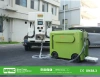
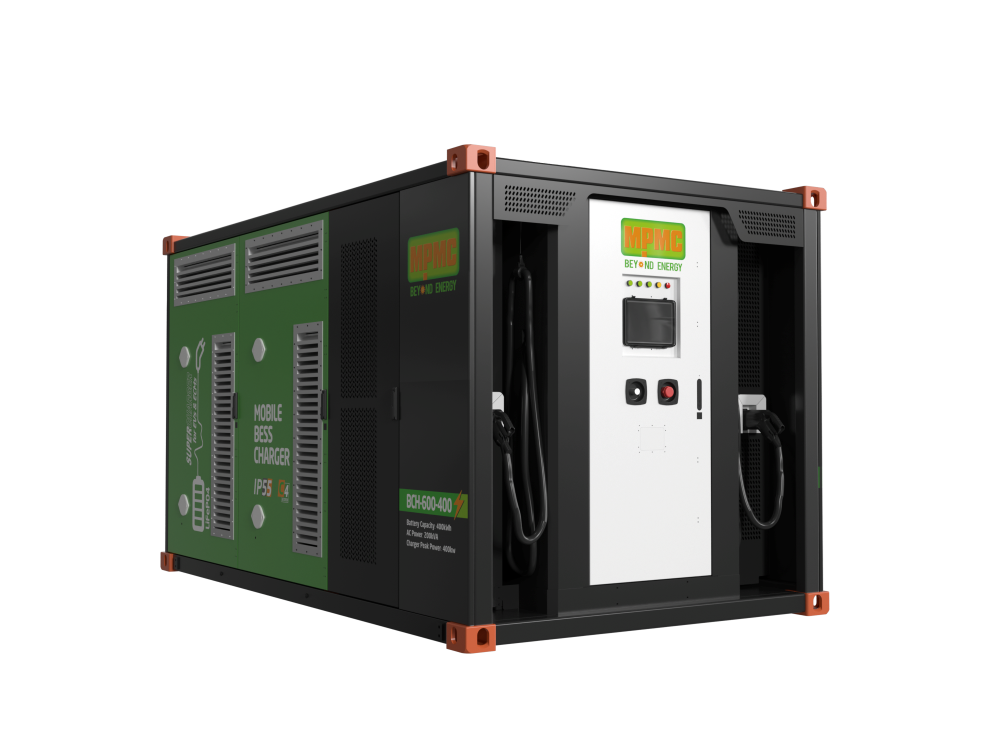 MPMC BCH-600-400 mobile BESS charger, delivering 400 kW of DC charging through two CCS2 guns for service-area and truck-stop charging.
Why Electric HGV Charging Is Growing Along Europe's Freight Routes
Electric Trucks Are Arriving Faster Than Grid Upgrades
As more electric HGVs enter service, drivers and fleet managers need reliable high-power charging along the routes they already use. A traditional grid reinforcement at a rural service area can take a long time to approve and build, while a mobile BESS charger can be installed and earning within a day. That speed lets operators capture early electric truck traffic and grow capacity step by step as demand rises.
Space at Service Areas and Truck Stops Makes Deployment Simple
Truck stops and service areas already have generous parking and manoeuvring space, which makes it easy to place trailer-mounted or containerised BCH units next to HGV bays without major construction. Units can be positioned where trucks naturally park, connected to the existing supply and brought online quickly.
Battery-Buffered Charging for Grid-Constrained Sites
High Charging Power From a Modest Grid Connection
A BCH unit draws a steady supply from the grid and stores it in its onboard battery, then releases it at much higher power when vehicles arrive. The BCH-600-400 takes 280 kW of AC input and delivers 400 kW of DC charging from 407 kWh of storage; the BCH-800-600 uses the same 280 kW input to deliver 600 kW with 1C charge and discharge; and the BCH-500-1000 combines 560 kW of input with 1,075 kWh of storage and 500 kW of output. Operators can therefore serve peak demand at busy times from the connection they already have, and recharge the battery during quieter periods, making full use of a grid supply that would otherwise sit underused overnight. The result is high-power charging from a grid connection well below the charging power delivered to vehicles.
Cars and Electric Trucks From the Same Hub
Dual CCS2 charging guns rated at 350 A on the larger models, and a wide DC output range of 50 V to 1,000 V, let one BCH serve passenger cars, vans and electric HGVs from the same bay. MPMC lists CCS2 and MCS among the BCH Series' supported charging standards, with CCS1, GB/T and CHAdeMO options for other markets, and BCH-800-600 and BCH-500-1000 charging guns support simultaneous charge and discharge for more versatile operation.
Table 1. BCH models for service areas and freight corridors
| Model | AC input (grid draw) | DC charging output | Storage | Best fit on the corridor |
|---|---|---|---|---|
|
BCH-275-200 |
80 kW |
150 kW (2 x 250 A) |
203.5 kWh |
Smaller service areas, cars and vans, first charging bays |
|
BCH-600-400 |
280 kW |
400 kW (2 x 350 A) |
407 kWh |
Mid-size service areas with growing HGV traffic |
|
BCH-800-600 |
280 kW |
600 kW (2 x 350 A) |
610.6 kWh |
High-throughput truck stops needing rapid turnaround |
|
BCH-500-1000 |
560 kW |
500 kW (2 x 350 A) |
1,075 kWh |
Large hubs serving cars and electric HGVs around the clock |
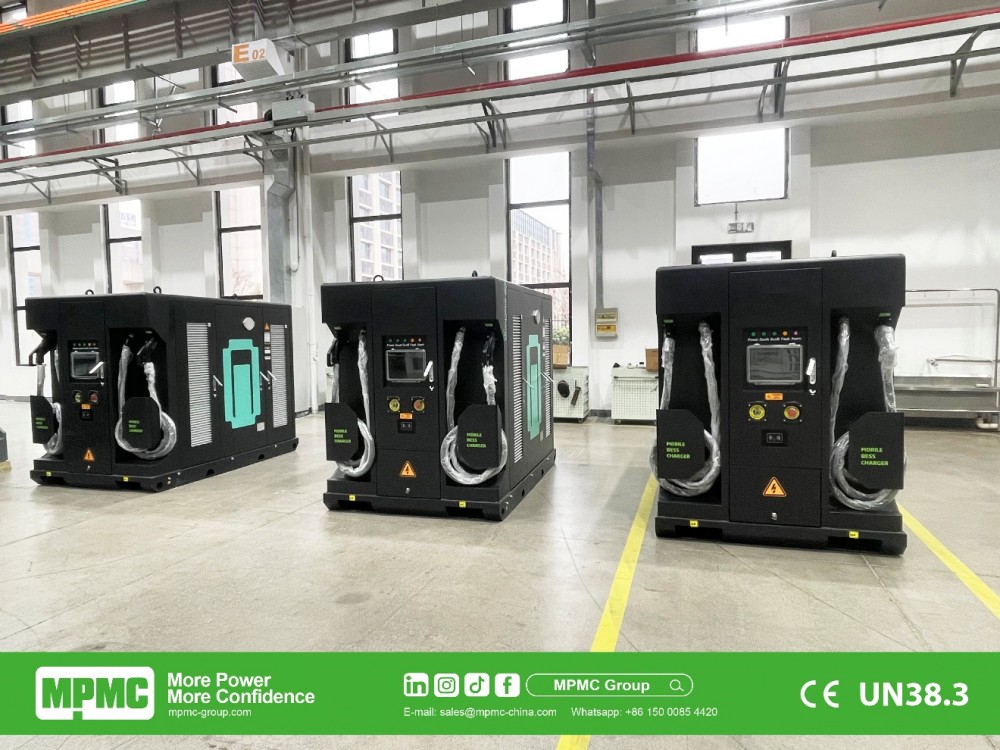 MPMC BCH-275-200 mobile BESS charger
Proven in European Charging Projects
Netherlands: Solar-Storage and Logistics Charging
In the Netherlands, MPMC has delivered a 1 MWh grid-connected solar-storage EV charging station built on a 500 kW, 1,000 kWh BCH integrated unit, and a renewable-powered port and logistics charging installation combining a BCH-275-200 with a BCH-500-1000. Both show the BCH working alongside an existing grid connection, which is exactly how most service areas and truck stops add charging capacity. Combining a smaller and a larger BCH on one site also shows how operators can build out in stages, starting with baseline capacity and adding high-power units as electric HGV traffic grows.
UK: Electric Trucks at a Logistics Port
At a UK logistics port, eight BCH-275-200 units bypassed a weak local grid that had forced 10-hour charging cycles for trucks running four-hour port routes, moving the operation to near-continuous charging. The same principle applies on freight corridors, where battery-buffered charging keeps electric HGVs moving and protects delivery schedules for the hauliers who rely on each stop.
The environmental case is just as clear. MPMC's UK data shows a BCH-275-200 delivering 3,457 kWh in place of 976 litres of diesel from an equivalent generator, with that single unit saving at least 37.5 tonnes of CO2 a year, a figure operators can use in their own sustainability reporting.
Live Within 24 Hours and Movable With Demand
Each BCH reaches full operational status within 24 hours of arrival, with no lengthy civil works. The BCH-275-200 travels on a 3.5-tonne trailer and the BCH-500-1000 in a 20-foot container, so operators can add capacity ahead of holiday traffic peaks, trial charging at a new location, or move units between sites as HGV traffic grows on different routes. Container loading is efficient too, with four BCH-275-200 units fitting in a 20-foot container for delivery to European ports.
Billing, Monitoring and Revenue Tools Included
Every BCH charging model has an EMS with 4G connectivity, OCPP 1.6 and an open, cloud-ready API, with optional RFID payment integration and full remote monitoring and command via Ethernet. Integrated SCADA and EMS automate energy management to keep staffing costs low, and pairing a BCH with solar PV turns on-site solar generation into high-value charging revenue. Because the BCH supports premium pricing where drivers value immediate access to high-power charging, operators can build a strong business case from the very first units.
Table 2. How the BCH Series supports service-area and corridor operators
| Operator requirement | BCH capability | Benefit to the operator |
|---|---|---|
|
Charging without a grid upgrade |
Battery buffer: e.g. 280 kW input to 400-600 kW output |
High-power HGV charging from the existing connection |
|
Mixed car and truck traffic |
Dual CCS2 guns, DC 50-1,000 V; CCS2/MCS standards |
One bay serves every vehicle class |
|
Fast capacity additions |
Full operation within 24 hours; trailer or container formats |
Capacity in place for seasonal and traffic peaks |
|
Billing and roaming |
OCPP 1.6, open API, optional RFID payment |
Connects to existing charge management and billing |
|
Remote operation |
4G EMS, SCADA, remote command |
Low staffing cost and high availability |
|
Renewable energy use |
Solar PV input with PV synergy revenue model |
Higher margin per kWh delivered |
Checklist: Planning Charging for a Service Area or Truck Stop
• Map peak demand from cars and HGVs, including holiday and weekend traffic
• Confirm the grid capacity available at the site today
• Choose BCH models whose battery buffer lifts available power to peak demand
• Plan the number of CCS2 guns needed for simultaneous charging
• Connect the units to your charge management platform via OCPP 1.6
• Decide on RFID payment or your existing billing system
• Consider solar PV to increase the margin on each kWh
• Contact MPMC at sales@mpmc-china.com or WhatsApp +86 150 0085 4420 for a corridor proposal
Questions Service Area and Truck Stop Operators Ask
Yes. MPMC's Netherlands projects run BCH units alongside the grid, with the battery covering peak charging so the connection supplies a steadier average load.
Each BCH reaches full operational status within 24 hours of arrival, so operators can add capacity in time for holiday peaks and new HGV routes.
Yes. The BCH-500-1000 and BCH-800-600 deliver 500 kW and 600 kW through dual 350 A CCS2 guns with a 50-1,000 V output range, serving cars and heavy goods vehicles from the same unit.
The battery stores energy from a steady grid supply and releases it at high power when vehicles arrive; for example, the BCH-800-600 draws 280 kW and delivers up to 600 kW of charging.
Yes. BCH units are trailer-mounted or containerised and reach full operation within 24 hours, so operators can move capacity to wherever demand is growing.
Recent Posts




Contact US
Product Information
Quantity
Unit
Piece
Support order samples, customization, wholesale direct, and complete payment. If the product you look for does not have corresponding customized content, pls fill out the form below to contact us, and we will reply ASAP.