


Language
Which Hybrid Power Solution Suppliers Suit Remote Island Microgrids?
Aug 12, 2026
Island microgrid projects rarely fail because a component underperforms. They fail at the joins, where equipment from different suppliers has to behave as one system and nobody owns the result.
That makes the supplier question less about product quality than about where the integration boundary sits, and who stands behind performance once the boundary is crossed.
Six Elements, and Who Normally Supplies Them
| Element | Function | Usual source |
|---|---|---|
|
Base generation |
Continuous supply and network stability |
Generator set manufacturer or packager |
|
Renewable generation |
Daytime energy offset |
PV supplier or EPC |
|
Energy storage |
Load shifting, transient absorption, voltage and frequency support |
Battery system manufacturer |
|
Power conversion |
Interface between DC, AC and the network |
PCS manufacturer, often bundled with storage |
|
Dispatch control |
Deciding what runs when |
EMS or SCADA vendor, sometimes the EPC |
|
Communications |
Remote monitoring and diagnosis |
Integrator or telecoms provider |
A project sourcing all six separately has five interfaces to manage and no single party responsible for whether the system meets its fuel-saving target.
Where Multi-Supplier Projects Come Apart
Dispatch logic nobody owns
The generator supplier optimises for engine protection. The battery supplier optimises for cycle life. The PV supplier optimises for yield. Without one party owning the dispatch rule, the default behaviour is conservative, and conservative means running the engine.
Protection coordination
Fault levels change when a battery is present, and again when it is grid-forming. Protection settings have to be coordinated across equipment from different origins.
Commissioning sequence
Each supplier commissions its own scope and leaves. The system-level behaviour is tested by whoever remains, which on an island is often the client.
Performance responsibility
When fuel consumption exceeds the projection, every supplier can demonstrate that its equipment met specification. The gap is real and nobody is contractually inside it.
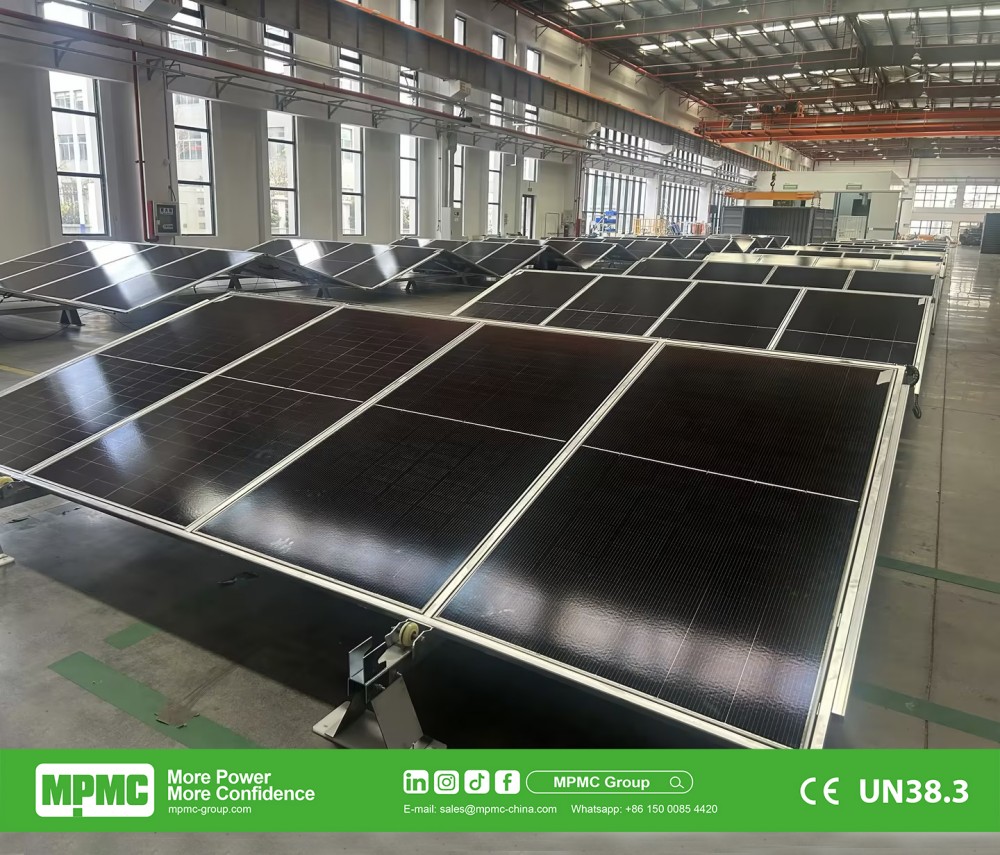 MPMC SPK Series mobile solar plant. Documented range from 7.65 kWp to 231.84 kWp with automatic or manual deployment.
Single-Supplier and Multi-Supplier Delivery Compared
| Consideration | Single supplier across the stack | Multiple specialist suppliers |
|---|---|---|
|
Dispatch responsibility |
Held by one party |
Requires an integrator or falls to the client |
|
Component optimisation |
Constrained to that supplier’s range |
Best-in-class selection per element |
|
Commissioning |
One mobilisation, system-level testing |
Sequenced visits, interface testing often informal |
|
Spare parts |
One channel, one lead time |
Multiple channels with differing lead times |
|
Commercial leverage |
Concentrated |
Diluted across contracts |
|
Performance guarantee |
Achievable at system level |
Difficult to obtain across boundaries |
Neither column is correct in general. What matters is that the choice is made deliberately, and that if the multi-supplier route is taken, the integration role is contracted to somebody explicitly.
MPMC’s Stack, Element by Element
| Element | MPMC’s documented product | Documented range |
|---|---|---|
|
Base generation |
Containerised diesel, gas, methanol and biofuel generator sets |
800 to 3,750 kVA single-engine; 1,250 to 3,000 kVA twin-engine; 1,600 kVA four-engine |
|
High-voltage generation |
MCLS2000H(S)-1 |
2,000 kVA prime at 10 to 11 kV, Cummins QSK50-G17 with LEROY SOMER LSA 53.2 VL7 |
|
Renewable generation |
SPK Series mobile solar plants |
SPK-8A at 7.65 kWp through SPK-240 at 231.84 kWp |
|
Bulk storage |
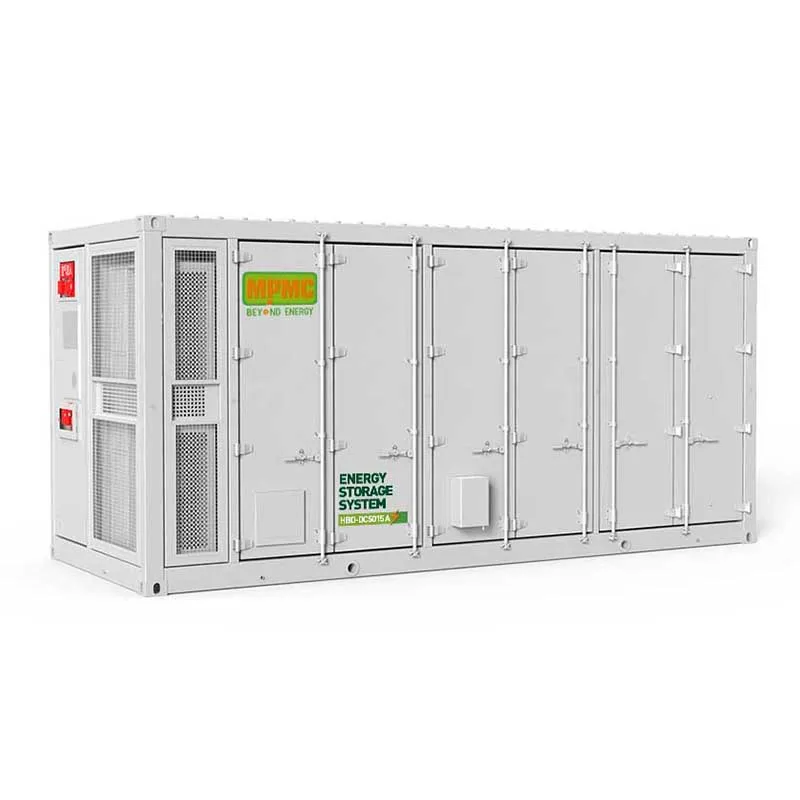
HBD-A Series |
125 kW to 1,125 kW; 261 kWh to 2,170 kWh; 5,015 kWh DC-coupled |
|
Mobile storage |
HBD-R Series |
30 kW to 610 kW; 61.44 kWh to 610.6 kWh |
|
Distributed hybrid units |
GSB Series hybrid power stations |
10 to 120 kVA maximum output; 20.4 to 112.5 kWh battery; 2,375 W integrated solar |
|
Dispatch and monitoring |
Self-developed EMS and SCADA |
Multi-source optimisation with weather forecasting; SL3 cybersecurity; 10-year data retention |
|
Communications |
Starlink satellite backup |
Listed as a backup link within the SCADA platform |
The control layer is the element that determines whether the rest performs. MPMC states EMS objectives as maximising PV generation efficiency, minimising diesel runtime and maximising storage response flexibility, with supported modes covering PQ, VF, VSG, black start and grid-forming.
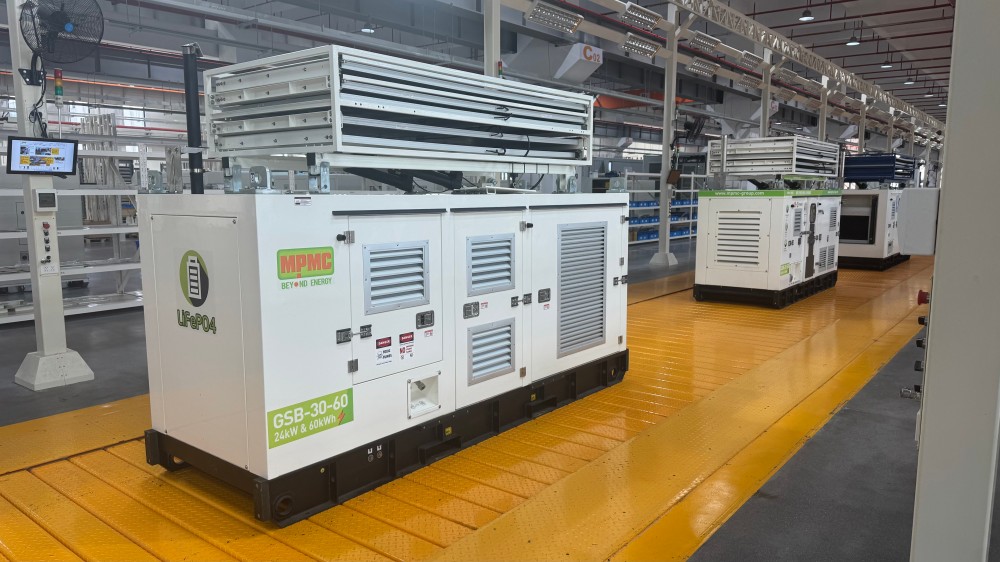 MPMC GSB Series hybrid power stations. Solar, generator set and battery in one mobile unit, 10 to 120 kVA maximum output.
Reading the Kenya Reference for What It Says About Delivery
MPMC publishes a four-site microgrid in Kenya at 6 MW combined. The configuration is worth reading as evidence about integration rather than about products.
Each site is listed with more than 1 MW of PV, at least 1 MWh of DC-coupled storage at 80% depth of discharge and 6,000 cycles with dual-unit redundancy, and 2 × 500 kW plus 2 × 250 kW diesel generation. Control is listed as MPMC’s own SCADA and EMS with Starlink satellite backup communication, supporting PQ, VF, VSG, black start, grid-forming, intelligent generation dispatch and reactive power regulation.
Three things follow from that description.
The diesel capacity is roughly 1.5 MW against 1 MW of PV. The design does not attempt to reduce generation to a token amount, because extended low-solar periods and redundancy still have to be covered.
The storage is DC-coupled with dual-unit redundancy, which is a design decision about availability rather than about energy.
The control and communications are from the same supplier as the generation and storage, which places dispatch responsibility in one place.
MPMC’s published outcome for the project is stable 24-hour power in a high-ultraviolet, sandy and grid-fluctuating environment, with seamless solar to diesel switching and minimal on-site manpower. That is a project-specific result rather than a transferable figure.
Contracting Models and What Each Leaves With the Client
Supply only
The client or an EPC takes integration, commissioning and performance risk. Cheapest at order, most expensive when something is unclear.
Supply with commissioning
The supplier attends site and proves its own scope. Interface behaviour is still largely untested.
System delivery
The supplier is responsible for the configuration performing as described. MPMC’s published delivery scope for the 18 MW Indonesian biodiesel project covers design, manufacturing, testing and commissioning, which is closer to this model.
The Question to Ask First
Before comparing products, ask each supplier a single question: if fuel consumption after one year exceeds your projection by 20%, who investigates and who pays?
The answers will sort a shortlist faster than any specification comparison. A supplier that can answer clearly has thought about the system. One that redirects to component performance is offering equipment, which may be exactly what the project needs, provided somebody else has been contracted to own the whole.

Recent Posts


Contact US
Product Information
Quantity
Unit
Piece
Support order samples, customization, wholesale direct, and complete payment. If the product you look for does not have corresponding customized content, pls fill out the form below to contact us, and we will reply ASAP.