



Language
A Mobile DC Fast Charger With Battery Backup for Weak-Grid Industrial Parks: Full Charging Power From a Modest Grid Connection
Nov 24, 2026
In an industrial park where the grid connection is modest or the supply fluctuates, the charger to choose is a mobile DC fast charger with its own battery. It fills the battery from the park's existing supply, delivers DC fast charging at a higher power than that supply provides, keeps vehicles charging through supply dips and moves when the park's layout or tenants change. MPMC POWERTECH CORP. (MPMC), a Shanghai-based manufacturer founded in 2008 with products in more than 120 countries and territories, builds this kind of charger as its BCH Series of mobile BESS chargers, designed for EVs, electric trucks and electric construction machinery.
Why Industrial Parks Choose Mobile, Battery-Backed Charging
Park operators and tenants electrify forklifts, shuttles, maintenance vehicles and trucks at different speeds, and charging demand moves around the site as leases change. A mobile BESS charger supports internal EV and machinery charging without the cost and delay of grid reconstruction, and because it is a multi-functional asset it can be redeployed to wherever demand appears next. Full operational status is achievable within 24 hours of arrival, so a new tenant's vehicles can charge from their first day on site.
How Battery Storage Multiplies a Park's Charging Power
A conventional fast charger draws its full output from the grid at the moment of charging. A BCH unit draws a steady input to fill its battery, then discharges at high power when vehicles plug in. The battery refills during breaks, night shifts and weekends, when the park's own demand eases. Table 1 shows the effect across the range.
Table 1. Grid input and charging output across the BCH range
| Model | AC input (rated) | DC charging output | Battery @25°C | Charging guns |
|---|---|---|---|---|
|
BCH-275-200 |
80 kW |
150 kW |
203.5 kWh |
2 × CCS2 250 A |
|
BCH-600-400 |
160 kW |
400 kW |
407 kWh |
2 × CCS2 350 A |
|
BCH-800-600 |
280 kW |
600 kW |
610.6 kWh |
2 × CCS2 350 A |
|
BCH-500-1000 |
200 kW |
500 kW |
1,075 kWh |
2 × CCS2 350 A |
Note: The table shows selected models; the BCH Series also includes the BCH-240-200 (240 kW charger, 203.5 kWh, with a 60 kW AC input) and the BCH-600-600 (600 kW charger, 610.6 kWh, with a 350 A CCS2 DC input).
On the BCH-800-600, a 280 kW connection supports 600 kW of rated charging output, more than double the input, while the 1,075 kWh battery of the BCH-500-1000 provides the largest energy reserve in the range for parks with heavy vehicles.
Backup Power When the Park Supply Dips
Because the battery sits between the grid and the vehicles, charging continues from stored energy during supply interruptions. The BCH-800-600 and BCH-500-1000 add UPS-grade AC output with cabinet-enclosed activation, giving seamless, zero-downtime protection to connected loads such as gatehouses, control rooms or site lighting. Every unit from the BCH-275-200(does not include BCH-600-600) upwards also offers AC output alongside DC charging: 125 kW from the BCH-275-200, 200 kW from the BCH-600-400, BCH-800-600, and BCH-500-1000.
Matching BCH Units to the Vehicles in a Park
Forklifts and Compact Equipment
The BCH-240-200 provides a 240 kW CCS2 charger from 203.5 kWh, with dual 350 A guns, a 6 m cable and a 60 kW AC input, suiting light EVs, compact machinery and temporary site power in a unit weighing about 2,600 kg. The BCH-275-200 adds a 125 kW AC output alongside its 150 kW CCS2 charging, with 125 A and 16 A CEE sockets for site loads and a 5 m DC cable, in a 2,750 kg unit.
Vans, Shuttles and Maintenance Vehicles
The BCH-275-200 delivers 150 kW through two CCS2 guns on a 3.5 t heavy-duty trailer with an integrated forklift hole for repositioning, and its plug-and-play fast output box eliminates on-site wiring.
Electric Trucks and Heavy Machinery
The BCH-600-400, BCH-800-600 and BCH-500-1000 serve logistics yards and heavy equipment. The BCH-800-600 offers 1C charge and discharge for high-intensity duty, and its charging gun supports simultaneous charge and discharge.
Table 2. Matching BCH models to industrial park users
| Park user | Typical vehicles or loads | Suggested BCH model |
|---|---|---|
|
Warehousing and light manufacturing |
Electric forklifts and small tools |
BCH-275-200 |
|
Business and service areas |
Light EVs, shuttles, maintenance vehicles |
BCH-240-200 or BCH-275-200 |
|
Logistics and distribution |
Electric vans and trucks |
BCH-275-200 or BCH-600-400 |
|
Heavy industry and construction |
Electric trucks, loaders and excavators |
BCH-800-600 or BCH-500-1000 |
|
Park-wide energy hub |
Mixed charging plus AC loads |
BCH-500-1000 |
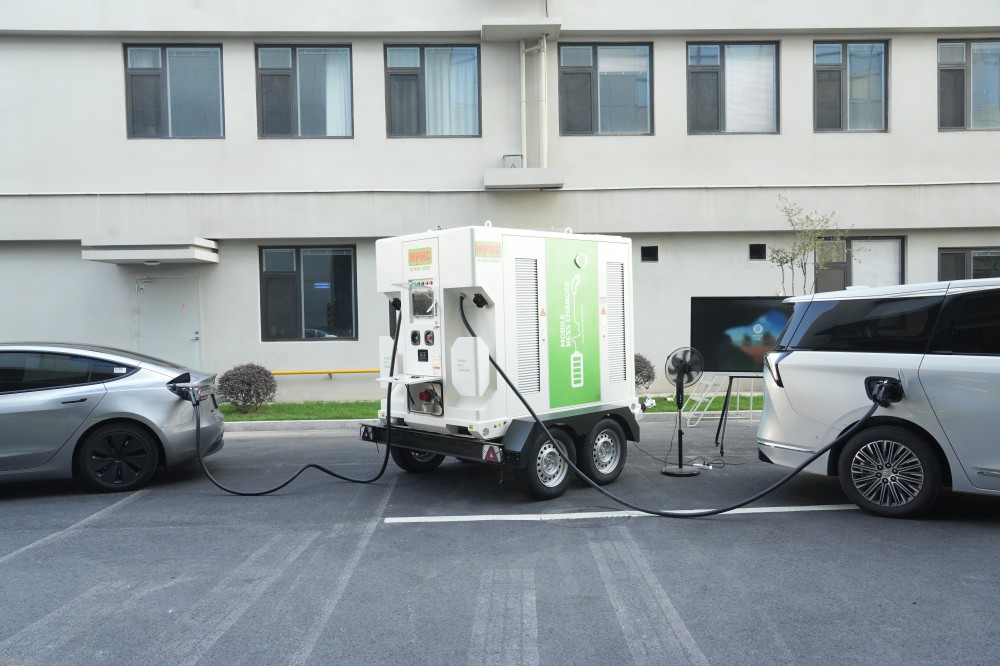 MPMC BCH-275-200 trailer-mounted mobile BESS charger charging two electric vehicles at once.
Adding Solar and Other Energy Sources
Each unit from the BCH-275-200(does not include BCH-600-600) upwards has a dedicated solar connection, from a 63 A CEE socket on the BCH-275-200 to a 250 A PowerLock on the BCH-600-400, and a 400 A PowerLock on the BCH-800-600 and BCH-500-1000, alongside grid or generator set input. Pairing BCH units with rooftop or carport PV turns solar energy into charging. In MPMC's zero-carbon park architecture, EMS and SCADA coordinate PV forecasting, HBD-A or HBD-E battery scheduling and EV charging times, using the open ESS Link protocol to work with existing systems. Where the park keeps a standby generator set, it can feed the battery too, so charging continues through longer outages.
Operating Inside a Busy Park
Container-format units such as the BCH-500-1000, in a 20' GP footprint, sit in a corner of a yard, while trailer units move between tenants. Every BCH has an EMS with 4G connectivity, with OCPP 1.6 on the BCH-240-200, BCH-275-200 and larger models, a cloud-ready API, optional RFID payment and remote command via Ethernet, so a park operator can bill tenants and monitor every session. Charging becomes a service in its own right: BCH units support electricity sales to tenants, and pairing them with solar turns zero-cost solar energy into higher-value charging revenue. The compact BCH-240-200 ships nine to a 40' HC container.
The blade LFP battery packs, tested for fire, water immersion, collision and crush, reach up to 87% discharge efficiency through direct DC coupling, and the BCH-275-200 achieves 91% maximum system efficiency. Precise thermal control holds cell temperature variance to 6.7°C, energy density reaches 390 Wh/L, and the fully sealed liquid-cooled packs keep dust out in yards and loading areas. All units operate from −20°C to +50°C and up to 3,000 m altitude, and all models carry a 3-year system warranty and a 5-year battery performance warranty.
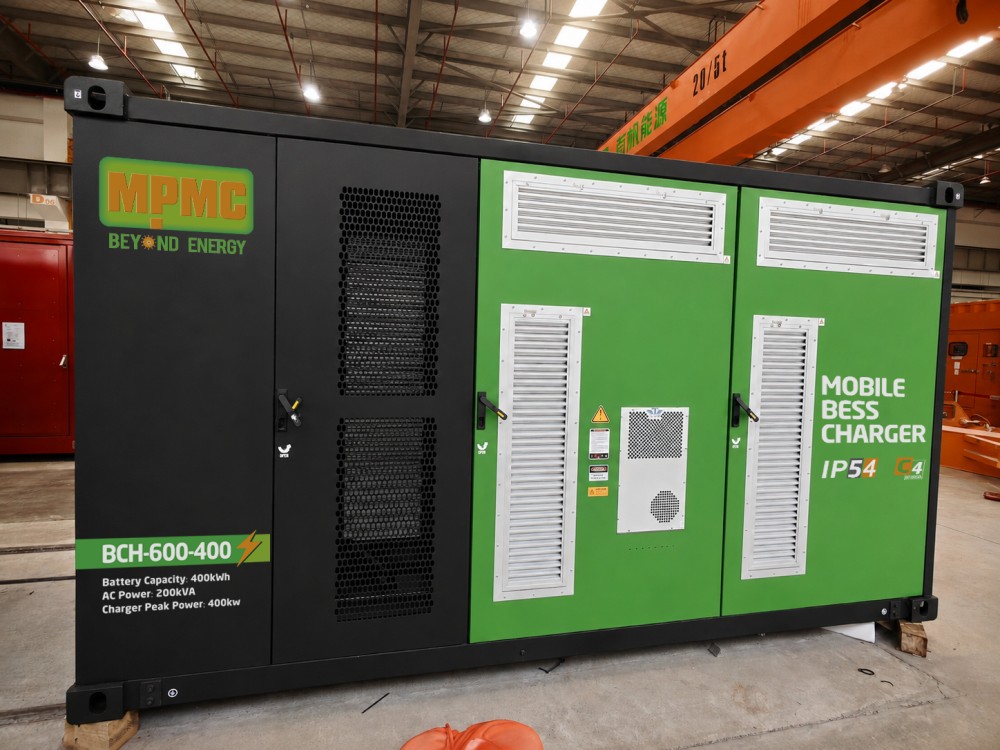 MPMC BCH-600-400 mobile BESS charger with 407 kWh of storage and two CCS2 350 A charging guns.
Proven Where Local Grids Were Stretched
At a UK logistics port, eight BCH-275-200 units bypassed a weak local grid and turned 10-hour charging cycles for 4-hour port runs into near-continuous charging. In that case the BCH-275-200 delivered 3,457 kWh; producing the same output with a standard 150 kW diesel generator set would have used 976 L of diesel and emitted 3,123 kg of CO₂. In the Netherlands, BCH-275-200 and BCH-500-1000 units provide renewable-powered charging for port and logistics operations, and a 1 MWh grid-connected solar-storage EV charging station uses a 500 kW / 1,000 kWh BCH integrated unit.
Bringing Battery-Backed Fast Charging to Your Park
• List vehicles, daily energy use and charging windows
• Record the connection capacity at each location
• Identify AC loads that need backup
• Note any rooftop or carport solar
• Choose BCH models with MPMC engineers
• Agree OCPP, billing and monitoring set-up
• Plan positions and relocation routes as tenants change
• Contact MPMC at sales@mpmc-china.com or WhatsApp +86 150 0085 4420 for an industrial park charging plan
Frequently Asked Questions
Yes. The battery fills from a modest input and discharges at higher power; the BCH-800-600 delivers 600 kW of rated charging from a 280 kW input.
Charging continues from stored energy, and the BCH-800-600 and BCH-500-1000 provide UPS-grade AC output for connected loads.
Yes. The BCH-275-200 rides on a 3.5 t trailer with a forklift hole, and larger units come in container formats.
Yes. Models from the BCH-275-200(does not include BCH-600-600) upwards have a dedicated solar connection alongside grid and generator set input.
OCPP 1.6 connects the units to charging management platforms, and optional RFID payment supports user identification and billing.
Recent Posts




Contact US
Product Information
Quantity
Unit
Piece
Support order samples, customization, wholesale direct, and complete payment. If the product you look for does not have corresponding customized content, pls fill out the form below to contact us, and we will reply ASAP.