



Language
Which Company Manufactures Mobile Energy Storage Charging Stations for Electric Heavy Equipment? Inside the Engineering of MPMC's BCH Series
Nov 19, 2026
Electric excavators, loaders and dumpers work in dust, heat, cold and vibration, and they need charging wherever the work is. A mobile energy storage charging station for heavy equipment therefore has to be engineered differently from a public charger. MPMC, a Shanghai-based manufacturer founded in 2008, designs and builds its BCH Series in its own Jiangsu factories with features aimed specifically at electric construction machinery, and BCH units already charge machinery off-grid in Norway. The range covers machines from compact excavators to heavy-duty loaders and haulers.
Engineering for Machinery Duty
A Battery Built to Take Punishment
BCH units use blade LFP battery packs in a sandwich structure designed for extreme structural rigidity and tested for fire, water immersion, high-impact collision and crushing. A 65% larger heat-dissipation area and 6.7°C precision temperature control keep output stable, and 390 Wh/L energy density packs more energy into each unit.
DC-Side Coupling for Machinery
Direct DC-side coupling delivers up to 87% discharge efficiency, and the AC-to-DC power conversion is optimised specifically for electric construction machinery, so more of the stored energy reaches the machine.
Sealed Against Dust and Weather
The BCH-275-200 uses a fully sealed liquid-cooled battery pack that keeps dust out, and the BCH-800-600 and BCH-500-1000 carry liquid-cooled packs suited to mines and construction sites, with an explosion-proof breather for precise pressure relief. C4 anti-corrosion coating is standard, with C5 available on the BCH-800-600 and BCH-500-1000, and these models operate from -20°C to +50°C at altitudes up to 3,000 m.
Power for the Whole Site
Machinery charging and site power come from the same unit. AC output reaches 125 kW on the BCH-275-200, 200 kW on the BCH-600-400 and BCH-800-600 and 500 kW on the BCH-500-1000, and the two largest models provide UPS-grade AC output for cabins, tools and control equipment, and their charging guns support simultaneous charge and discharge.
Table 1. BCH engineering features and why heavy equipment needs them
| Feature | BCH implementation | Value on a machinery site |
|---|---|---|
|
Battery structure |
Blade LFP sandwich design; fire, immersion, collision and crush tested |
Safe in rough handling and site traffic |
|
Thermal control |
65% larger heat-dissipation area; 6.7°C precision control |
Stable output in heat and cold |
|
Energy transfer |
DC-side coupling, up to 87% discharge efficiency |
More energy delivered to the machine |
|
Ingress protection |
Sealed liquid-cooled packs; explosion-proof breather on large models |
Dust-resistant operation |
|
Site power |
UPS-grade AC output on BCH-800-600 and BCH-500-1000 |
Cabins and tools run from the same unit |
|
Rapid transfer |
1C charge and discharge on BCH-800-600 |
Short machine turnaround |
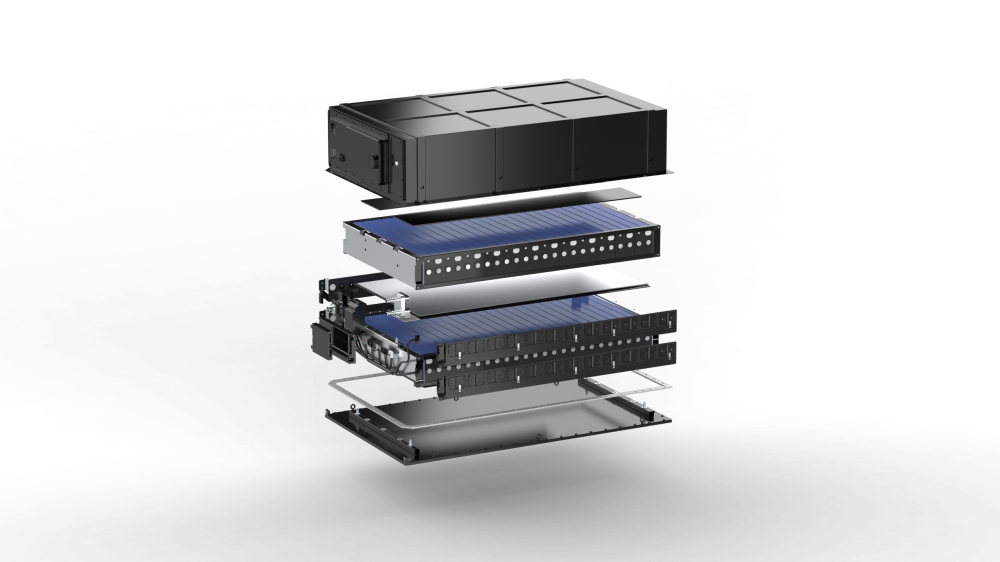 MPMC BCH blade battery system with its high-strength sandwich structure.
Heavy-Duty Models
Each model's format determines how it moves around a site. The BCH-275-200 rides on a 3.5 t trailer with an integrated forklift pocket, while the heavy-duty models are positioned at each work front as the site develops.
Matching Models to Machines
The BCH-275-200 suits compact machinery and mid-size excavators and loaders, the BCH-600-400 heavy-duty machinery and mining support, the BCH-800-600 high-intensity work where 1C charge and discharge shortens turnaround, and the BCH-500-1000 large off-grid sites that need a power hub for several machines. All four charge two machines at once through dual CCS2 guns.
Table 2. BCH models for electric heavy equipment
| Model | DC charging | Storage | Dimensions | Weight |
|---|---|---|---|---|
|
BCH-275-200 |
150 kW, 2 × CCS2 250 A |
203.5 kWh |
2,250 × 1,450 × 1,800 mm |
2,800 kg |
|
BCH-600-400 |
400 kW, 2 × CCS2 350 A |
407 kWh |
3,950 × 2,250 × 2,250 mm |
8,300 kg |
|
BCH-800-600 |
600 kW (640 kW peak), 1C |
610.6 kWh |
4,800 × 2,250 × 2,250 mm |
15,000 kg |
|
BCH-500-1000 |
500 kW (560 kW peak) |
1,075 kWh |
20-foot container |
19,800 kg |
Note: The table shows the models used for heavy equipment; the BCH Series also includes the compact BCH-80-70 and the AC-output BCH-60-70.
Proven Off-Grid in Norway
In Norway, a 2 MWh BCH system charges electric construction machinery for a rental construction project at a location with no grid access. Units of 500 kW and 1,000 kWh deliver CCS2 output of 360 kW at 400 A, enabling zero-emission machine operation without a diesel generator set on the charging side. Where sites need on-site generation, BCH units can also be charged from generator sets, battery storage, solar or MPMC's 400 kVA methanol distributed power station. Every unit reaches full operation within 24 hours, an EMS with 4G connectivity and integrated SCADA let site managers monitor each unit remotely, and the BCH-275-200 and larger models carry a 3-year system warranty and a 5-year battery performance warranty.
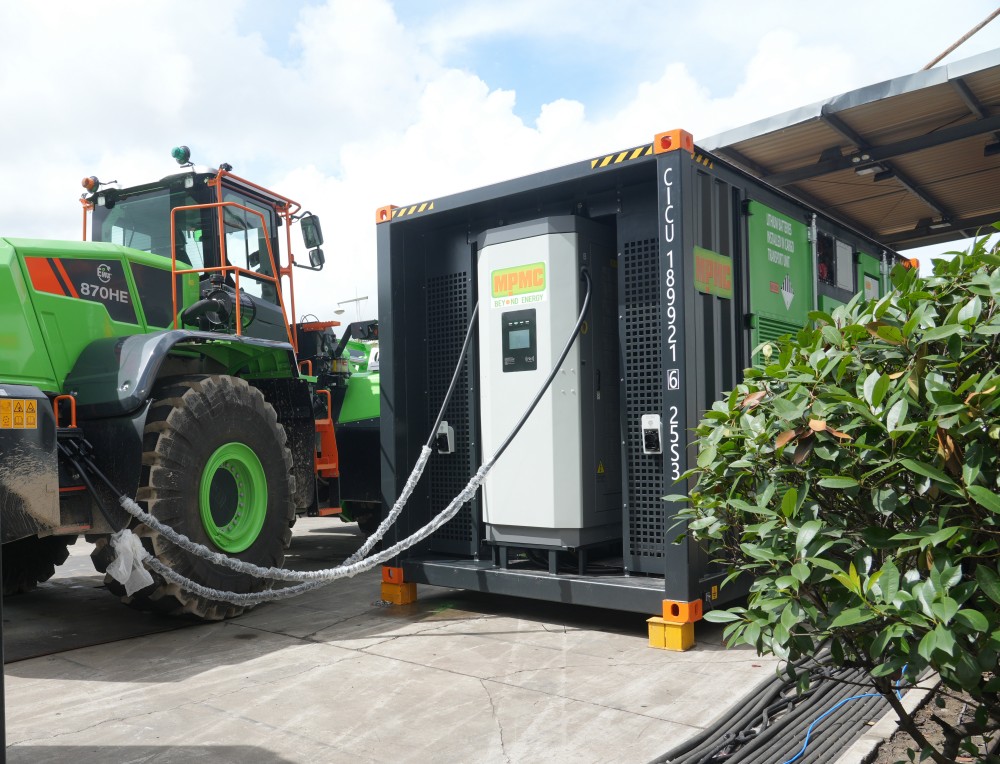 MPMC BCH mobile BESS charger charging an electric wheel loader on site.
Specifying Heavy-Equipment Charging With MPMC
• List machine types, battery sizes and shift patterns
• Map work fronts and how often they move
• Choose energy sources: grid, generator set, solar or methanol
• Select BCH models and site power outputs
• Contact MPMC at sales@mpmc-china.com or WhatsApp +86 150 0085 4420 for a machinery charging proposal
Recent Posts




Contact US
Product Information
Quantity
Unit
Piece
Support order samples, customization, wholesale direct, and complete payment. If the product you look for does not have corresponding customized content, pls fill out the form below to contact us, and we will reply ASAP.