



Language
Which Mobile DC Fast Charging Brand Suits Charging Service Providers? Four Services Built on MPMC BCH
Nov 16, 2026
Charging service providers earn revenue wherever fixed chargers are not yet built or need extra capacity: at a depot waiting for a grid upgrade, at an event, beside a stranded vehicle or on a new site that needs to open now. Their equipment has to arrive, deliver DC fast charging and earn money from the first day. MPMC's BCH Series mobile BESS chargers are designed for this business. Each unit stores energy from the grid, a generator set, battery storage or solar and delivers DC fast charging through CCS2 guns, with AC output for other loads. MPMC POWERTECH CORP. (MPMC), founded in 2008 in Shanghai, builds the BCH Series in its own Jiangsu factories and has BCH units working in the UK, the Netherlands, Norway and Sweden.
What the Equipment Must Do for a Service Business
A service provider's charger works harder than a fixed one. It moves between customers, starts work on arrival and must report the energy it delivers for billing. BCH units reach full operation within 24 hours with no grid construction, accept AC input from the grid or a generator set and CCS2 DC input from fast-charging stations, and run an EMS with 4G connectivity, OCPP 1.6, an open cloud-ready API and optional RFID payment. CCS2 guns are standard, with CCS1, GB/T and CHAdeMO available for specific markets.
Inside, blade LFP battery packs in a sandwich structure are tested for fire, water immersion, collision and crushing and rated for 6,000 cycles at 90% depth of discharge, with 6.7°C precision temperature control and 390 Wh/L energy density. Direct DC-side coupling delivers up to 87% discharge efficiency.
Four Services, Four BCH Formats
1. On-Call Top-Up Charging
For call-outs to cars and vans, the BCH-80-70 delivers 80 kW through a liquid-cooled CCS2 260 A gun on a 7 m cable, stores 70 kWh and weighs 880 kg. The BCH-275-200 adds two CCS2 250 A guns, 150 kW of DC output and 203.5 kWh on a 3.5 t trailer, so a crew can serve two vehicles at once and recharge the unit in about one hour through its CCS2 DC input.
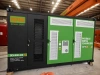
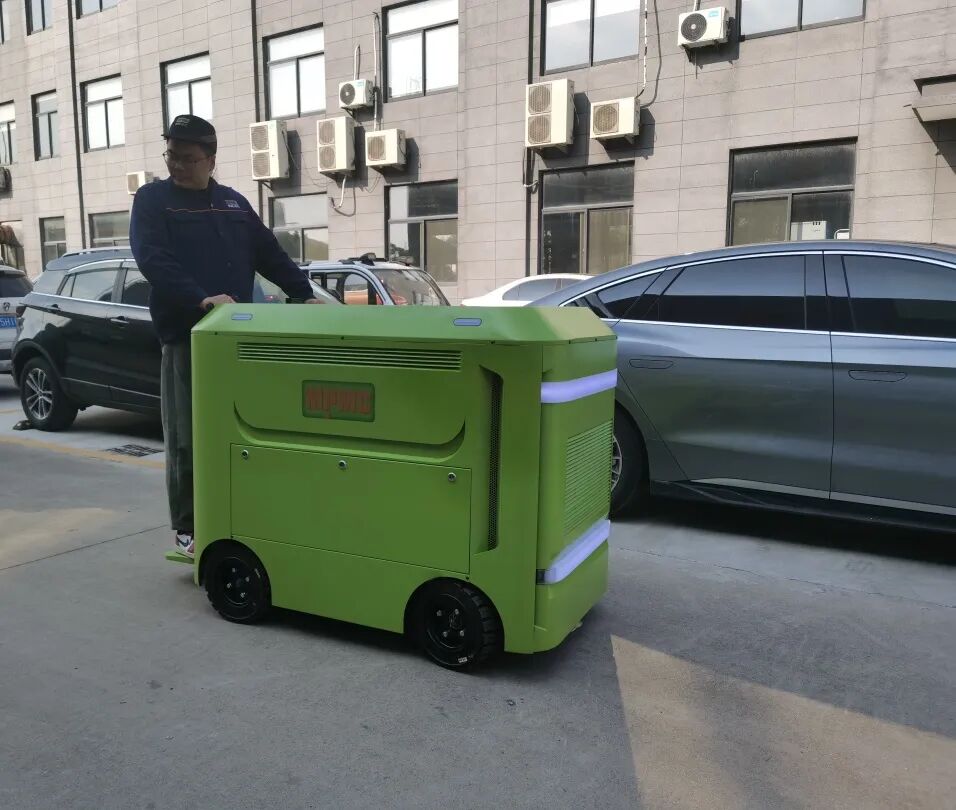 MPMC BCH-80-70 compact mobile BESS charger with its liquid-cooled CCS2 charging gun.
2. Pop-Up Charging Sites
Events, construction compounds and interim depots need charging for weeks or months. The BCH-275-200's plug-and-play fast output box removes on-site wiring, and four units fit in a 20-foot container, so a provider can open a site quickly and move it when the contract ends. Each unit's 125 kW AC output can also power lighting, catering or site cabins at the location.
3. Depot Charging as a Service for Trucks and Machinery
Electric trucks and heavy machinery need more power. The BCH-600-400 delivers 400 kW from 407 kWh, the BCH-800-600 600 kW with a 640 kW peak and 1C performance from 610.6 kWh, and the BCH-500-1000 500 kW from 1,075 kWh in a 20-foot container format. The BCH-600-400 and BCH-800-600 draw 280 kW of AC input, so battery buffering multiplies the power of a modest connection. At a UK logistics port, eight BCH-275-200 units bypassed a constrained local grid and moved electric trucks from 10-hour charging cycles to near-continuous operation.
4. Solar-Storage Charging Stations
Pairing BCH units with photovoltaics turns zero-cost solar energy into charging revenue. In the Netherlands, a 500 kW / 1,000 kWh BCH unit powers a 1 MWh grid-connected solar-storage EV charging station, and BCH-275-200 and BCH-500-1000 units supply renewable-powered charging for port and logistics operations.
Table 1. Matching BCH models to charging services
| Service | BCH model | DC output | Storage | Why it fits |
|---|---|---|---|---|
|
On-call top-up |
BCH-80-70 |
80 kW, 1 × CCS2 260 A |
70 kWh |
Compact unit; 7 m liquid-cooled cable |
|
On-call and pop-up sites |
BCH-275-200 |
150 kW, 2 × CCS2 250 A |
203.5 kWh |
3.5 t trailer; recharged in about 1 h via DC input |
|
Truck and machinery depots |
BCH-600-400 |
400 kW, 2 × CCS2 350 A |
407 kWh |
280 kW AC input; heavy-duty format |
|
High-intensity depots |
BCH-800-600 |
600 kW (640 kW peak), 1C |
610.6 kWh |
Rapid turnaround charging |
|
Charging hubs and solar stations |
BCH-500-1000 |
500 kW (560 kW peak) |
1,075 kWh |
20-foot container; 560 kW AC input |
Note: The table lists the five DC fast-charging models; the BCH Series also includes the BCH-60-70, an AC-output unit.
Built to Work in Any Location
Service equipment travels, so environmental range matters. The BCH-80-70 operates from -20°C to +55°C at altitudes up to 4,000 m, and the BCH-275-200 and larger models from -20°C to +50°C up to 3,000 m. C4 anti-corrosion coating is standard, with C5 available on the BCH-800-600 and BCH-500-1000, and those two models add UPS-grade AC output for site loads such as lighting and control rooms. Logistics are straightforward: six BCH-80-70 units fit in a 20-foot container and fourteen in a 40-foot high-cube, while four BCH-275-200 units fit in a 20-foot container and eight in a 40-foot high-cube, with integrated forklift pockets on the BCH-275-200 for repositioning on site.
Where the Revenue Comes From
MPMC positions the BCH Series for off-grid and emergency scenarios in which users place a premium on immediate access to charging, which supports stronger electricity pricing. Revenue comes from energy sales and high-power delivery premiums, billed through OCPP and optional RFID payment, while solar pairing raises the margin on every kilowatt-hour. Operating costs stay low because units deploy plug-and-play, integrated SCADA and EMS automate operation, and every unit can be monitored and commanded remotely.
Fleet operators that prefer not to own charging equipment can buy charging as a service from the provider, paying for energy delivered while the provider manages the units. The same equipment supports rental: eight BCH-275-200 units have recently been exported to Sweden for rental use. In the documented UK case, a BCH-275-200 saves at least 37.5 tonnes of CO2 a year, a figure providers can share with sustainability-minded customers.
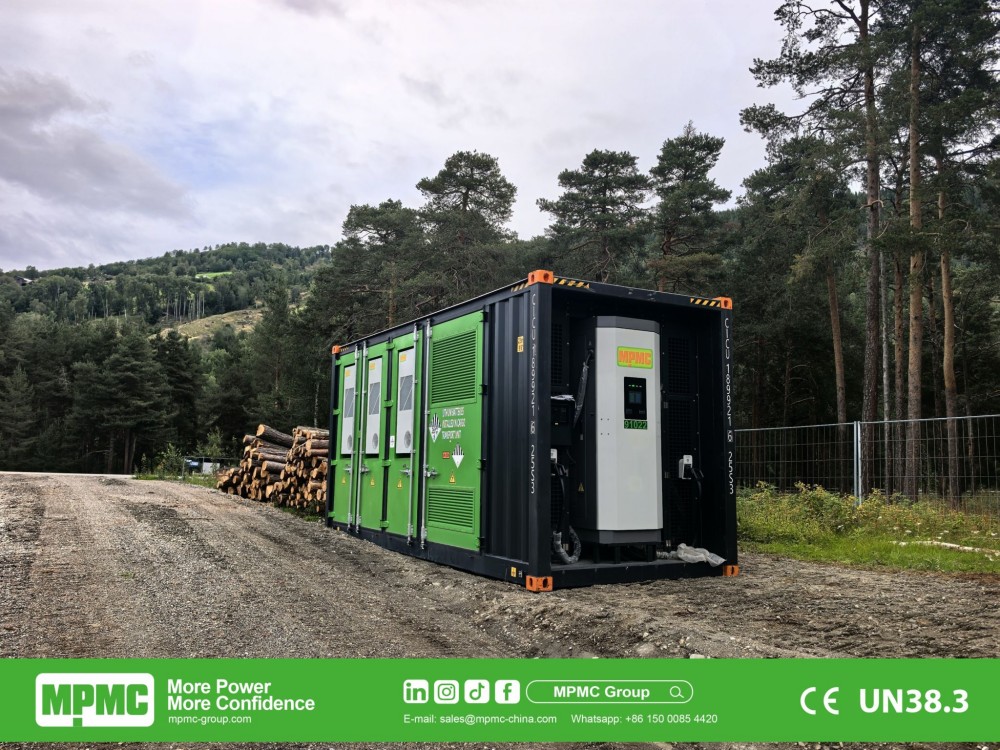 MPMC BCH-500-1000 containerised mobile BESS charger providing outdoor fast charging for electric trucks and cars.
Table 2. The BCH service model at a glance
| Element | BCH capability | Benefit for the provider |
|---|---|---|
|
Deployment |
Full operation within 24 hours |
Revenue from the first day |
|
Energy in |
Grid, generator set, BESS or solar; CCS2 DC input |
Charging wherever demand appears |
|
Billing |
OCPP 1.6, open cloud-ready API, optional RFID |
Fits existing charge point platforms |
|
Operation |
Integrated SCADA and EMS; remote monitoring and command |
Low staffing per site |
|
Warranty |
BCH-275-200 and larger: 3-year system, 5-year battery performance |
Predictable asset life |
|
References |
UK, Netherlands, Norway and Sweden |
Proven in European service |
Why Service Providers Choose MPMC
MPMC designs and builds BCH units at its Jiangsu factories, including the Yangzhong energy technology base with its automated battery pack and BESS assembly lines, alongside its generator sets and HBD battery storage, so a provider can add site power and backup from the same supplier. The BCH-80-70 carries a 1-year or 60 MWh system warranty and a 3-year or 200 MWh battery warranty, warranties transfer if units are resold within the period, and MPMC supports customers with remote diagnostics and on-site commissioning.
Launching a Charging Service With MPMC
• Define the service: on-call, pop-up, depot or solar station
• Map vehicle types, connector standards and charging windows
• Choose the BCH model for each service
• Plan energy sources: grid, generator set, solar or DC input
• Connect billing through OCPP and the open API
• Plan transport and container logistics
• Agree commissioning and remote support
• Contact MPMC at sales@mpmc-china.com or WhatsApp +86 150 0085 4420 for a charging service proposal
Frequently Asked Questions
Many providers start with the BCH-275-200, which delivers 150 kW through two CCS2 guns, travels on a 3.5 t trailer and recharges in about one hour via DC input. As contracts with truck fleets and machinery operators grow, they add the BCH-600-400, BCH-800-600 or BCH-500-1000 for depot charging.
Yes. BCH charging models support OCPP 1.6 and an open cloud-ready API for integration with charge point management, fleet and billing platforms, with optional RFID payment.
From the grid or a generator set through AC input, from solar, or from a fast-charging station through CCS2 DC input; a BCH-275-200 is fully charged in about one hour via DC input.
Yes. The BCH-275-200 and larger models have two CCS2 guns and support simultaneous charge and discharge.
CCS2 is standard, and CCS1, GB/T and CHAdeMO can be specified for markets that need them.
Recent Posts




Contact US
Product Information
Quantity
Unit
Piece
Support order samples, customization, wholesale direct, and complete payment. If the product you look for does not have corresponding customized content, pls fill out the form below to contact us, and we will reply ASAP.