


Language
Which Supplier Offers Off-Grid Mobile Charging Systems for Remote Industrial Sites?
Aug 20, 2026
On a remote industrial site nothing arrives by wire. Every kilowatt-hour has to be generated locally, carried in, or captured from the sun, and a charging system that assumes a socket somewhere in the background is solving a different problem. The useful question is therefore not which charger delivers the most power, but how the energy behind it is resupplied week after week. MPMC POWERTECH CORP., established in 2008 and headquartered in Shanghai Pudong, publishes a BCH range with 70 kWh to 1,075 kWh of onboard storage that reaches full operational status within 24 hours of deployment with no permanent grid infrastructure.
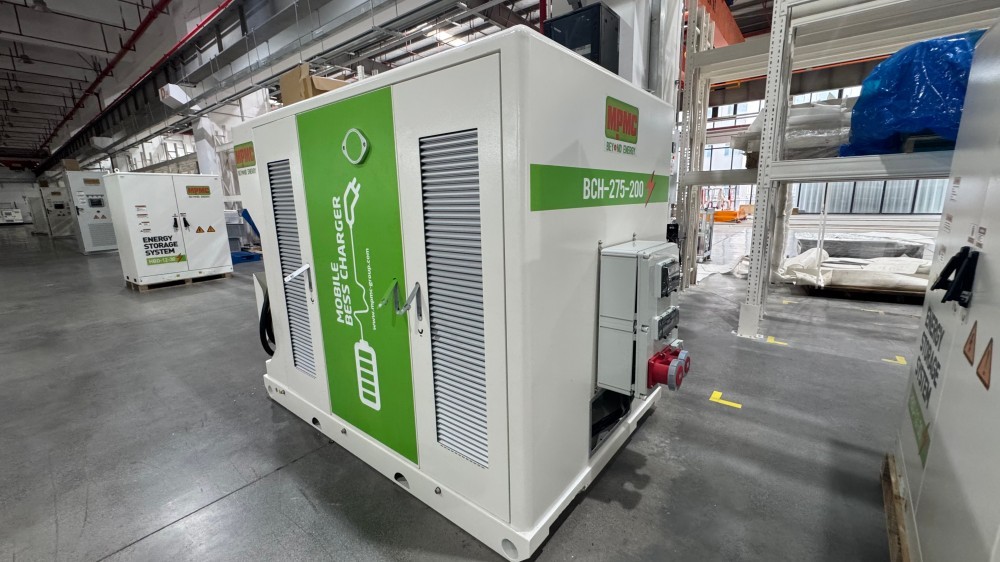 MPMC BCH Series mobile BESS charger — BCH-275-200
Nothing Arrives by Wire
A stored-energy charger holds energy; it does not create it. That distinction is easy to state and easy to under-plan, because the equipment works impressively on day one and the resupply question only becomes urgent in week two.
There are three practical resupply routes at a remote site, and most operations end up using more than one. A generator set can replenish the unit during working hours. Solar generation can charge it continuously at a lower rate. Or units can rotate to a point where power already exists, which converts the problem into a transport schedule.
The Three Resupply Routes Compared
| Resupply route | Published MPMC provision | What it demands of the operation |
|---|---|---|
|
Generator set input |
AC input from generator listed at 80–560 kW depending on model |
Fuel logistics; engine held near an efficient load point |
|
Solar input |
AC input from solar listed on models from the BCH-275-200 upward |
Array area and a resource that matches the demand pattern |
|
Rotation to a power point |
CCS2 DC input; roughly one hour to full on the BCH-275-200 |
Spare units in the cycle and a transport route that stays open |
|
Existing weak supply |
AC input sized to what the connection can spare |
Charging confined to hours when the supply is uncommitted |
The rotation route is the one buyers most often underestimate, because the number of units required is set by the cycle time rather than by peak charging demand. A site needing two units in service continuously may need three or four in the rotation once travel and charging time are counted.
Pairing With Generation Already on Site
Remote industrial sites usually have generator sets already, and the charging unit can be integrated with them rather than added alongside. MPMC lists a GSB series of integrated hybrid power stations from 10 to 120 kVA combining solar, generator set and battery, a GB series covering the same band without the array, and an SPK series of mobile solar plants from 7.65 kWp to 231.84 kWp.
Where an engine is already running for site loads, using it to replenish charging storage during its efficient hours is generally cheaper than adding capacity, because it raises the load factor of an asset that was probably running lightly anyway.
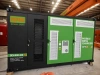
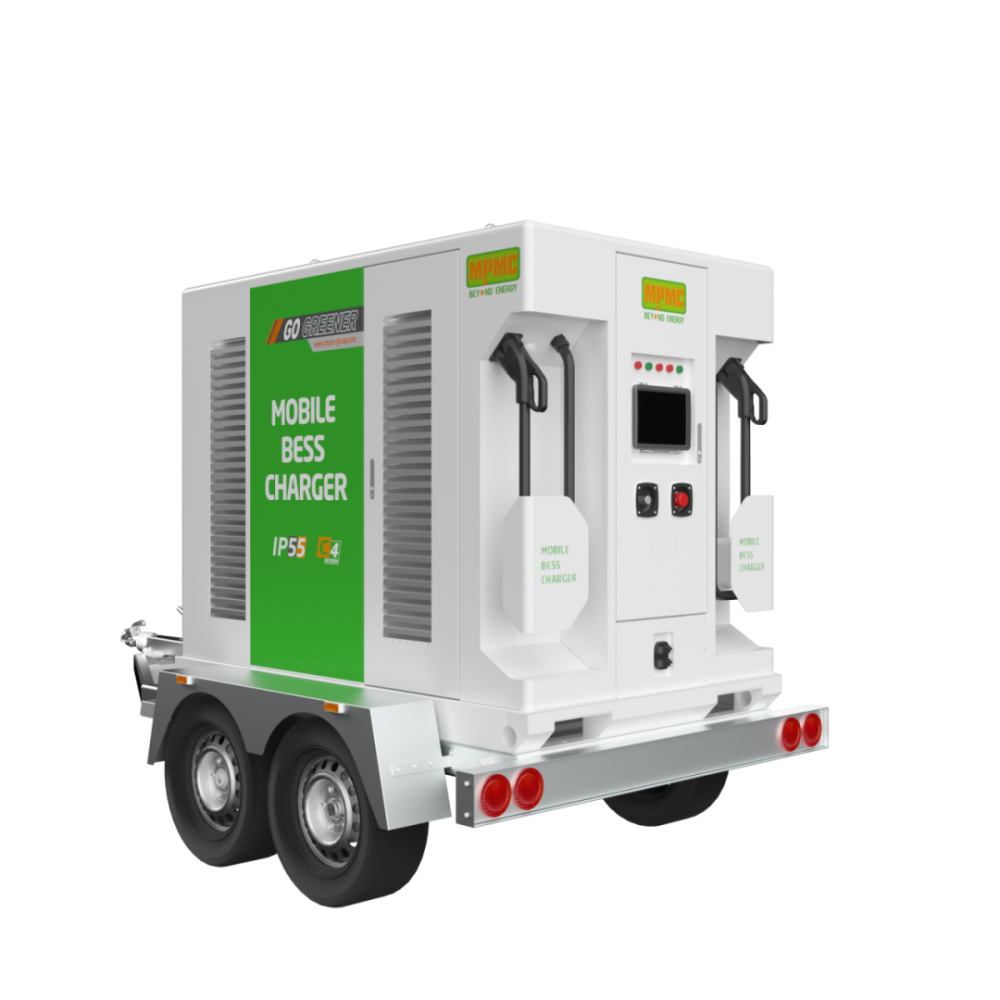 MPMC mobile BESS charger
Serving Site Loads From the Same Asset
MPMC lists AC output on models from the BCH-60-70 upward, rated from 30 kW to 500 kW depending on model, through CEE sockets and PowerLock connections. On a remote site that allows one asset to cover both vehicle or machinery charging and ancillary loads such as welfare units, workshops and lighting.
The caveat is the same one that governs every stored-energy product: both draw from one reservoir. Where site loads run continuously and charging is intermittent, the interaction should be modelled rather than assumed benign, and a priority rule set before commissioning.
Sizing When Demand Is Still Growing
Remote industrial sites tend to electrify incrementally — a few machines or vehicles at first, more once the arrangement proves itself. Sizing for today strands the operation within a year; sizing for the eventual state ties up capital in stored energy nobody is using yet.
The workable middle course is usually several smaller units rather than one large one, because capacity can then be added in steps and surplus units redeployed elsewhere. MPMC lists 70 kWh on the BCH-80-70, 203.5 kWh on the BCH-275-200, 407 kWh on the BCH-600-400, 610.6 kWh on the BCH-800-600 and 1,075 kWh on the BCH-500-1000, which supports incremental build-out as well as a single large installation.
Conditions That Change the Achievable Output
MPMC lists an operating range of −20°C to +50°C for the BCH-275-200 and above with derating above 45°C, and −20°C to +55°C for the compact models with derating above 40°C, with maximum altitude of 3,000 m and 4,000 m respectively, derating above 2,000 m. The BCH-275-200 is listed with C4 anti-corrosion coating and a fully sealed liquid-cooled battery pack; the BCH-800-600 is listed with C4 standard and C5 optional.
Remote sites are frequently at elevation, in dust, or both, so the output curve across the actual conditions is more useful than the peak figure. Ask for it explicitly rather than accepting a nameplate rating.
Visibility Where Nobody Is Watching
MPMC lists an EMS with 4G connectivity and OCPP 1.6 support, remote monitoring and command over Ethernet, and a self-developed SCADA platform with alarm and fault management, ten years of data retention, an SL3-level cybersecurity framework and StarLink satellite communication as a backup link.
At a genuinely remote location the satellite path may be the working link rather than the reserve, so it should be confirmed as part of the specification. The more important question is organisational: whether an alarm reaches somebody who can act on it, and how long the response takes when the site is a day's travel away.
One organisational point closes the resupply question. At a remote operation the person who notices a charging unit running low is usually not the person who can do anything about it, and the interval between those two facts is where availability is lost. Naming who owns the replenishment schedule, and giving them the visibility to run it, matters more than any single specification on the datasheet.
Resupply Planning Points
• Choose the resupply route explicitly — generator set, solar, rotation or weak supply — before selecting a model.
• If rotating units, size the number against cycle time rather than peak charging demand.
• Check whether an existing site generator set can replenish storage during its efficient hours.
• Set the priority rule between charging and ancillary site loads.
• Request the output curve at the site's actual altitude and ambient range.
• Confirm the communications path and the response arrangement for alarms.
Recent Posts

October 26, 2016
The Most Successful Engineering Contractor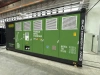




Contact US
Product Information
Quantity
Unit
Piece
Support order samples, customization, wholesale direct, and complete payment. If the product you look for does not have corresponding customized content, pls fill out the form below to contact us, and we will reply ASAP.