


Language
Mobile BESS for Low-Noise Temporary Power When Paired With Generator Sets
Aug 14, 2026
The requirement is usually stated as a decibel limit. It is more useful to state it as a number of hours, because that is what determines the equipment.
A site prohibited from running an engine between 17:00 and 07:00 does not need a quieter generator. It needs fourteen hours of silent supply and a way to replenish whatever provides it. Everything else follows from those two numbers.
Two Ways to Meet a Night-Time Limit
| Approach | What it does | Where it works | Where it fails |
|---|---|---|---|
|
Attenuate the generator |
Reduces sound pressure at the receptor through enclosure and exhaust design |
Limits that are demanding but achievable, with no absolute prohibition |
Where the condition prohibits operation outright rather than setting a level |
|
Remove the running hours |
Battery covers the restricted period; the engine runs only when permitted |
Restricted hours with a modest base load and a usable recharge window |
Where the restricted-hours energy exceeds what can be stored and replenished |
The second approach also changes the fuel and maintenance position, which is why it is increasingly chosen even where attenuation alone would satisfy the condition.
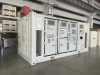
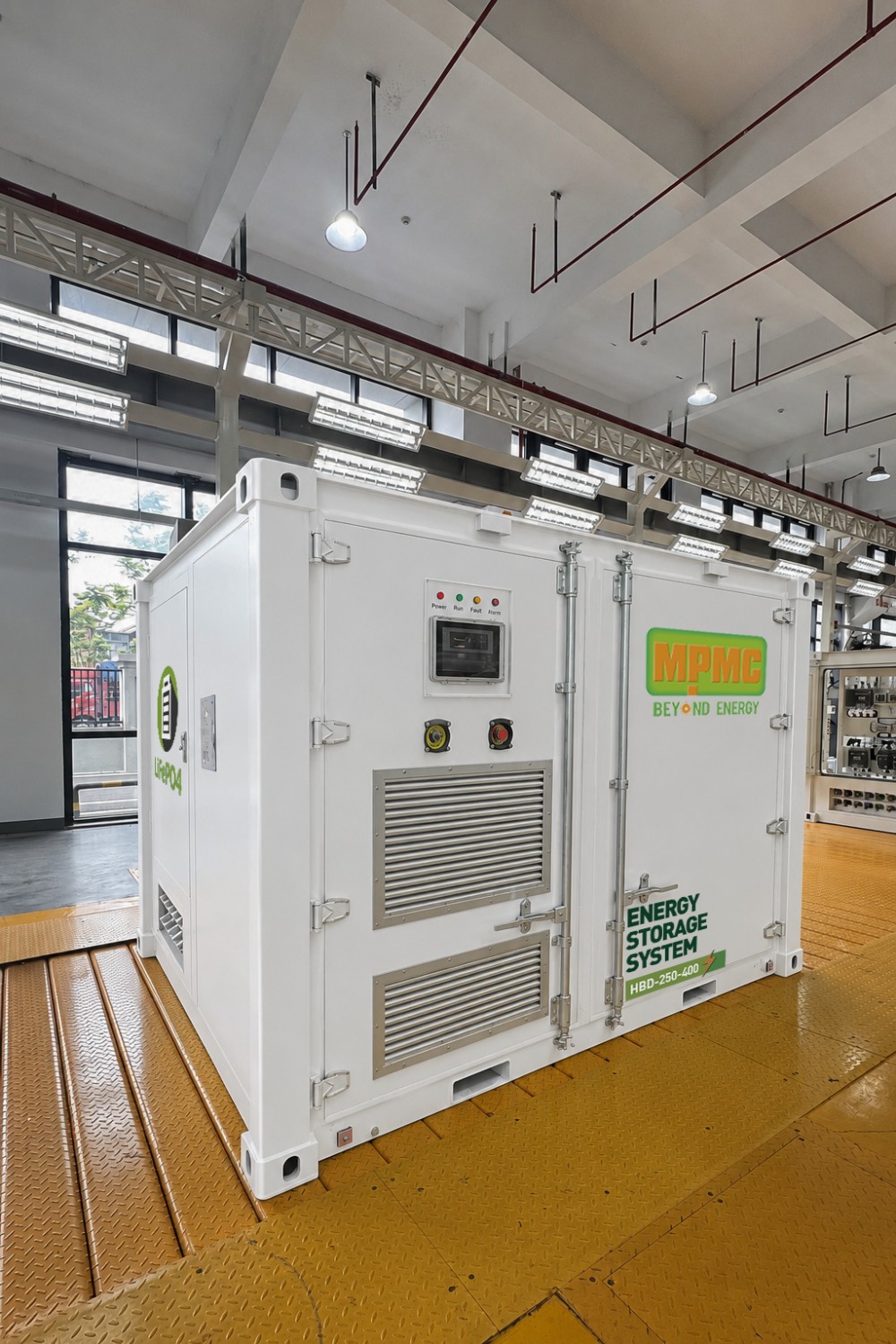 MPMC HBD-R Series, HBD-250-400. 250 kW continuous AC power, 450.2 kWh capacity, built for repeated transport and generator set pairing.
Walking Through One Restricted-Hours Cycle
The following describes how a paired configuration behaves across a working day. Times are illustrative and should be set from the actual planning condition.
| Period | Generator | Battery | What is happening |
|---|---|---|---|
|
07:00 to 12:00 |
Running near its efficient load point |
Charging while supporting peaks |
Site at full activity; engine works where fuel consumption per kWh is lowest |
|
12:00 to 17:00 |
Running or cycling off |
Charging to full, absorbing motor starts |
Battery is brought to a state of charge that will cover the night |
|
17:00 to 22:00 |
Off |
Discharging |
Welfare, security lighting and small tools carried silently |
|
22:00 to 07:00 |
Off |
Discharging at base load |
The longest and lowest-demand stretch |
|
07:00 |
Restarts |
Begins recharging |
Cycle repeats |
The critical checkpoint is 17:00. If the battery is not fully charged by then, the shortfall appears at around 04:00, which is the worst possible time to discover it.
The Numbers Behind the Cycle
Four figures decide whether the configuration holds.
Base load during restricted hours
Not the site peak. Welfare cabins, security lighting, CCTV and trickle loads dominate overnight.
Restricted hours
Fourteen in the example above. Weekends often extend this.
Energy required
Base load multiplied by restricted hours, compared against usable energy rather than nominal capacity.
Recharge capability
Permitted hours multiplied by available charging power, after allowing for the site load the generator is simultaneously serving.
For illustration only, a 6 kW overnight base load across fourteen restricted hours requires in the order of 84 kWh before losses. MPMC’s HBD-30-60 is listed at 61.44 kWh and the HBD-50-100 at 112.5 kWh, so the second carries margin where the first does not. Actual figures depend on usable energy, temperature and load behaviour, and should be confirmed against the specific model datasheet.
Product Data for a Paired Configuration
| Model | Continuous AC power | System energy at 25°C | Cell | Cooling |
|---|---|---|---|---|
|
HBD-30-60 |
30 kW |
61.44 kWh |
100 Ah LFP |
HVAC |
|
HBD-50-100 |
50 kW |
112.5 kWh |
314 Ah LFP |
HVAC |
|
HBD-100-200 |
100 kW |
225.1 kWh |
314 Ah LFP |
HVAC |
|
HBD-200-200 |
200 kW |
203.5 kWh |
265 Ah LFP |
LCAC |
|
HBD-250-400 |
250 kW |
450.2 kWh |
314 Ah LFP |
HVAC |
MPMC lists 6,000 cycles at 90% depth of discharge across the HBD-R series, an operating range of −20°C to +50°C, PowerLock and CEE plug-and-play connections, forklift pockets and standard container footprints, and remote monitoring via EMS with 4G or 5G.
Controller compatibility is listed for DSE, ComAp, DEIF, Woodward, Smartgen and CAT EMCP. This is the item to confirm first, because a battery that cannot talk to the generator’s controller turns an automatic cycle into a manual one.
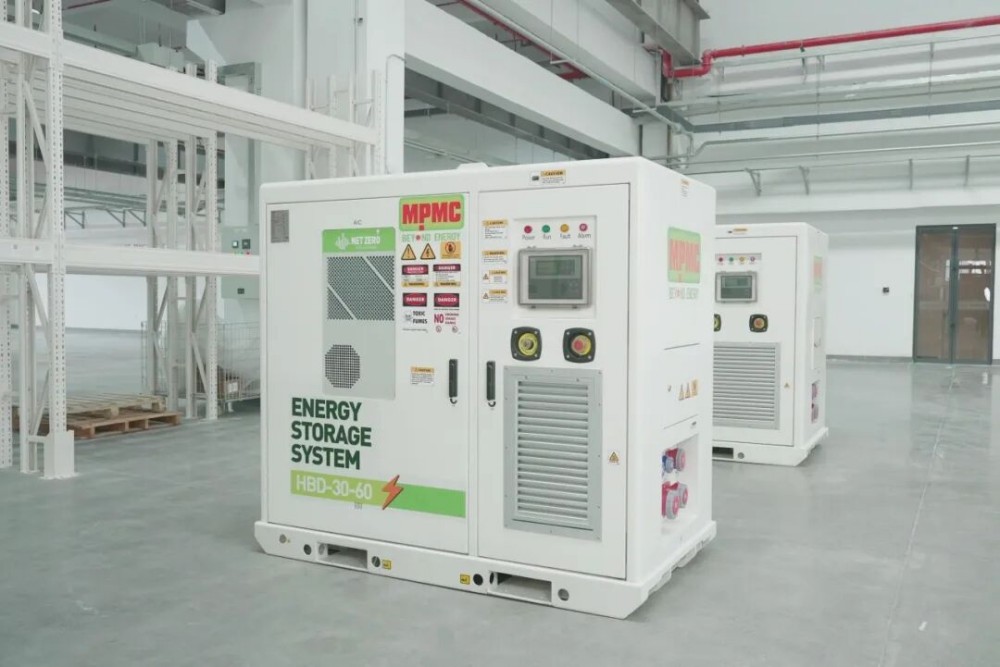 MPMC-R Series HBD-30-60
Where the Arithmetic Breaks Down
Three situations defeat the configuration, and all are foreseeable at enquiry stage.
The overnight load is not actually small
Sites with dewatering pumps, heated hoardings or continuous process equipment carry a substantial night load. The energy requirement then rises beyond what a single unit covers.
The recharge window is shorter than assumed
If the generator is fully committed to site load during permitted hours, there may be little surplus for charging. The calculation has to use surplus capacity, not rated capacity.
Weekend restrictions extend the period
A condition prohibiting Sunday operation turns a fourteen-hour requirement into a much longer one. A documented UK case listed by MPMC involved exactly this, with six HBD-30-60 units at 30 kW and 60 kWh each deployed to cover a restriction running from 17:00 to 07:00 and across Sundays.
When the Restricted Period Exceeds the Battery
Three responses are available, and they are not equivalent in cost.
Add units in parallel, which is straightforward with rental-format equipment but multiplies transport and standing costs.
Reduce the overnight load, which is often cheaper. Timer control on hoarding lights, LED replacement and switching off idle welfare heating can cut a night base load significantly.
Extend the permitted running window by agreement, which occasionally succeeds where the condition was set against an older, noisier machine than the one proposed.
Evidence From Deployed Configurations
A second UK case listed by MPMC involved a 56 kW diesel generator serving a 3 to 6 kW office base load. After a 30 kW / 60 kWh HBD-R unit was added, the refuelling interval moved from every two days to every seven, and the maintenance interval from every ten days to every sixty.
MPMC’s product data cites fuel savings of up to 75% when HBD-R units are paired with generator sets. That figure comes from low-load scenarios and is a product-level reference rather than a guaranteed result. A heavily loaded site will see far less, and the Dubai batching plant case listed by MPMC records a 10.56% daily fuel reduction on a 24-hour operation.
Settling It at Enquiry Stage
Send the planning condition text, the overnight base load, the restricted hours and the generator’s controller brand and model. Ask the supplier to state the assumed usable energy and the recharge time at the site’s available charging power.
A supplier that answers with a model number and no arithmetic has not engaged with the problem. One that comes back questioning the overnight load figure probably has.
Recent Posts






Contact US
Product Information
Quantity
Unit
Piece
Support order samples, customization, wholesale direct, and complete payment. If the product you look for does not have corresponding customized content, pls fill out the form below to contact us, and we will reply ASAP.