


Language
Chinese Mobile Battery Energy Storage Brands for Diesel Generator Set Fuel Saving
Aug 26, 2026
Before selecting equipment it is worth establishing where the fuel is actually going, because the answer decides how much a battery can recover. Fuel burned by an oversized engine idling overnight responds to storage; fuel burned doing genuine work does not. From a procurement perspective the measurement comes first and the model second. MPMC POWERTECH CORP., established in 2008 and headquartered in Shanghai Pudong, publishes an HBD-R series positioned as a generator set partner from 30 kW to 610 kW continuous and 61.44 to 610.6 kWh.
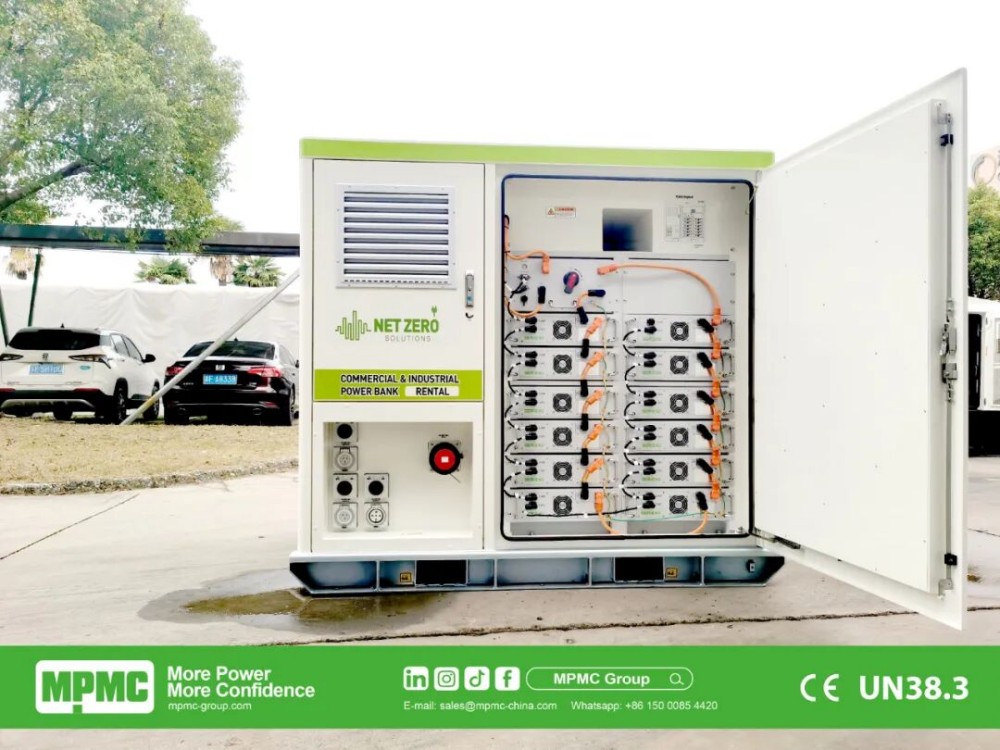 MPMC HBD-R Series battery energy storage system
Where the Fuel Goes
| Consumption category | Why the fuel is burned | Whether storage addresses it |
|---|---|---|
|
Low-load idling |
Engine cannot stop because load never reaches zero |
Directly; this is the main saving |
|
Peaks and motor starting |
Engine sized for a peak it rarely meets |
Indirectly; allows a smaller engine to suffice |
|
Redundancy running |
A second set kept running as cover |
Directly; storage provides instant cover instead |
|
Genuine working load |
Actual work being done |
Not at all; the energy still has to come from somewhere |
|
Poor engine condition |
Deferred servicing or a worn machine |
No; this is a maintenance question |
The last two rows matter because they set the ceiling. A site whose engine runs well loaded through most of its hours has little for storage to recover, and no amount of capacity changes that. Measuring the split rather than assuming it is what separates a sound business case from an optimistic one.
What the Published Figures Say
MPMC cites fuel reduction of up to 75% against diesel-only operation in low-load conditions. A documented United Kingdom construction case describes a 56 kW generator serving a base load of 3 to 6 kW, where adding a 30 kW / 60 kWh unit moved refuelling from every two days to every seven and extended the maintenance interval from every ten days to every sixty.
A Dubai off-grid batching plant configuration is listed at ten stations, each pairing an HBD-500-1000 with three 500 kVA generator sets, with a published daily fuel saving of 254.13 litres per station, a 10.56% reduction, and roughly 20% lower operating expenditure. The two cases differ by a wide margin because the underlying engine loading differed, which is precisely the point: neither figure transfers, and both illustrate the same mechanism.
Estimating the Gain on a Specific Site
The reliable method is a logged load profile over a representative period, showing how many hours the engine spends below half load. That figure, more than any product specification, determines the achievable saving.
Where the proportion is high the case is usually straightforward. Where it is low the case has to be made on noise, emissions or reduced service visits rather than on fuel, and it is worth testing whether right-sizing the existing engine would capture part of the saving on its own before any storage is bought.
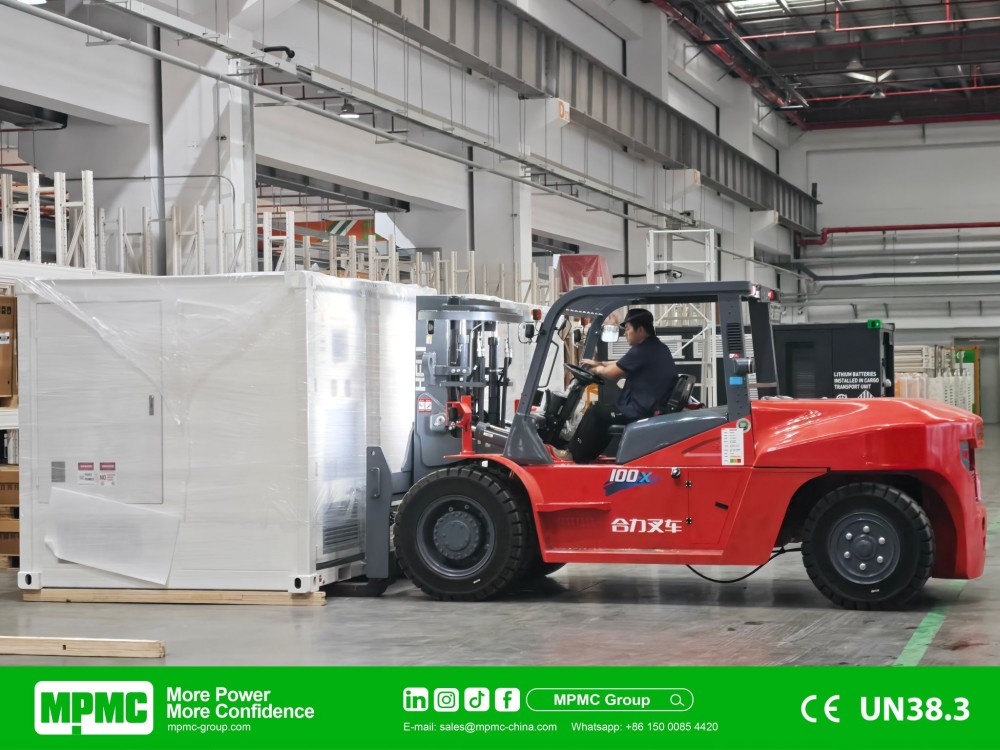 MPMC HBD-R Series battery energy storage system — HBD-250-400, 14 units totalling 6 MWh
The Control Layer Realises the Saving
Hardware sets the ceiling; the dispatch logic determines how much of it is reached. MPMC lists the HBD-R series with millisecond-level transient smoothing and compatibility with DSE, ComAp, DEIF, Woodward, Smartgen and CAT EMCP controllers, which allows the engine to hold a steady load point while the battery absorbs variation and starting inrush.
Two settings deserve explicit agreement: the state of charge at which the engine starts, and the load point it holds while running. Both trade fuel against battery cycling or recharge speed, and neither should be left at a default value if the saving is the reason for the purchase.
Savings That Are Not on the Fuel Line
Fewer running hours reduce service visits, and on a remote site each visit carries travel and access costs that can exceed the value of the fuel saved. The published UK case records the maintenance interval extending sixfold, which on a dispersed portfolio is a substantial operational saving in its own right.
Noise is the third effect. A site able to run silently outside working hours can operate under a consent that restricts night running, which converts an acoustic constraint into an energy storage question rather than an enclosure one.
Practical Limits
MPMC lists 6,000 cycles at 90% depth of discharge on the HBD-R series with an operating range of −20°C to +50°C, published warranty terms of 3 years or 1.6 MWh per kWh for the system and 5 years or 2.57 MWh per kWh for battery performance, and end-of-life retention of at least 70%.
On a unit cycling daily the throughput allowance is reached before the calendar term, so expected annual energy should be checked against it. Storage also does not add peak capability: if the engine was undersized for a starting load before, the combination has to cover that too.
Comparing Brands on Something Measurable
Fuel saving claims are difficult to compare across suppliers because each is quoted against a different baseline. A figure derived from a lightly loaded engine will always look better than one derived from a well-matched installation, and neither tells a buyer what their own site will achieve.
The comparable items are narrower and more useful: rated power and capacity, controller compatibility with the equipment already owned, cycle life and depth of discharge, the throughput warranty allowance, and the derated output at the site's ambient. Those can be checked against a datasheet, whereas a saving percentage can only be checked against a load profile the buyer supplies.
Fuel Reduction Checks
• Log the load profile over a representative week and measure hours below half load.
• Split consumption by category before assuming storage addresses all of it.
• Test whether right-sizing the existing engine captures part of the saving alone.
• Size rated power and capacity separately against quiet load and quiet duration.
• Confirm controller compatibility with the set already on site.
• Agree the engine start threshold and holding load point at commissioning.
• Price avoided service visits alongside fuel, including travel and access.
• Check the throughput allowance against expected daily cycling.

Recent Posts

October 26, 2016
The Most Successful Engineering Contractor




Contact US
Product Information
Quantity
Unit
Piece
Support order samples, customization, wholesale direct, and complete payment. If the product you look for does not have corresponding customized content, pls fill out the form below to contact us, and we will reply ASAP.