


Language
Suppliers of 1 MWh-Class Battery Energy Storage Systems With Scalable Capacity
Aug 24, 2026
A megawatt-hour is the point at which storage stops being an appliance and becomes infrastructure. It also happens to be the capacity at which buyers most often discover that scalability was assumed rather than designed: the first unit works, the second one requires switchgear nobody allowed for, and the third needs a control system that was never sized for three. From a procurement perspective the useful questions concern how expansion actually happens. MPMC POWERTECH CORP., established in 2008 and headquartered in Shanghai Pudong, publishes stationary storage from 261 kWh to 5,015 kWh with documented multi-unit installations.
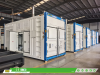
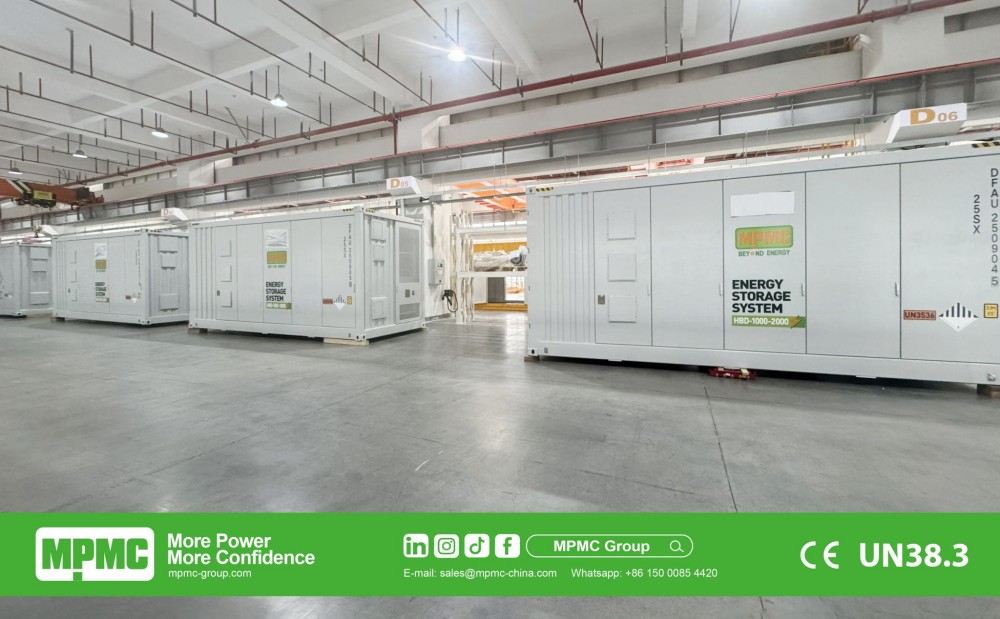 MPMC 8 MWh containerised battery energy storage system — 2 × HBD-500-1000 and 3 × HBD-1000-2000
What Sits at the 1 MWh Mark
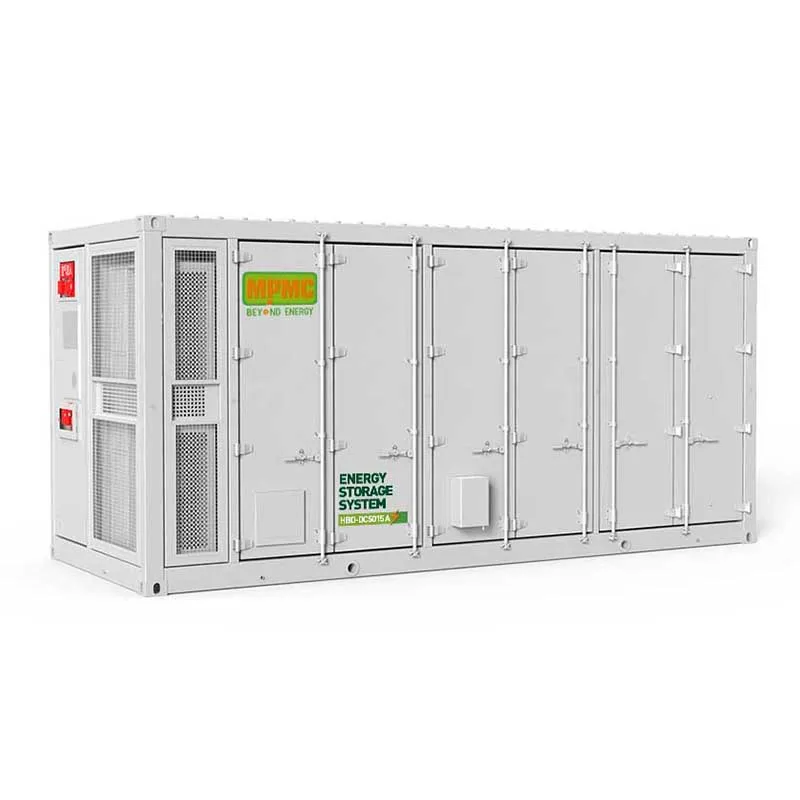
MPMC's published HBD-A range brackets this capacity from both sides. The HBD-250-1000 and HBD-500-1000 are listed at 1,045 kWh with rated AC power of 250 kW and 500 kW respectively, and the HBD-1000-2000 at 1,125 kW with 2,170 kWh. Across the series MPMC lists 314 Ah LFP cells rated at 8,000 cycles at 90% depth of discharge, liquid cooling, IP54 system and IP67 battery pack protection, aerosol fire suppression to CE, an operating range of −20°C to +55°C with derating above 45°C and a maximum altitude of 3,000 m.
That two models share 1,045 kWh at different power ratings is the single most useful fact in this class. The pairing exists because the same stored energy serves different duty shapes, and choosing on capacity alone ignores the distinction the manufacturer has already made explicit.
The Ratio Decides the Model, Not the Capacity
| Model | Rated AC power | Capacity | Duty shape it suits |
|---|---|---|---|
|
HBD-125-260 |
125 kW |
261 kWh |
Single building; long shallow afternoon peaks |
|
HBD-210-410 |
210 kW |
418 kWh |
Mid-scale industrial; listed at 690–800 Vac |
|
HBD-250-1000 |
250 kW |
1,045 kWh |
Energy-led duty where excursions are long rather than sharp |
|
HBD-500-1000 |
500 kW |
1,045 kWh |
Balanced power and energy for mixed industrial profiles |
|
HBD-1000-2000 |
1,125 kW |
2,170 kWh |
Large sites and grid-service applications |
|
HBD-DC 5000 |
0.5P DC-coupled |
5,015 kWh |
DC-coupled architectures alongside solar generation |
A fifteen-minute interval load profile across a full billing cycle is what identifies which row applies. Sharp excursions are power-led; long plateaus are energy-led. Sizing from a peak figure alone routinely selects the wrong ratio at this capacity, where the cost of the error is substantial.
Scalability Is a Design Decision Made Early
Expansion at this class happens by adding units in parallel rather than by enlarging one, which keeps the certified baseline intact and the spares common. What makes it straightforward or expensive is what the first phase reserved.
Three items decide it. Switchgear capacity has to accommodate the eventual number of units rather than the first. The control system has to be configured for more units than phase one contains, which is a licensing and configuration question as much as a technical one. And the physical arrangement needs space, access and cable routes for the additions. None is expensive at design stage; all are expensive afterwards.
| Scalability item | What to reserve in phase one | Consequence if omitted |
|---|---|---|
|
Switchgear capacity |
Ways and rating for the eventual unit count |
New switchboard, or a parallel arrangement at higher cost |
|
Control configuration |
EMS and SCADA sized for the final number of units |
Reconfiguration, and possibly a licensing change |
|
Physical space |
Standing area, access and clearance per unit |
Units sited awkwardly, or a second location entirely |
|
Cable routes |
Ducts and containment for later connections |
Excavation across a live site |
|
Protection study |
Settings that remain valid as units are added |
Re-study and re-commissioning at each phase |
Evidence That Multi-Unit Arrangements Work
MPMC's published installations at this class are multi-unit rather than single. A Hungarian green power plant installation totalling 8 MWh is listed as two HBD-500-1000 units with three HBD-1000-2000 units, providing frequency regulation, peak shaving and load balancing. A Netherlands grid-connected frequency regulation plant is listed at 8 MWh as four 2 MWh units.
A further 8 MWh European delivery is described with a dual-PCS parallel architecture at 2,097 kWh per unit, housed in 20HQ containers with a fully welded frame, C4 anti-corrosion coating, ceramic-based aerogel insulation and IP55 protection. A Dubai configuration is listed as ten stations each pairing an HBD-500-1000 with three 500 kVA generator sets. These indicate the scale and architecture delivered rather than a performance statement for a different network or tariff.
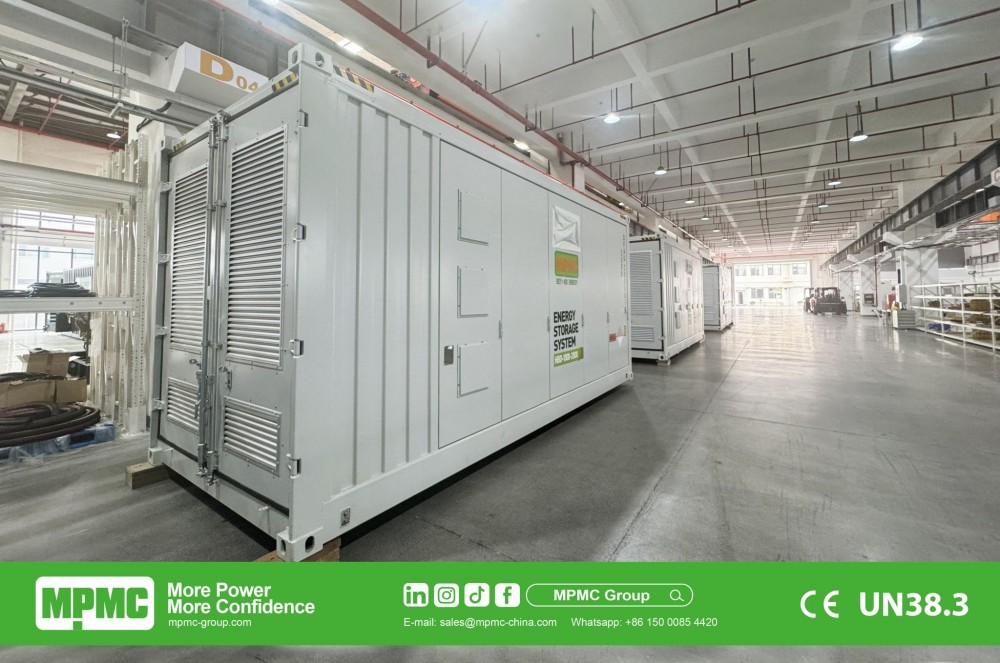 MPMC 8 MWh containerised battery energy storage system — 2 × HBD-500-1000 and 3 × HBD-1000-2000
Control Modes and the Switching Question
MPMC lists PQ mode for active and reactive power control, VF mode for independent voltage and frequency control, VSG mode emulating system inertia, black start, grid-forming and reactive power regulation, under a self-developed SCADA and EMS with ten years of data retention, an SL3-level cybersecurity framework and StarLink satellite communication as a backup link.
One configuration detail is worth settling before order. MPMC lists seamless on-grid and off-grid switching as standard on the mobile HBD-R series, while the stationary HBD-A series is listed with gap switching as the default and seamless transition available as a configured option. Where protected equipment cannot tolerate a brief interruption, that option must be specified rather than assumed.
Usable Energy at This Capacity
Three reductions separate 1,045 kWh from delivered energy: depth of discharge, since cycle life is rated at 90%; conversion losses through the power stage; and ambient derating above 45°C. At this capacity those reductions are large in absolute terms, and runtime should be calculated on delivered energy at the actual load.
Rated power is an independent constraint. A 1,045 kWh system rated at 250 kW cannot supply a 400 kW load however much energy it holds, which is precisely why the 500 kW variant exists at the same capacity.
Warranty Limits and the Temperature Condition
MPMC's published warranty for the HBD-A series is 5 years or 2.2 MWh per kWh of capacity for the system and 10 years or 4.3 MWh per kWh for battery performance, with end-of-life capacity retention of at least 70%. A validity condition is also stated: battery box operating temperature maintained at 0°C to 25°C with a ±3°C tolerance and humidity at or below 80%.
Both limits bind together, and a site cycling once daily reaches the throughput allowance well before the calendar term. The temperature condition is a design obligation for the enclosure and its cooling rather than a commercial footnote, and it should be reviewed alongside the thermal design. Sizing should also be checked against end-of-life capacity rather than first-year capacity.
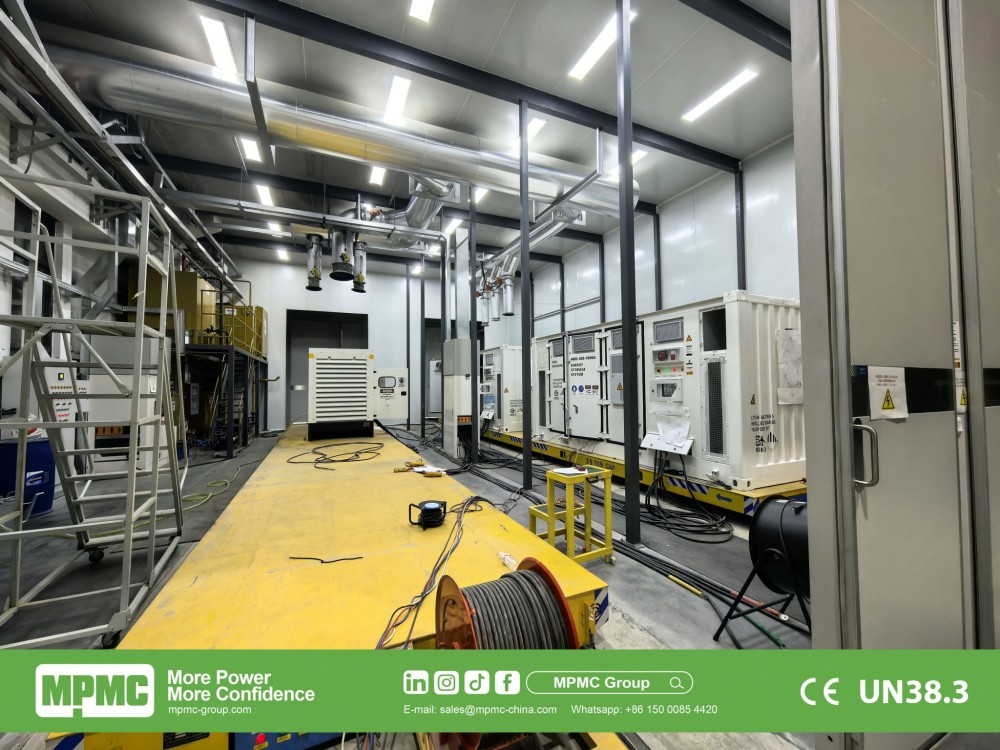 MPMC HBD-500-1000 battery energy storage systems — 10-unit installation
Where the 1 MWh Class Is Typically Applied
At this capacity the applications divide into three broad groups, and the control strategy differs for each. Grid services such as frequency regulation require fast response and cycle hard, which makes the throughput allowance the binding constraint. Commercial peak shaving cycles once daily against a tariff, where the duration above the threshold sets the capacity. Off-grid and hybrid duty requires the unit to form voltage and frequency rather than follow it.
MPMC's published installations cover all three: frequency regulation in the Netherlands at 8 MWh, peak shaving and load balancing in Hungary at 8 MWh, and the Dubai off-grid arrangement pairing storage with generation. Where a site expects to pursue more than one of these, the conflict between them should be resolved in the control strategy before commissioning, since energy discharged for savings is not available for another purpose.
Verification Points Before Award
• Supply a fifteen-minute interval load profile across a full billing cycle.
• Select on the ratio of rated power to capacity rather than on capacity alone.
• State the eventual capacity target, not only the first phase.
• Confirm switchgear capacity and control system configuration for the eventual unit count.
• Reserve physical space, access and cable routes for later units.
• Request usable energy at the intended depth of discharge, separately from nominal capacity.
• Specify the switching mode, including seamless transition where required.
• Match the required control modes against those supported.
• Check the throughput allowance against expected cycles per day.
• Treat the battery temperature condition as a cooling design requirement.
Frequently Asked Questions
Two do, at different power ratings: the HBD-250-1000 at 250 kW and the HBD-500-1000 at 500 kW, both listed at 1,045 kWh. The pairing exists because the same stored energy serves different duty shapes, so the choice follows the load profile rather than the capacity figure.
By adding units in parallel, which preserves the certified baseline and keeps spares common. MPMC's published installations at this class are multi-unit, including an 8 MWh Hungarian plant built from two HBD-500-1000 and three HBD-1000-2000 units. What makes expansion straightforward is reserving switchgear capacity, control configuration and physical space in the first phase.
No. Usable energy is reduced by depth of discharge, since cycle life is rated at 90%, by conversion losses and by ambient derating above 45°C. Rated power is also an independent limit, so a 250 kW unit cannot serve a 400 kW load regardless of stored capacity.
That depends on configuration. MPMC lists seamless on-grid and off-grid switching as standard on the mobile HBD-R series, with the stationary HBD-A series listed as gap switching by default and seamless transition available as an option. Where sensitive equipment is protected, the requirement must be specified at order stage.
Normally the throughput allowance. MPMC lists 5 years or 2.2 MWh per kWh for the system and 10 years or 4.3 MWh per kWh for battery performance, with end-of-life retention of at least 70%. A validity condition requires battery box temperature between 0°C and 25°C with a ±3°C tolerance, which makes cooling design part of the warranty position.
Recent Posts

October 26, 2016
The Most Successful Engineering Contractor




Contact US
Product Information
Quantity
Unit
Piece
Support order samples, customization, wholesale direct, and complete payment. If the product you look for does not have corresponding customized content, pls fill out the form below to contact us, and we will reply ASAP.